
ByCoinGape
Key Highlights
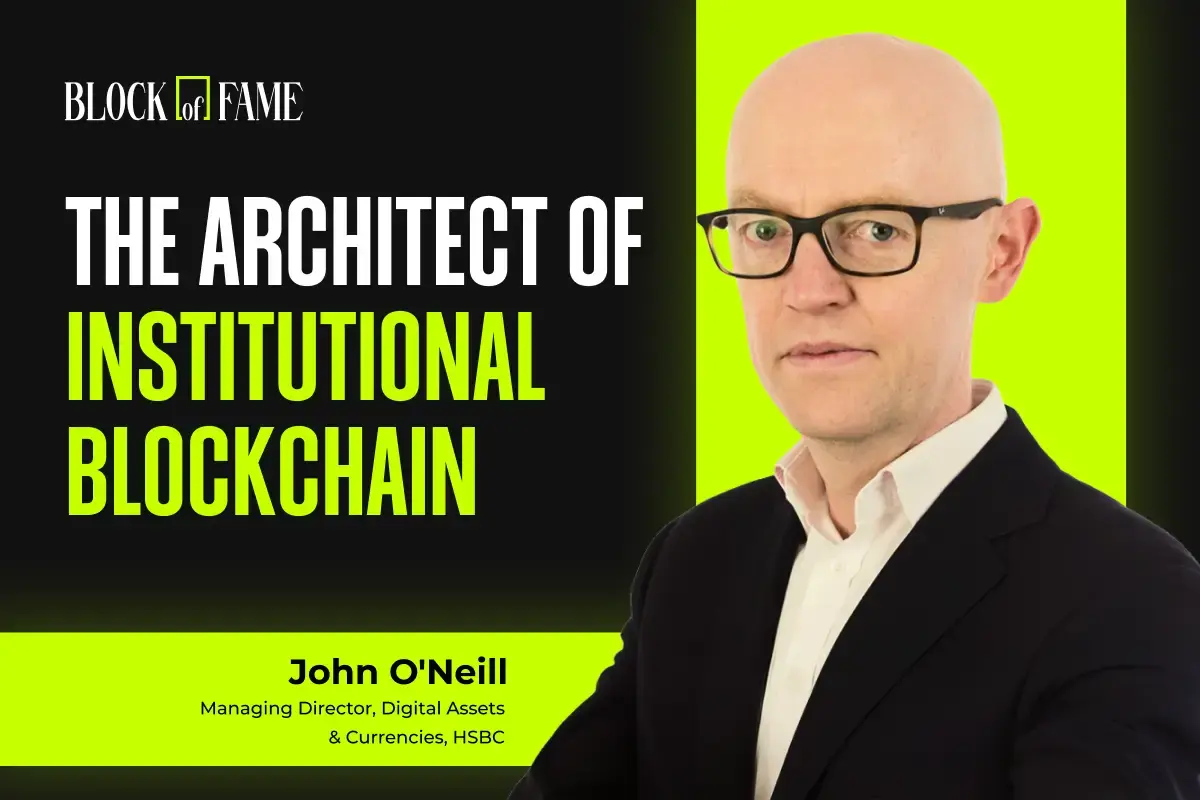
When Bitcoin launched in 2009, most banks saw it as a curiosity. John O’Neill saw something else.
Not a currency. Not an investment. But the beginning of a new market infrastructure.
Few digital asset executives arrive from crypto. O’Neill arrived from market infrastructure.
His career began in 2001 at LIFFE, (The London International Financial Futures Exchange) where he worked on the trading systems powering some of Europe’s busiest derivatives markets. Following LIFFE’s integration into NYSE, he spent another thirteen years developing listed derivatives products.
Two decades later, blockchain revolution is driving another transformation.
And once again, O’Neill finds himself at its center.
Today, as Managing Director and Group Head of Digital Assets & Currencies at HSBC, he leads one of the world’s most ambitious institutional blockchain strategies.
His mandate spans digital assets, asset tokenisation, central bank digital currencies (CBDCs), stablecoins and cryptocurrencies. He also oversees HSBC Orion, the bank’s flagship digital asset platform designed to bring traditional capital markets on-chain.
For O’Neill, blockchain isn’t replacing finance.
It’s upgrading it.
O’Neill joined HSBC in 2015 to modernize the bank’s electronic trading capabilities and market structure. Over the next six years, he led innovation initiatives spanning fintech, e-trading and capital markets infrastructure. These are the experiences that proved invaluable as blockchain began moving from experimental technology to institutional priority.
Recognizing that shift, HSBC appointed him Global Head of Digital Assets Strategy in 2021.
The assignment ofcourse was not to launch another crypto product.
It was to build a long-term digital asset strategy for one of the world’s largest banking groups.
Working with regulators, financial market infrastructures (FMIs), institutional issuers and clients across multiple jurisdictions, O’Neill helped define how blockchain could fit within regulated financial markets rather than operate outside them.
That groundwork laid the foundation for everything that followed.
In 2024, O’Neill became Group Head of Digital Assets & Currencies, assuming responsibility for HSBC’s global digital asset business. In 2026, he was promoted to Managing Director, reflecting the growing strategic importance of tokenization within the bank.
Perhaps his most significant contribution has been HSBC Orion.
Unlike blockchain platforms built for retail crypto trading, Orion focuses on institutional finance. It supports governments, supranational organizations, financial institutions and corporations issuing regulated digital securities.
The numbers illustrate just how quickly the platform has matured.
Since launch, HSBC Orion has facilitated more than US$3.5 billion in digitally native bond issuance. This includes sovereign and corporate issuances across Europe, Asia and the Middle East.
The platform has powered several landmark transactions, including:
For O’Neill, these are no longer pilot projects.
They represent the gradual modernization of global capital markets.
O’Neill’s influence extends beyond the bank.
He serves as a Board Member at Marketnode, Singapore’s digital market infrastructure company backed by SGX Group and Temasek.
He previously served on the board of HSBC Investment Bank Holdings, the business responsible for many of the bank’s fintech investments.
Those roles place him at the intersection of banking, regulation, market infrastructure and financial innovation.
John O’Neill rarely describes blockchain as a revolution.
Instead, he speaks the language of capital markets. Settlement. Liquidity. Collateral. Efficiency. Transparency.
That perspective explains why HSBC’s digital asset strategy feels less like a technology experiment and more like the natural evolution of modern finance.
This comes as the institutional race is on. HSBC isn’t pursuing tokenization in isolation.
Across Wall Street and global banking, institutions are investing heavily in blockchain infrastructure.
JPMorgan has expanded Kinexys to process hundreds of billions of dollars in tokenized payments. BlackRock’s BUIDL has become one of the largest tokenized money market funds. Franklin Crypto Head Christopher Perkins arguing that the biggest risk for institutions today isn’t investing in crypto. It’s having no digital asset strategy. Read our exclusive interview with Christopher Perkins.
If the first era of financial markets was paper, and the second was electronic trading, O’Neill believes the third will be tokenized.
And if that vision becomes reality, the defining blockchain story of the next decade may not only be written by crypto exchanges or decentralized protocols.
It may also be written inside the world’s largest banks. That too by the executives quietly rebuilding the financial system, one piece of infrastructure at a time.

 Sneha Agrawal
GUIDE
Sneha Agrawal
GUIDE



Share