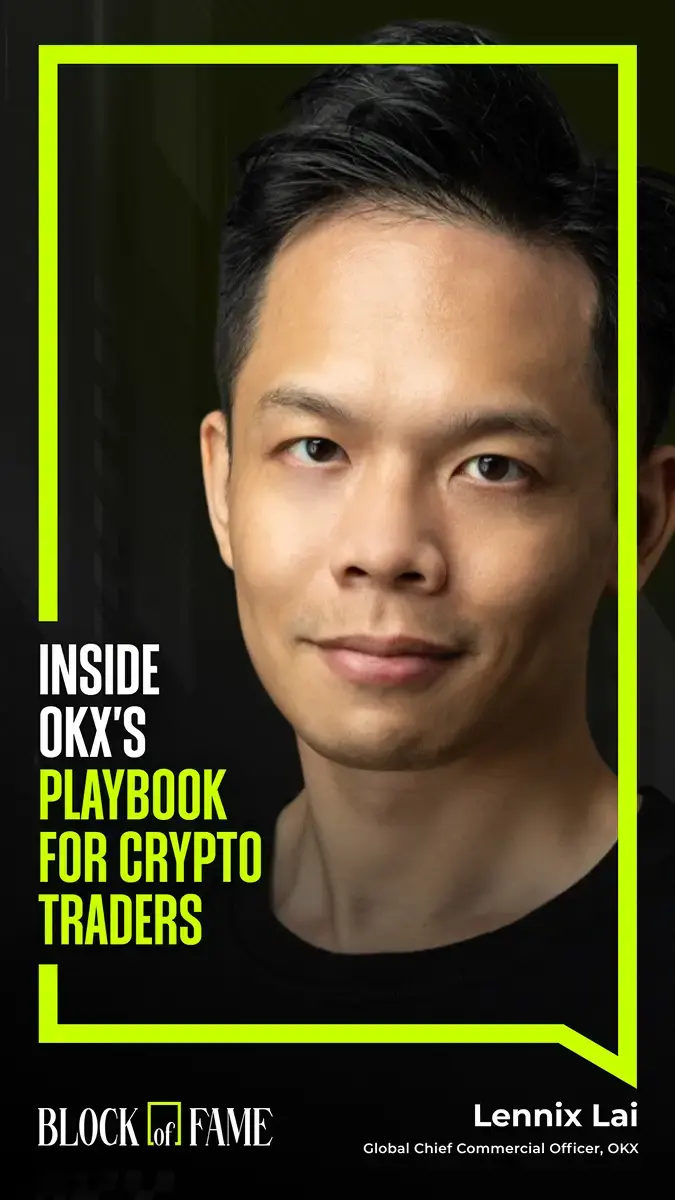
Crypto markets have matured not quietly, but decisively. According to Lennix, Global Chief Commercial Officer at OKX, the defining shift isn’t about new instruments or faster rails. It’s about what traders fundamentally expect from the platforms they use.
“Today’s traders are less excited by headline yields and far more focused on whether the platforms they use are regulated, transparent and built to last,” Lennix tells CoinGape in an exclusive Block of fame conversation. “Three to five years ago, a lot of flow chased offshore leverage and memes; today, more of it is migrating toward licensed venues, proof-of-reserves and institutional-grade custody.”
Solution to CEX vs DEX Debate
Perpetual DEXs may be surging – from the rise of Aster DEX to Lighter – but Lennix rejects the idea that users are choosing sides.
“We don’t think in terms of DEX versus CEX,” he says. “We think in terms of a spectrum that the same user wants to move along based on their needs.”
As the centralized exchange which recently came up with its own DEX Byreal, Lennix shares OKX data that shows both Web3 and DEX activity are growing multiples faster than CEX, while centralized volumes continue to edge higher.
“That tells you users want both onchain access and mature centralized infrastructure,” Lennix notes.
The solution is architectural. “Our answer is a CeDeFi approach: one wallet and onchain stack that plug natively into our centralized venue,” he says. “For most users, the ideal journey is to start with CEX-like simplicity and then graduate into DEX sophistication inside the same ecosystem.”
Also Read: Ethereum Foundation’s James Smith on Next Upgrade
Token Listings Are Entering a Public-Markets Era
Token listings, long viewed as opaque and still debatable, are now under regulatory scrutiny and Lennix sees that as overdue.
“We’re clearly moving into a world where listing standards have to look more like public-markets standards,” he says.
That means transparency by default. “Public listing criteria, independent smart-contract audits, and ongoing disclosure about tokenomics, large holders and any material regulatory issues.”
Regulation is accelerating this convergence. “Frameworks like MiCA and those emerging in APAC and MENA are pushing everyone toward the same baseline,” Lennix notes. “Asset segregation, onchain transparency and stablecoin quality are no longer optional.”
For exchanges, working with regulators early is the only sustainable path. “The most effective approach is to bring regulators into the conversation early,” he says. “Proof-of-reserves, segregated custody and clear risk disclosures are areas where user protection and regulatory expectations align naturally.”
Speed doesn’t have to disappear either. “If you combine that with pilots and phased rollouts, you can still move fast — but within a framework that’s resilient when markets are stressed.”
Also Read: Grayscale Research Head on Launching Solana ETF
What Today’s Crypto Traders Want
As someone who heads a global crypto exchange, Lennix explains that the shift in crypto trader’s priorities is evident in product demand. Where users once optimized for leverage and speed alone, today’s focus is on infrastructure, liquidity, and smooth CeDeFi connectivity.
“Top of the list {that traders want} are deep liquidity, simple but robust risk controls, and CeDeFi-style connectivity that lets them move smoothly between CEX, DeFi and custody,” Lennix says.
Further, in an ever volatile environment, traders increasingly want consolidation, not fragmentation.
“Traders increasingly want a single environment where they can go from spot to perps to staking and onchain without juggling multiple wallets or seed phrases.”
AI-driven tools, once a “nice to have,” have now become expected. “People are basically asking for fewer tabs, less friction and more intelligence in the core trading screen,” Lennix adds.
Regional Diversification of Traders
Regional behaviour is diverging but maturing. “In APAC we see a much more mature mix than in the last cycle,” he says. “Users follow narratives, but most activity is still anchored in spot, perps and yield rather than pure meme trading – and the region now accounts for a large share of our volumes”.
In MENA and LATAM, structural demand dominates.
“There’s stronger demand for stablecoins and payment rails, driven by cross-border flows and inflation concerns.
Our strategy is depth over breadth, so we’re focused on deepening in a small number of high‑conviction, regulated markets like Australia, Singapore, the UAE, the EEA under MiCA and, increasingly, the US. Those are the jurisdictions where clear rulebooks and strong local partners let us build for the long term.”
Advise for Traders
Leverage remains one of crypto’s most persistent risks, but Lennix offers solutions that are practical. “The message from users is that they need clearer guardrails,” Lennix says. “Pre-trade risk budgets should be standard, so every leveraged order clearly shows what percentage of total capital is at risk before you hit confirm.”
He also points to structural defaults. “Mandatory stop-loss entry for leveraged positions, plus integrated position-size calculators, would already remove a lot of ‘accidental’ over-exposure.”
Longer-term, access itself should be earned. “Higher leverage tiers should be tied to education and experience tests, rather than being the default.”
For retail traders navigating ongoing macro volatility, Lennix’s advice is disciplined. “Size positions so that a single trade includes less of your capital,” he says. “Use leverage sparingly and deliberately – prioritise isolated margin and make stop-losses part of your initial order.”
Third, do your homework at the venue level: trade on regulated platforms, check for proof‑of‑reserves where it’s available, and understand how your assets are custodied and segregated before you think about chasing yield. In a macro environment that can shift quickly, your risk process is often more important than your view on the next price move.
The Playbook for 2026
Looking ahead, Lennix sees three forces reshaping the competitive landscape of crypto exchanges.
“First, institutional-grade custody will be a key differentiator,” he says. “Second, CeDeFi rails that let users move across spot, perps, staking and onchain liquidity from a single interface will become the default expectation.”
“The third is already visible. AI-native tooling will increasingly define the user experience – from execution and routing to risk monitoring and support.”
Beneath it all sits a longer arc. “Tokenization is a long-duration theme that will steadily reshape how traditional assets are issued, traded and held.”
At the ecosystem level, Lennix ties it all back to one principle. “Trust is the real currency in this market — and our job is to keep strengthening that across both centralized and onchain layers.”
Why trust CoinGape: CoinGape has covered the cryptocurrency industry since 2017, aiming to provide informative insights to our readers. Our journalists and analysts bring years of experience in market analysis and blockchain technology to ensure factual accuracy and balanced reporting. By following our
Editorial Policy, our writers verify every source, fact-check each story, rely on reputable sources, and attribute quotes and media correctly. We also follow a rigorous
Review Methodology when evaluating exchanges and tools. From emerging blockchain projects and coin launches to industry events and technical developments, we cover all facets of the digital asset space with unwavering commitment to timely, relevant information.
Investment disclaimer: The content reflects the author’s personal views and current market conditions. Please conduct your own research before investing in cryptocurrencies, as neither the author nor the publication is responsible for any financial losses.
Ad Disclosure: This site may feature sponsored content and affiliate links. All advertisements are clearly labeled, and ad partners have no influence over our editorial content.









Share