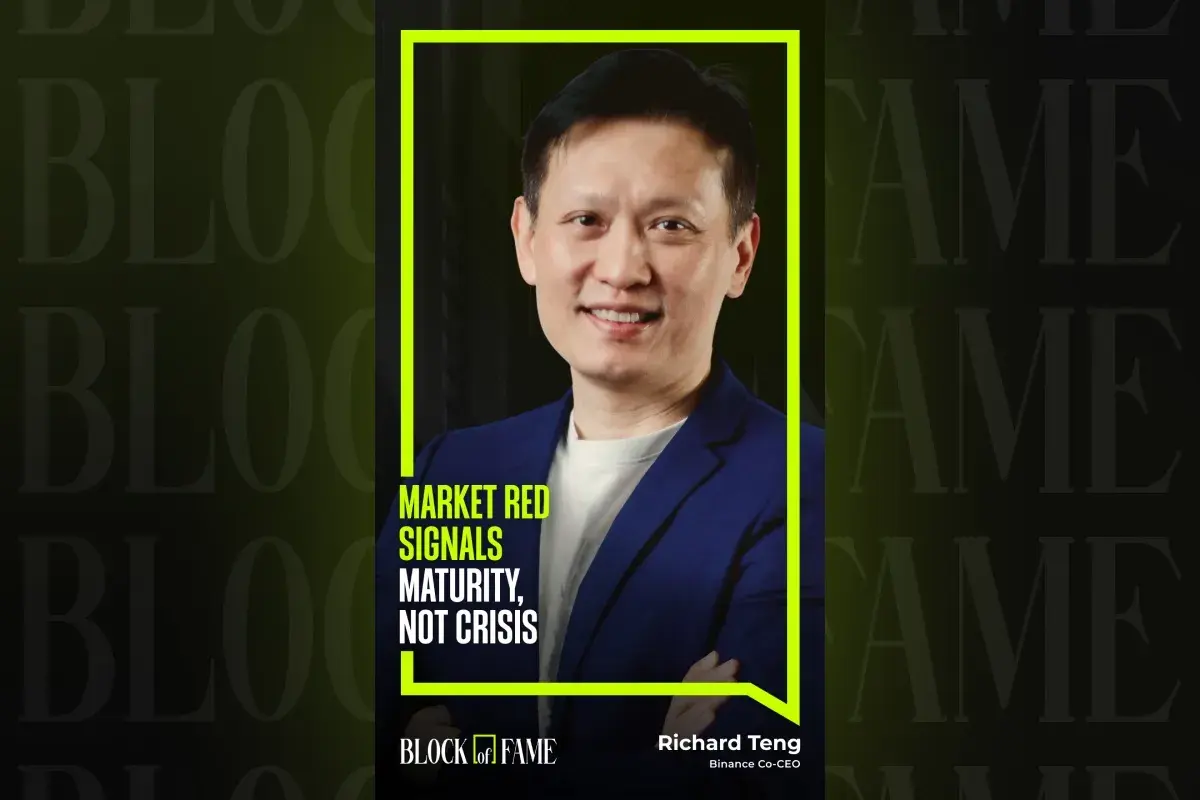
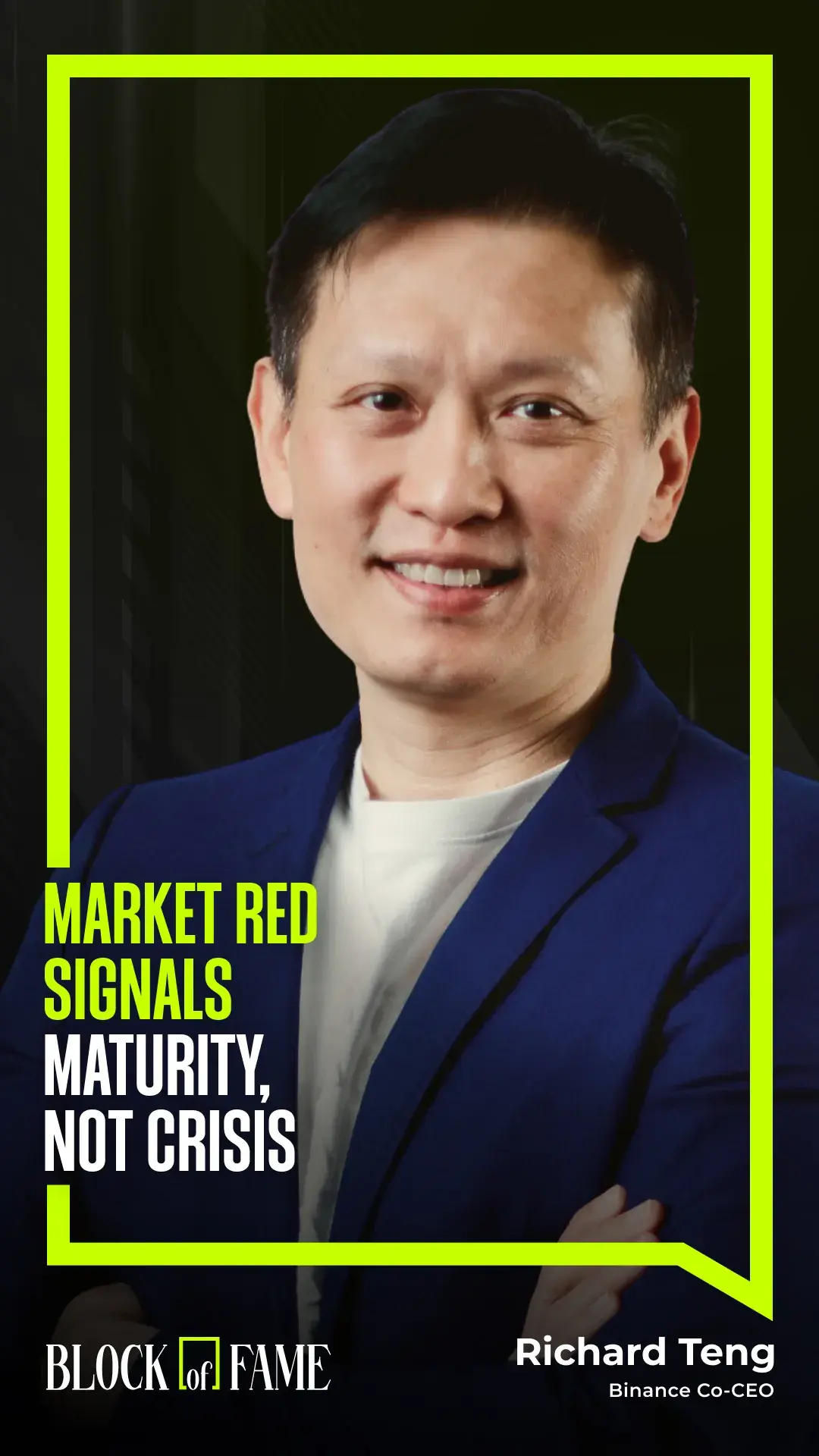
The crypto charts are bleeding again. But for Binance co-CEO Richard Teng, market red is not a signal of failure – it’s a stress test.
Speaking to CoinGape in an exclusive Block of Fame conversation, Teng shares why he believes the industry is quietly maturing beneath the noise.
“Market Red Is Not a Breakdown – It’s a Reset”
Teng is quick to contextualize the current downturn. Crypto, he argues, is behaving exactly like a high-beta global asset should.
“Market ups and downs are normal in any asset class, and crypto is no different,” he says. “What we’re seeing now is partly driven by broader global risk-off sentiment and position unwinding.”
Importantly, Teng points out that even after recent drawdowns, Bitcoin remains well above early-2024 levels, when institutional heavyweights like BlackRock first entered the space.
For Binance, quieter markets are not a pause, they are preparation.
“These periods help the market reset and get ready for the next phase of growth. Consolidation is healthy if you want sustainability,” says Richard.
Also Read: Ethereum Foundation’s James Smith on Next Upgrade
Token Listings: Why “Opaque” Is the Wrong Word
Token listings remain one of the most misunderstood parts of exchange operations. But Teng is blunt on it: “the process is neither casual nor static.”
He shares that “at Binance, listings are subject to ongoing review across factors like team credibility, development activity, liquidity and trading health, network security, transparency and ecosystem contribution.
“Listing is not a one-time approval,” he stresses. “Projects must continuously meet our standards.”
This, Teng believes, is how exchanges rebuild credibility and not through secrecy, but repeatable rigor.
Illicit Finance: A Perception Problem, Not a Crypto Problem
Few issues haunt crypto’s public image more than illicit finance. Teng doesn’t deny the challenge but he rejects the framing.
“Illicit finance is not unique to crypto,” he says. “In fact, the scale in traditional finance dwarfs crypto.”
He cites data showing:
- $3.1 trillion in illicit funds flowed through traditional finance in 2023 (NASDAQ)
- $40 billion in crypto-related crime (Chainalysis, 2025)
- U.S. government reports confirming crypto’s share remains well below fiat channels
The solution, Teng argues, is not fear but coordination.
“Smarter technology, clearer policy, and stronger cooperation across the industry. That’s the only path forward.”
What Still Blocks Mainstream Adoption
Despite over 300 million registered Binance users, Teng says crypto still faces familiar friction.
The missing pieces according to him remain “Regulatory clarity, user education and real-world use cases.”
“We’re seeing progress in all these areas, but there’s still work to do. It’s similar to how the internet evolved. It took time for people to trust and use it widely as we are seeing today. Crypto is on that path, but we need everyone to keep pushing forward”, says Teng.
“This is how the internet evolved too. Trust comes before scale.”
Also Read: Grayscale Research Head on Launching Solana ETF
Institutions Are In – But Not Just From Wall Street
Binance’s expanding institutional footprint including off-exchange collateral setups and partnerships with firms like BlackRock signals a broader shift.
“Institutional interest brings liquidity and maturity,” Teng says.
“However, it’s important to remember that it’s not just Wall Street driving this change. Around the world, governments and regulators are creating clearer rules and building infrastructure to support digital assets. Wherever there’s regulatory clarity and trust, adoption follows.”
Regulation: Why MiCA-Style Clarity Matters, Even for India
Despite the accelerating institutional embrace of crypto, Teng acknowledges that skepticism still runs deep in several jurisdictions including India. Here exchanges are often viewed as risky intermediaries rather than financial infrastructure.
Crypto, he argues, is still a young industry when compared to Big Tech or traditional finance. And according to him, “uneven regulatory approaches are a natural consequence of that maturity gap.”
“It’s natural that governments are taking different approaches,” Teng says. “Crypto is still a young industry.”
Yet momentum toward convergence is building.
Teng points to Europe’s Markets in Crypto-Assets (MiCA) framework as a meaningful step toward regulatory harmonization.
“Frameworks like MiCA help create a clearer path for industry players and users alike,” he notes.
For Binance, regulation is not something to work around – it’s something to help shape responsibly.
“We’re working closely with regulators worldwide,” Teng says. “Our focus is on sharing best practices and advocating for smart, practical rules that protect users while supporting innovation.”
While Teng declines to comment on specific licenses Binance is pursuing, his position on engagement is unequivocal.
“Building safe, transparent crypto ecosystems requires ongoing cooperation between industry and regulators,” he adds. “And we’re committed to being part of that process.”
Fixing the Hardest Misconception After CZ
Stepping in after someone as influential as CZ meant inheriting not just scale, but assumptions.
“When I stepped into the CEO role, some assumed that rapid growth might come at the expense of compliance or user safety,” Teng says. “That’s a misconception.”
For Teng, the idea that growth and compliance sit on opposite ends of the spectrum misunderstands how Binance operates today.
“Our focus has always been on building strong, reliable systems and working closely with regulators to ensure we meet the highest standards,” he explains. “These goals are not mutually exclusive.”
Under his leadership, compliance is no longer treated as a defensive necessity. It is positioned as a strategic advantage.
“We are now the most regulated exchange globally,” Teng notes. “And we intend to continue to invest heavily in compliance to make it a competitive advantage.”
Looking Ahead: The Top Priorities for 2026
Moving into 2026, Richard shared, “The biggest lesson this year is that success depends on the confidence our community places in us. Without that trust, none of our achievements would be possible.”
That confidence, Teng emphasizes, is not static. It is built through constant feedback, accountability, and a willingness to evolve.
“We’re grateful to our community for their support and for their feedback,” he adds. “It helps us continue getting better.”
Looking ahead to the next 12–24 months, Teng says Binance’s priorities remain intentionally consistent rather than reactive.
Users, he says, remain the anchor.
“We always place our users first,” Teng notes, pointing to continued investment in platform features, security infrastructure, and compliance standards.
At the same time, regulation remains a core pillar of Binance’s long-term strategy and not as a hurdle, Teng says.
“We aim to work closely with governments and regulators to support clear, balanced rules that protect users while fostering innovation,” he says.
“We will continue to work with global partners to support crypto adoption and deployment,” he adds. “That’s how this industry moves forward.”
And on BoF’s fav question on what keeps him up at night, despite the scale, Teng’s answer is simple.
“Crypto itself,” he says. “It’s a 24/7 industry, one that never stops evolving.” His focus remains “on building safer systems, improving UX, and staying ahead of emerging risks.”
Because in Teng’s view, trust, not price, is crypto’s real long-term asset.
Why trust CoinGape: CoinGape has covered the cryptocurrency industry since 2017, aiming to provide informative insights to our readers. Our journalists and analysts bring years of experience in market analysis and blockchain technology to ensure factual accuracy and balanced reporting. By following our
Editorial Policy, our writers verify every source, fact-check each story, rely on reputable sources, and attribute quotes and media correctly. We also follow a rigorous
Review Methodology when evaluating exchanges and tools. From emerging blockchain projects and coin launches to industry events and technical developments, we cover all facets of the digital asset space with unwavering commitment to timely, relevant information.
Investment disclaimer: The content reflects the author’s personal views and current market conditions. Please conduct your own research before investing in cryptocurrencies, as neither the author nor the publication is responsible for any financial losses.
Ad Disclosure: This site may feature sponsored content and affiliate links. All advertisements are clearly labeled, and ad partners have no influence over our editorial content.






Share