
ByCoinGape

Farcaster:- Decentralized social protocol Farcaster has been considered the “X” of web3 with leaders like Vitalik using it as their default mode of communication. But now the platform leaders are making a decisive pivot in strategy after years of struggling to achieve broad market fit as a social-first network.
The shift, openly acknowledged by Farcaster co-founder Dan Romero, is now making the company move away from prioritizing social features. It is moving toward building a wallet-centric product aimed at driving real protocol usage.
In a series of posts this week, Romero emphasized that Farcaster’s core focus is no longer on competing as a traditional social network, but on growing adoption through its wallet infrastructure.
“We’re focused on building a great wallet that will get more people to use it,” Romero wrote. “Every new, retained wallet user is a new user for the protocol.”
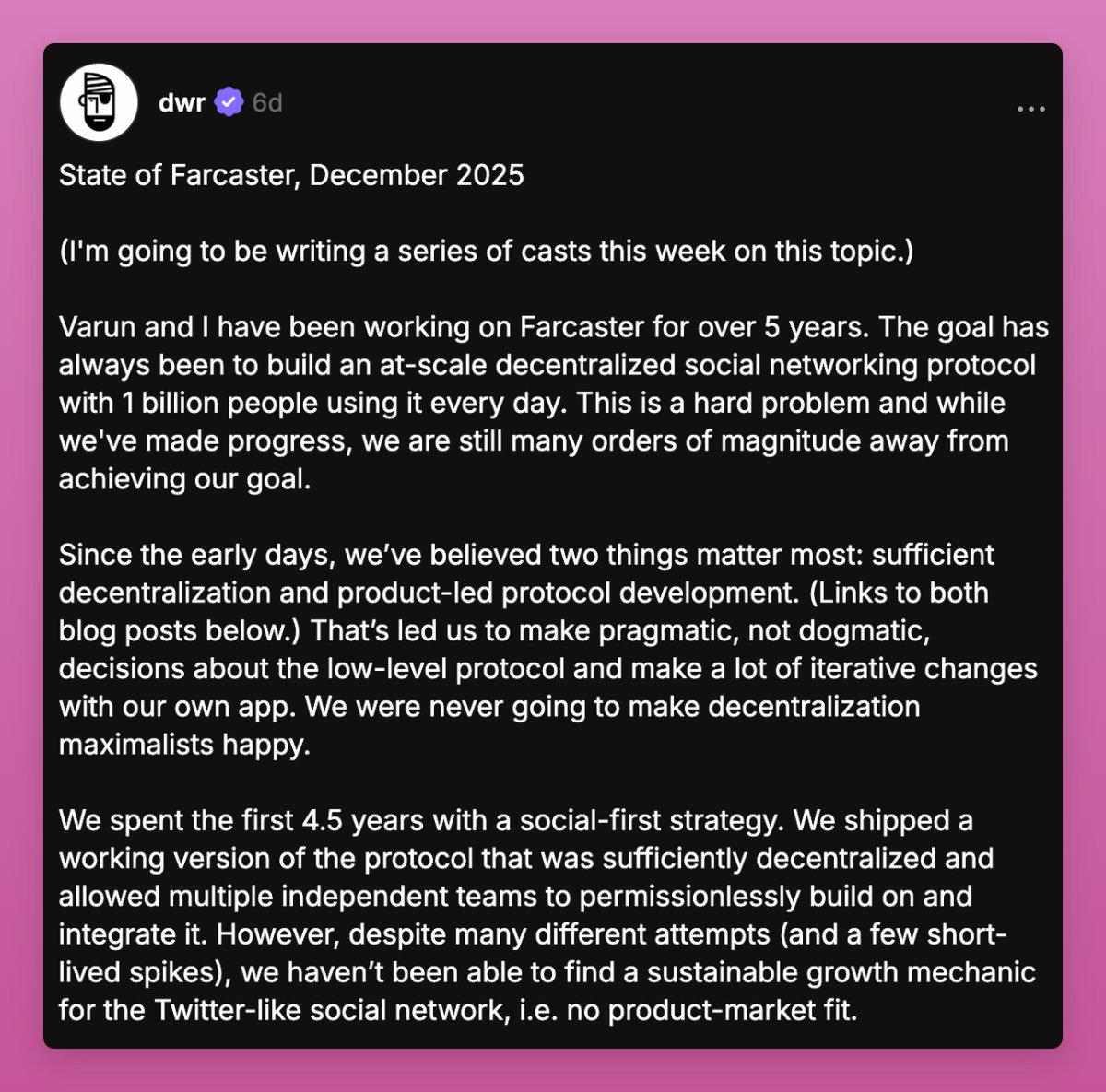
According to Romero, the team spent roughly four and a half years pursuing a “social-first” strategy. This is an approach that ultimately failed to deliver the scale and engagement required to validate the model.
“We tried social-first for 4.5 years. It didn’t work for us,” he said, adding that wallet usage, by contrast, has shown consistent growth.
The strategic rethink marks a major inflection point for Farcaster. Decentralized social messaging platform Farcaster was founded to offer an alternative to centralized social networks by giving users ownership over identity and data.
In another post titled State of Farcaster, Romero reflected on the long-term ambition behind the project. “Varun and I have been working on Farcaster for over 5 years,” he said.
“The goal has always been to build an at-scale decentralized social networking protocol with 1 billion people using it every day. This is a hard problem.”
The new direction suggests that Farcaster now views wallets – not social feeds – as the most viable distribution layer for onboarding users into its ecosystem. Going forward, new features and product positioning will be explicitly wallet-focused. This is based on company’s evolving view now that financial utility and onchain interaction offer a clearer path to sustained engagement than purely social content.
Also Read: Binance Appoints Co-CEO For the Exchange
However, Farcaster’s move into wallets, with trading as a core focus, will not be easy. The shift has drawn pushback from users who joined the network for its social-first vision. Some community members have openly questioned the change in direction.
But founder Romero have been direct in addressing community members who may disagree with the shift. “If you’re not a fan of this direction,” he wrote, outlining three options: use another client, build a new client, or consider another social network altogether.
The competitive environment adds further pressure. Farcaster is entering a crowded wallet market led by established players such as Base Wallet, Trust Wallet, and other Web3-native providers. These platforms already offer deep liquidity access, refined user interfaces, and strong distribution.
Wallet adoption also comes with higher expectations around security and reliability. Any missteps could slow user growth. As competition intensifies, Farcaster will need to clearly differentiate its product to sustain momentum.
Also Read: Crypto Lawyer Solana Co-Founder ‘Failed to Hire’ Now Joins Its DAT

 Sneha Agrawal
|
Newsletter
Sneha Agrawal
|
Newsletter
Subscribe to our newsletter for new updates

By signing-up you agree to our Terms & Conditions and Privacy Policy.


Share