
ByCoinGape


A major shift in U.S. crypto taxation is about to begin as its the first year when IRS new rules announced in December 2024 will be finally implemented.
The IRS had announced that starting January 1, 2025, all centralized crypto exchanges will be required to report users’ digital-asset transactions using a new tax reporting form introduced by the Internal Revenue Service (IRS). The form, known as Form 1099-DA,for the tax year 2025, will be required to submit by exchanges by 31 March, 2026.
The rule marks the most significant overhaul of crypto tax reporting in the United States to date, bringing digital assets closer to the reporting standards applied to traditional securities markets.
As this is the first time for exchanges, the shift represents a major operational challenge.
The new reporting framework applies to digital-asset transactions executed between January 1 and December 31, 2025, commonly referred to as tax year 2025.
Although the transactions occur in 2025, the reporting cycle will take place this year. Crypto exchanges have been required to send Form 1099-DA statements to users summarizing their digital-asset sales by February 2026. Exchanges like Coinbase, Kraken, Binance.US have already begin sending out the forms in mid-February. The same forms must then be electronically submitted to the IRS by March 31, 2026.
As the first reporting deadline approaches, the IRS has also proposed a change on Thursday to how those forms are delivered. The agency, as per guidelines, is allowing brokers, ‘word for exchnages’ to send electronic delivery of tax forms to their users, rather than mailing paper copies to customers.
Also Read: NYSE Parent ICE Invests in OKX
If finalized, exchanges could distribute the forms through account dashboards or email notifications. That’s a move aimed at reducing operational costs. Exchnages such as Coinbase have often complained about the new rules saying, “Requiring 1099-DA forms for stablecoins, assets designed to track the dollar with no gain or loss, creates a mountain of paperwork for zero tax revenue.”
The 2025 tax year marks a big shift in how the IRS views digital assets, with the new Form 1099-DA.
And we believe some aspects of the new reporting rules go too far.
For the first time, the IRS is requiring custodial brokers, like Coinbase, to report customer proceeds from…
— Coinbase 🛡️ (@coinbase) February 17, 2026
Form 1099-DA will require custodial crypto exchanges to report the gross proceeds from digital-asset sales conducted on their platforms.
The form will typically include:
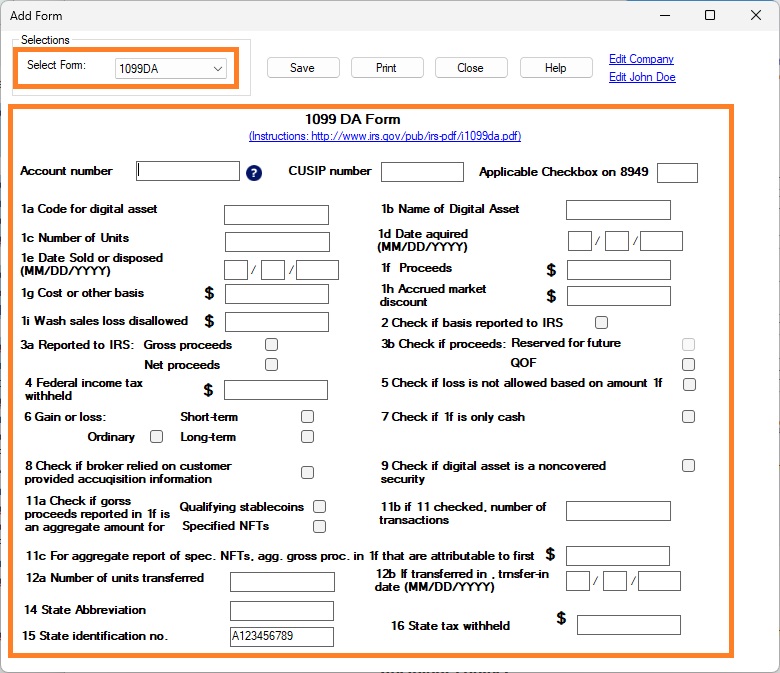
However, for the first year of reporting, exchanges will not be required to report cost basis which is the original purchase price of the asset. That responsibility will largely remain with investors, particularly when assets have been transferred between exchanges or moved from self-custody wallets.
Major crypto exchanges have already begun preparing their infrastructure ahead of the reporting rollout.
Coinbase has taken one of the earliest steps by integrating tax software from CoinTracker directly into its platform. The integration allows users to sync external wallets and exchanges, reconcile transaction histories, and reconstruct missing cost-basis data before the first reporting cycle begins in 2026.
Other exchanges are also providing guidance to users as the rules approach implementation.
Kraken has published tax documentation explaining how customers will receive Form 1099-DA statements summarizing digital-asset sales. Meanwhile, Binance.US has issued similar guidance advising users to maintain accurate transaction records and export trading histories for tax reconciliation.
The upcoming reporting rules highlight a broader shift in the role of crypto exchanges.
For large exchanges, simplifying tax reporting could also become a competitive differentiator. Investors faced with complex tax filings may gravitate toward platforms that make compliance easier.

 Sneha Agrawal
 More Stories
|
Newsletter
Subscribe to our newsletter for new updates

By signing-up you agree to our Terms & Conditions and Privacy Policy.




Share