
Binance Alpha: 5 Things Founders Need to Know Before Launching, Learned From EchoTrade’s 2,000+ Token Launches



Binance Alpha puts a new token in front of Binance’s users for a full day. Whether the token performs well enough to keep trading well or reach a Binance spot or futures listing depends on the preparations developers made weeks earlier.
EchoTrade, a crypto market maker that has supported over 2,000 token launches in the past, more than 40 of which were on Binance Alpha, brings users five things they should know before showcasing their digital assets.
For 2026-2027, Binance Alpha is one of the best options for a first token launch. According to Binance Academy, Binance features early-stage projects inside Binance Wallet for around 24 hours, with one-tap purchases through Quick Buy, and Alpha 2.0 lets users trade the same tokens from the main Binance app.
It gives founders the first place to showcase their assets, and Binance calls the program a pre-listing selection pool.
Around 80% of the Alpha projects EchoTrade has worked with later went on to a Binance spot or futures listing, a much higher share than tokens that apply to the exchange directly. Although listing is not guaranteed, the extended exposure gets the word out about the token long enough to gain customer interest.
This guide shows the five things founders should know before the 24-hour countdown begins.
1. Who decides whether a token gets on Binance Alpha?
Binance has the sole power to decide which token gets a spot on Binance Alpha. Founders cannot make a public application. The world’s leading exchange looks at an asset’s market signals and community interest before deciding to add it to the Alpha program.
There is no launchpad to streamline the process, and no agency that can guarantee selection.
What a project can control is being ready on time. Over 40+ Alpha launches, EchoTrade has seen which signals Binance responds to: an active community, settled tokenomics, real on-chain activity and a visible team. Those are the things a project can prepare.
2. How fast does demand arrive during the showcase?
In one wave, and earlier than most teams expect. On the launches EchoTrade runs, about 40% of day-one volume happens in the first four hours. The showcase behaves more like a morning than a day.
Since Alpha purchases settle on-chain, a token’s liquidity decides the price buyers get. If the pool is deep, the wave is absorbed in steps. If the pool is thin, it prints one spike and then a long slide. Later, that chart becomes a reference point for every exchange and holder.
3. Why plan 30 days instead of 24 hours?
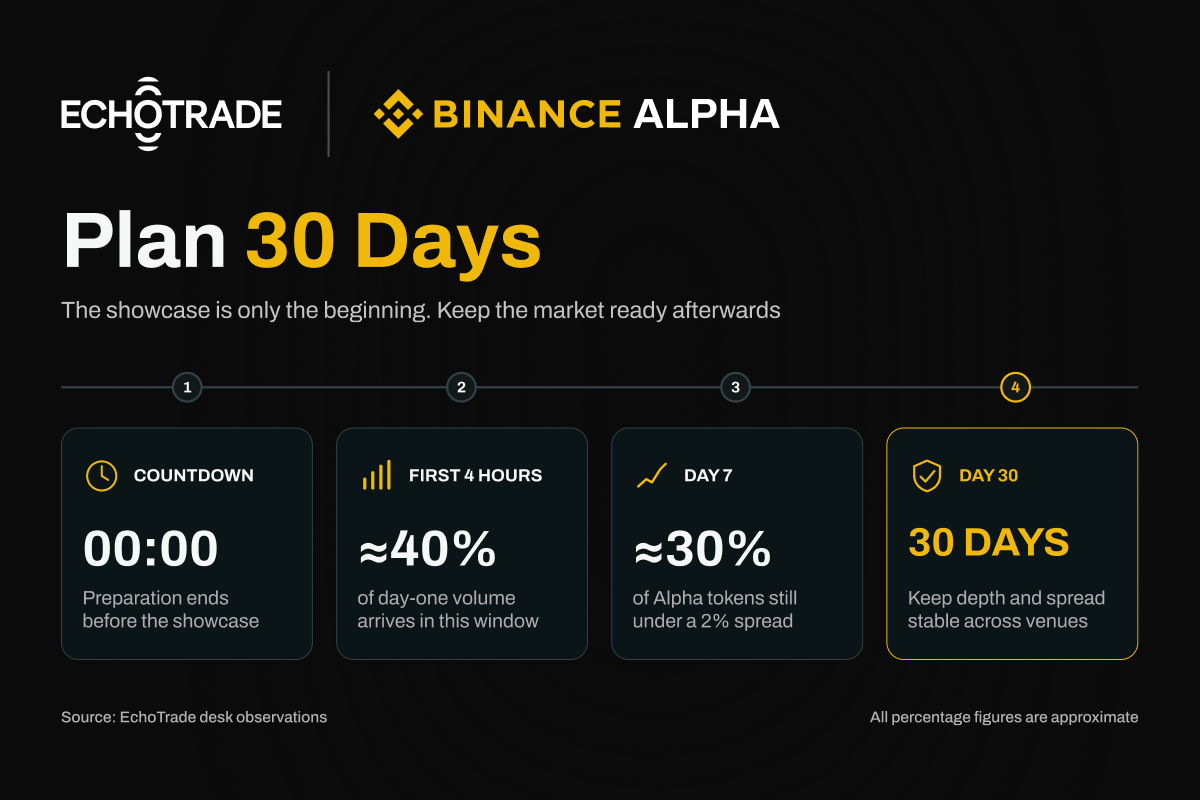
Alpha markets thin out fast after the featured window closes. A general observation of Alpha tokens revealed that only 30% of the tokens still trade with a spread under 2% by day seven.
The projects that are able to persist are those whose founders cared for them the same way as they did the first day. Such a project has the same depth and the same spread on every venue, which leads to the market still being there for them even though the attention has moved away. Any exchange the token lists on next will check exactly those numbers.
4. What does a typical Binance Alpha launch strategy look like?
On the launches EchoTrade runs, the sequence usually looks like this. Three to six months out, the team builds the community that Binance reads as interest. Four to six weeks out, tokenomics and every distribution are locked: Alpha airdrops, Alpha Box allocations and early unlocks. Two to four weeks out, the market maker is onboarded and inventory is in place. Then comes the showcase and the 30 days after it, and only then the next step: a centralized order book such as MEXC, and later an application for Binance spot or futures.
Put every distribution on one calendar before the launch, share it with your market maker, and size depth around each date. Binance’s own guidelines for projects and market makers ask teams to stick to their token release schedules and to report their market maker’s details to the listing platform.
5. When should a project onboard a market maker for Binance Alpha?
Two to four weeks before the showcase. Exchange accounts, liquidity pools, inventory and the launch-day plan all have to be in place before the countdown, not built during it.
This is the work EchoTrade‘s dedicated Binance team does with projects: preparing the token for a Binance Alpha launch, running liquidity through the showcase and the 30 days after it, and building the market record Binance looks at before any later spot or futures listing. The desk quotes on 90+ centralized and decentralized exchanges for 100+ active projects and is an official liquidity partner of MEXC. The sector it sees growing fastest on Alpha right now is real-world assets (RWA).
How to pick the right desk is in EchoTrade’s guide to choosing a market maker for Binance Alpha.
Frequently Asked Questions (FAQs)
1. How long is a token featured on Binance Alpha?
2. Can a project apply to Binance Alpha?
3. Does Binance Alpha lead to a Binance listing?
4. Does a Binance Alpha token need a market maker?
5. When should a project start preparing for Binance Alpha?


- Is Changelly Legit? KYC, Fees, App and Customer Support Review
- Payments Could Give Crypto Super Apps a Daily Use Case, TOKEN2049 Speakers Say
- Paybis vs MoonPay: Which Is Better for Buying Crypto?
- Standard, Expert or Raw Spread? How to Compare Forex Account Types Beyond the Headline Spread
- Bitget Launches Open Custody Network, Giving Institutions Choice in Custody and Access to Markets