 Newsletter
Why Most Investors Miss Bitcoin Mining Profits, and How BitFrac Changes That



Bitcoin keeps breaking records, yet for most investors, the real Bitcoin mining profits remain out of reach. While miners receive rewards every 10 minutes, the average investor often finds themselves on the sidelines. So, what’s the reason behind this? And how is BitFrac, a newcomer in the mining sector, changing this traditional scenario? Let’s simplify it.
Why So Many Investors Miss Out on Bitcoin Mining Profits
According to CoinLaw, Bitcoin miners earned $11.2 billion in 2025, with mining rewards rising by 7.1% year-over-year. However, an average investor does not have a share in the Bitcoin mining profits. Here is why.
1. High entry costs
Mining Bitcoin is not a cheap activity. Setting up a single best bitcoin miner rig can cost over $50,000, not including power and maintenance. For most people, that’s simply not realistic.
2. It’s too technical
You may have the funds, yes, but mining still requires a certain level of technical expertise. You need to choose the right machines, optimize their performance, manage firmware updates, and monitor hash rates around the clock. A single error can stop your Bitcoin production.
3. High electricity costs
Coinlaw highlights that Bitcoin mining now consumes approximately 0.55% of global electricity demand. Home electricity rates are often two or three times higher than industrial rates. This means home miners lose about 80% of potential profits to utility bills.
4. Hardware becomes obsolete fast
Mining equipment loses efficiency every year (outdated within 12-18 months) as new technology emerges. What’s profitable today might be outdated next year, forcing constant reinvestment in new rigs.
5. No passive income
Unlike simply buying Bitcoin and holding it for passive income, mining requires active management, troubleshooting, and technical support. Most investors simply don’t have the time for that.
How BitFrac Changes the Game
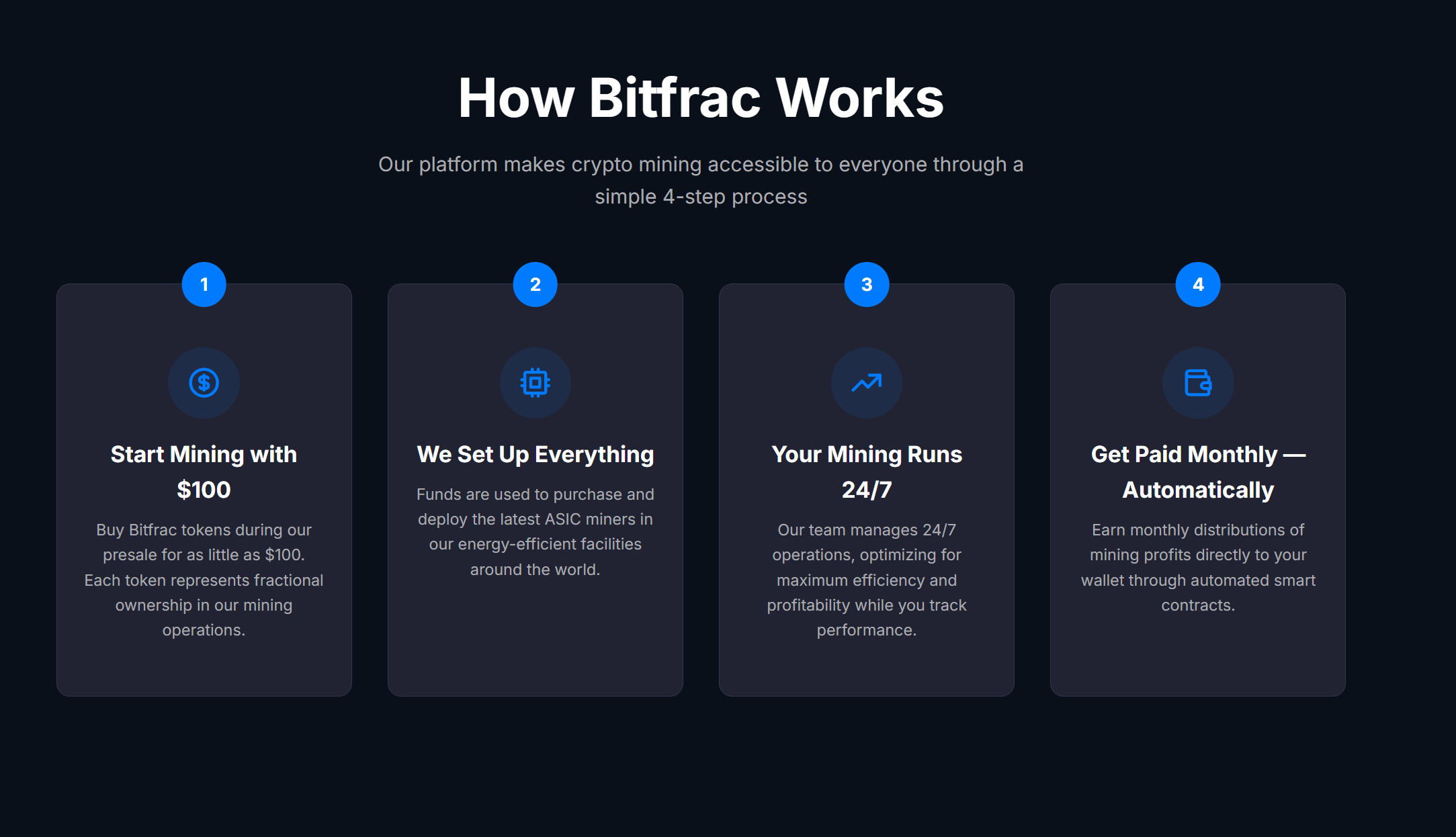
BitFrac is introducing a tokenized ownership model that breaks down the barriers to Bitcoin mining. Through its BFT token, investors can own fractional shares of professional mining operations without directly running or maintaining hardware.
Here’s how it works.
1. Fractional ownership of mining assets
Each BFT token represents a share of BitFrac’s industrial-scale mining operations. This allows you to start investing with as little as $100 instead of purchasing entire machines.
2. Zero technical work / professional management
BitFrac’s expert team takes care of everything, from setup and maintenance to optimizing power usage. You don’t have to worry about the technical details.
3. Lower energy costs
The company operates in regions with wholesale electricity rates, mining Bitcoin at energy costs that are up to 70% lower than those faced by individual miners. This reduction in costs translates to higher potential profits for token holders.
4. Continuous equipment upgrades
Mining technology can become outdated quickly, but BitFrac addresses this issue head-on. The company reinvests a portion of its profits to keep its equipment up to date. This ensures that token holders benefit from the latest advancements in mining technology without incurring additional expenses.
5. Automated profit distribution
As outlined in BitFrac’s whitepaper, mining profits are distributed to token holders every month through smart contracts. These automatic payments are sent directly to your wallet in Bitcoin, providing a transparent, quick, and secure process.
6. Deflationary tokenomics
BitFrac says it plans to allocate a part of its revenue for buybacks and token burns, which will gradually decrease the token supply. This strategy could enhance the token’s value over time while rewarding long-term holders.
Why’s BitFrac’s Model Matters
If successful, BitFrac’s model could represent a democratization of Bitcoin mining. This could allow wider participation in a sector historically dominated by large-scale players.
The approach aligns with a broader industry trend of tokenization of real-world assets (RWAs). Market analysts project the RWAs sector could become a multi-trillion-dollar market, reaching $16.1 trillion by 2030, according to Boston Consulting Group.
For investors seeking exposure to Bitcoin mining without the operational complexity, projects like BitFrac could mark a new direction. This is where blockchain technology bridges the gap between infrastructure and accessibility.
Final Thoughts
Mining will always involve market and operational risks, including power costs, equipment degradation, and Bitcoin price volatility. However, tokenized mining models like BitFrac’s introduce a new layer of participation for everyday investors.
In the evolving mining sector, accessibility and transparency may define the next wave of Bitcoin infrastructure.

Why Trust CoinGape
CoinGape has covered the cryptocurrency industry since 2017, aiming to provide informative insights Read more… to our readers. Our journal analysts bring years of experience in market analysis and blockchain technology to ensure factual accuracy and balanced reporting. By following our Editorial Policy, our writers verify every source, fact-check each story, rely on reputable sources, and attribute quotes and media correctly. We also follow a rigorous Review Methodology when evaluating exchanges and tools. From emerging blockchain projects and coin launches to industry events and technical developments, we cover all facets of the digital asset space with unwavering commitment to timely, relevant information.
Premium Partners






Delivered every day.
- Insights that move markets
- 100,000 active subscribers
Related Articles




- Michael Saylor Teases New Bitcoin Buy As ‘Orange Dots’ Return
- December Recovery Ahead? Coinbase Outlines Why Crypto Market May Rebound
- Peter Brandt Hints at Further Downside for Bitcoin After Brief Rebound
- $1.3T BPCE To Roll Out Bitcoin, Ethereum and Solana Trading For Clients
- Why is the LUNC Price Up 70% Despite the Crypto Market’s Decline?
- Ethereum Price Holds $3,000 as Bitmine Scoops Up $199M in ETH; What Next?
- Solana Price Outlook Strengthens as Spot ETFs See $15.68M in Fresh Inflows
- Dogecoin Price Gears Up for a $0.20 Breakout as Inverse H&S Takes Shape
- Bitcoin Price Forecast as BlackRock Sends $125M in BTC to Coinbase — Is a Crash Inevitable?
- XRP Price Prediction As Spot ETF Inflows Near $1 Billion: What’s Next?
- Solana Price Outlook: Reversal at Key Support Could Lead to $150 Target