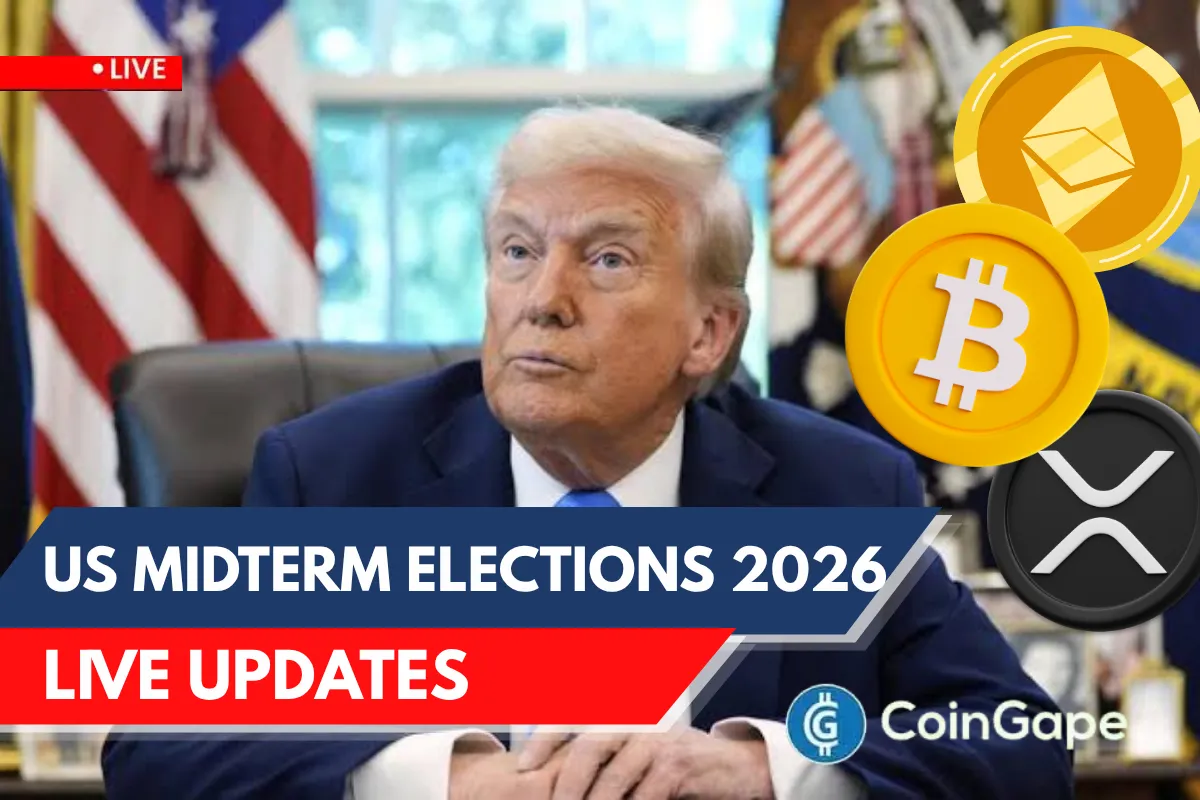

US Midterms 2026 LIVE: 57M Early Vote Fuels Senate Flip Fears




Highlights
- More than 57.5 million early votes had been recorded by Monday evening, about 11.5 million above the 2022 midterm total.
- Republicans hold a 53–47 Senate edge, and prediction markets put Democratic odds of winning the Senate at roughly 74–77% and the House at about 94–95%.
- The CLARITY Act stalled in a September Senate cloture vote, so a Republican-held Senate would reopen its path, while a Democratic flip could push it into 2027 or later.
With more than 57.5 million early ballots already counted, the US midterm elections 2026 arrive on November 3 as the highest-stakes midterm cycle for digital-asset legislation in years.
CLARITY Act and Crypto’s Legislative Moment
The outcome matters directly for digital-asset investors. CLARITY Act revival hinges on the Senate composition that emerges tonight.
President Donald Trump made his closing pitch on Election Eve, declaring, “If our people vote, we win in a landslide.”
His remarks came as the US midterm elections live updates logged a surge in early in-person and mail-in votes across every major Senate battleground.
The University of Florida Election Lab recorded 57,530,789 early votes as of Monday evening, roughly 11.5 million above the 2022 midterm total.
Surges were heaviest in Senate contests that could flip chamber control: Texas, Ohio, Michigan, North Carolina, Georgia, Iowa, and Kansas.
Republicans currently hold a 53–47 Senate edge and a narrow House majority of around 218–214. Democrats need a net gain of four Senate seats while protecting their own to flip the upper chamber.
Prediction markets have priced the tightest Senate race in recent memory. Polymarket odds on a Democratic House climbed to ~94–95% by Election Day morning, while Senate odds settled near 74–77%.
A Democratic sweep of both chambers carries a combined probability of roughly 75–77% on Kalshi.
Michigan remains particularly unpredictable after Democrat Haley Stevens’ shock GOP endorsement of Republican Mike Rogers on November 1, though markets still price the Democratic nominee Abdul El-Sayed at ~82%.
The market-structure bill failed a Senate cloture vote and was deferred until after the US midterm elections 2026.
A Republican-held Senate improves the odds of picking up where the bill stalled. A Democratic gain of four-plus seats shifts the committee math and could push any market-structure vote into 2027 or beyond.
The SEC has already felt the pressure: the agency’s XRP ETF delay earlier this cycle was widely attributed to pre-election regulatory caution.
Industry money flowed heavily into the cycle. Crypto midterm donations from Coinbase, Ripple, and the Winklevoss twins topped the sector’s spending tally, signaling how much the industry has wagered on the result.
The departure of Patrick Witt from the White House Crypto Council last month added uncertainty around the administration’s post-election digital-asset posture, regardless of the congressional outcome.
What Markets Are Watching After the Polls Close
Polls begin closing as early as 6 p.m. ET in parts of Indiana and Kentucky. Major waves follow at 7, 7:30, 8, and 9 p.m. ET, with Alaska final results arriving near 1 a.m. ET.
Sabato’s Crystal Ball projects at least 239 seats leaning Democratic in the House and a Democratic lean in six or more current Republican Senate seats.
DDHQ models put the Democratic House probability at ~83–84% and Senate at ~62–64%, with a median projection of 52–53 Democratic Senate seats.
For crypto markets, the US midterm elections 2026 result functions as a direct legislative referendum. A Republican Senate hold reopens the CLARITY Act path and sustains the pro-industry regulatory momentum of the past two years.
A Democratic chamber flip raises the prospect of tighter oversight, delayed ETF approvals, and slower TradFi integration.
Trump has also floated a $5,000 “Trump dividend” contingent on Republicans holding both chambers, a potential liquidity injection that Bitcoin, Ethereum, and XRP could benefit from, according to analysts.
On the legal front, the Supreme Court rejected a Trump administration emergency bid on November 2 to segregate ~20,000 California mail ballots the DOJ alleged were from non-citizens.
The one-sentence, unsigned order drew no noted dissents. Lower courts had already dismissed the request under the Purcell principle, which bars last-minute election-rule changes.
A separate federal judge also tossed a DOJ effort to delay certification in the Alaska Senate race. Post-election foreign policy attention will likely shift quickly, Trump eyes post-midterm Iran strikes even as Vance is reported to be testing a back-channel with Tehran.
Instant Currency Exchange at BestChange with Ease
- Compare Rates Across 1000+ Exchanges
- Access 250+ Cryptocurrencies & Pairs
- Save Time with Real-Time Price Tracking
- Trusted & Verified Exchange Listings

Why Trust CoinGape
CoinGape has covered the cryptocurrency industry since 2017, aiming to provide informative insights Read more… to our readers. Our journal analysts bring years of experience in market analysis and blockchain technology to ensure factual accuracy and balanced reporting. By following our Editorial Policy, our writers verify every source, fact-check each story, rely on reputable sources, and attribute quotes and media correctly. We also follow a rigorous Review Methodology when evaluating exchanges and tools. From emerging blockchain projects and coin launches to industry events and technical developments, we cover all facets of the digital asset space with unwavering commitment to timely, relevant information.



Delivered every day.
- Insights that move markets
- 100,000 active subscribers

CRYPTO IMPACT AWARDS 2026