Key Highlights
Franklin Crypto:- For years, institutional investors debated whether cryptocurrencies deserved a place in professional portfolios. Concerns around regulation, custody, operational risk and reputation kept many of the world’s largest allocators on the sidelines.
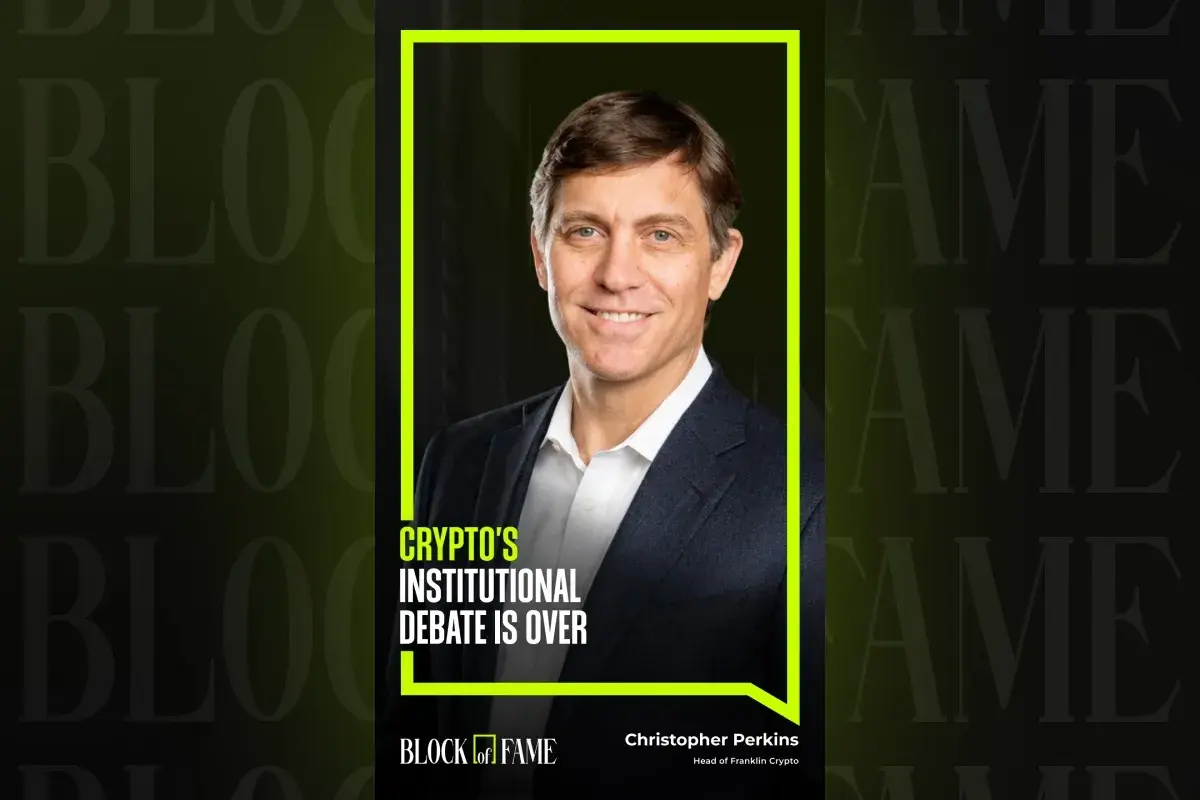
However, Christopher Perkins, Head of Franklin Crypto, believes that debate has fundamentally changed.
“They are asking now, and that is a real change,” Perkins says. “For years the reputational risk ran one way, where an institution took heat simply for being in the space. That has flipped.
Today the bigger risk is sitting it out. If the world is moving toward always-on, global, tokenized markets and you have no strategy, that is where you get left behind. So the conversation has moved from ‘should we touch this’ to ‘how do we do this properly and at scale.'”
That shift sits at the heart of Franklin Templeton’s latest expansion into digital assets. Following its acquisition of 250 Digital, the nearly $1.8 trillion asset manager has launched Franklin Crypto. It is going to serve as the tradfi giant’s dedicated active digital asset management division built to serve institutional investors.
Franklin Crypto is a deliberate, strategic bet for the firm rather than a standalone side venture. The larger mission is helping institutions overcome the misconceptions that continue to shape their view of digital assets.
As digital assets become increasingly embedded within global financial markets, Perkins believes institutions face a very different decision than they did only a few years ago.
“The way I would frame it for any allocator is this: a few years ago the risk was being in crypto, and today the bigger risk is having no strategy at all. A thoughtful, appropriately sized allocation is how you stop being a spectator.”
However, according to Perkins, institutions still make one fundamental mistake: treating crypto as a single speculative asset instead of an increasingly diverse financial ecosystem.
“The biggest one is that crypto is still a single, speculative, all-or-nothing bet. A lot of allocators still picture magic internet money and meme-driven price swings, and they treat the whole asset class as one undifferentiated risk.”
That view, he argues, no longer reflects reality.
“What has actually happened is that this matured into a real asset class with enormous range. You have Bitcoin as a digital store of value, you have programmable infrastructure, you have tokenized real-world assets, you have stablecoins becoming the settlement layer for on-chain markets. These are very different things with very different fundamentals and utility, and lumping them together is how you miss the opportunity and misjudge the risk at the same time.”
Yet investment selection itself is no longer the industry’s biggest challenge.
“The second misconception sits right underneath that one. Institutions tend to assume the hard part of crypto is getting the investment view right. In reality, the hard part is everything around it.”
For Perkins, institutions have never been afraid of market risk. What has slowed adoption is everything surrounding the investment itself.
“Investors are paid to take market risk and they are comfortable with it. What makes them uncomfortable is the rest: regulatory risk, reputational risk, operational risk, custody and counterparty risk.”
Other Articles...
While those concerns kept many institutions on the sidelines, Perkins believes the industry has entered a new phase where infrastructure ad not interest is the primary challenge.
“The gaps that remain are mostly about the how, and they are closing faster than people realize.”
He points to market structure, regulated derivatives, custody and legal clarity as the remaining barriers preventing institutions from scaling digital asset exposure.
“If I had to rank it, the two biggest remaining gaps are the operational backbone and that last mile of market structure and legal clarity. That is the bridge we are built to provide.”
Closing those gaps, Perkins says, is exactly why Franklin Crypto was created.
“We pair people who have been native to this space for years with the institutional muscle of a firm that has spent decades earning the trust of the world’s largest allocators… Crypto-native expertise reinforced with that kind of enterprise control is a powerful combination, and it is what turns a misconception into an allocation.”
Perkins describes the approval of spot Bitcoin and Ether ETFs as one of the defining moments in institutional crypto adoption.This is not simply because they offered exposure, but because they legitimised the asset class inside investment committees.
“The ETFs were the permission structure,” he says. “Before they existed, the conversation was almost entirely about whether an institution could be in this asset class at all without taking reputational or career risk.”
The regulated investment vehicles gave allocators a familiar wrapper through which they could begin building exposure. But Perkins believes ETFs are only the beginning.
“A passive ETF is a starting line,” he says. “Once you own some beta, the next questions come quickly. How do I get active, fundamentals-driven exposure? How do I earn yield on these assets? How do I separate the tokens with real utility from the ones that were pure narrative?”
Those questions, he says, are real reasons why Franklin crypto exists. That shift is also reflected across the industry. In a previous Block of Fame opinion, Grayscale’s Rayhaneh Sharif-Askary explained how the firm’s GSOL launch was the culmination of years of institutional research and investor engagement. Read an opinion piece written by Grayscale’s Rayhaneh Sharif-Askary
Looking beyond today’s market cycle, Perkins expects tokenization to reshape capital markets in much the same way electronic trading transformed finance decades ago.
“The belief is that most funds and assets eventually run on these rails, because the technology solves real problems.”
Shared ledgers, automated smart contracts and near-instant settlement, he argues, will gradually replace slower and more expensive financial infrastructure.
“The direction of travel is institutions treating digital assets as a permanent part of the portfolio. The experiment phase is ending.”
Franklin Templeton already had years of blockchain experience before launching Franklin Crypto. Franklin’s tokenization initiatives, validator operations and its Benji tokenized money market fund are some of its biggest bets. But Perkins argues active crypto investing requires a fundamentally different organisation.
“Generating alpha by actively trading liquid token markets around the clock is a different muscle, with a different team, a different risk apparatus, and a different culture.”
So Franklin Templeton built that capability as a dedicated, crypto-native team backed by institutional governance.
“There is an active, liquid-strategies component that some people would recognize as a hedge-fund-style approach… But that label is too narrow for what this is. Franklin Crypto is a dedicated active asset management division serving institutional allocators… The breadth of mandates is far wider than any single fund vehicle.”
For Perkins, however, success ultimately comes down to trust.
“And the way I run any business comes down to four things, in order: people, clients, strategy, and controls. In this division the controls piece is not optional, because that is precisely what institutional clients are paying us for.
So yes, we will pursue returns aggressively where it makes sense, and we will do it inside a regulated framework with the operational and risk infrastructure that a firm of this scale and history brings to the table. That is the whole point of building this inside Franklin Templeton.”

 Sneha Agrawal
 More Stories






Share