
ByCoinGape

Key Highlights
The ongoing race to become the blockchain of choice for institutional finance is increasingly shifting beyond stablecoins to tokenized Treasury products.
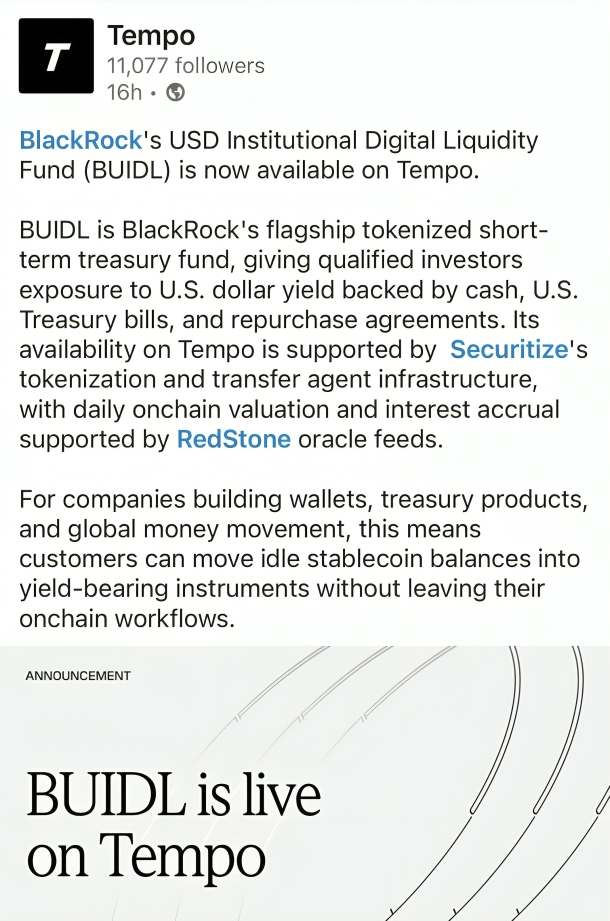
The latest entrant is Stripe’s blockchain Tempo, which has integrated BlackRock’s USD Institutional Digital Liquidity Fund (BUIDL) into its ecosystem. It gives eligible users access to the world’s largest tokenized money market fund and expands its infrastructure for onchain payments and treasury management. Here’s how:
Unlike conventional stablecoins, which generally do not generate returns, tokenized Treasury funds allow institutions to earn U.S. dollar yield while keeping capital onchain.
As stablecoin circulation has climbed beyond $300 billion, asset managers and blockchain infrastructure providers are increasingly competing to turn idle digital cash into productive treasury assets without forcing users back into traditional banking rails.
Tempo’s latest integration reflects that shift. It isn’t building as just another general-purpose Layer-1 network. Rather the Stripe- and Paradigm-incubated blockchain is building infrastructure around institutional financial activity. Its focus spans cross-border payments, stablecoin settlement, tokenized deposits and embedded finance. These are the areas where regulated financial products are expected to play an increasingly important role.
The partnership also comes as asset manager is targeting $500 million in annual digital assets revenue by 2030, driven by crypto ETFs, stablecoin reserve management and tokenized funds. Read more about BlackRock’s digital asset strategy
The announcement follows a series of ecosystem developments from Tempo over the past month. The blockchain recently partnered with Meow to expand stablecoin-native banking services. It has introduced Open USD infrastructure, and supported what it described as South Korea’s first end-to-end KRW stablecoin payment involving Coupang and Woori Bank.
Together, the initiatives suggest Tempo is assembling a broader institutional financial stack rather than pursuing isolated product launches.
The move also comes as tokenized U.S. Treasuries emerge as one of crypto’s fastest-growing real-world asset (RWA) categories. According to RWA.xyz, the sector now holds more than $8 billion in onchain assets, a dramatic increase from less than $1 billion two years ago.
BlackRock’s BUIDL alone accounts for over $3 billion of that market. That makes it the largest tokenized Treasury fund globally and one of the strongest indicators of institutional demand for blockchain-based financial products.

 Sneha Agrawal
 More Stories
GUIDE





Share