
X

Stablecoin Firm Dakota Joins Race for U.S. National Trust Bank Charter

Dakota has applied for a U.S. national trust bank charter, joining Circle, Ripple, and other crypto firms seeking federal banking licenses.

Published by

Sneha Agrawal
Sneha Agrawal

Sneha Agrawal

Managing Editor (Block of Fame)
Expertise : Markets, Law, Politics, Commodities, Crypto, Forex
With over four years of experience in covering and tracking the financial markets, Sneha Agrawal is a dedicated Crypto Journalist and Editor with passion for researching and writing the crypto pieces. She is currently leading the Block of Fame, here at CoinGape. She likes to keep track of political, legal and financial happenings all around the world - without which she deems her day incomplete. Apart from her Journalistic endeavours, she is a solo traveler, museum goer, and a keen reader of books.
Read full bio
Stablecoin Firm Dakota Joins Race for U.S. National Trust Bank Charter

Key Highlights

  • Dakota has applied for a U.S. national trust bank charter with the Office of the Comptroller of the Currency (OCC).
  • CEO Ryan Bozarth said the charter would allow the company to operate under a “single, unified federal framework.
  • The move follows a growing trend of crypto firms, including Circle, Ripple, and BitGo, seeking federal banking licenses.

As crypto companies race to secure banking licenses in the United States, stablecoin infrastructure firm Dakota has become the latest to apply for a national trust bank charter from the U.S. Office of the Comptroller of the Currency (OCC).

The application marks another step in the industry’s effort to bring crypto businesses under federal banking oversight. This comes as companies are preparing for growing institutional demand for stablecoins and tokenized financial products.

Dakota Applies for National Trust Bank Charter

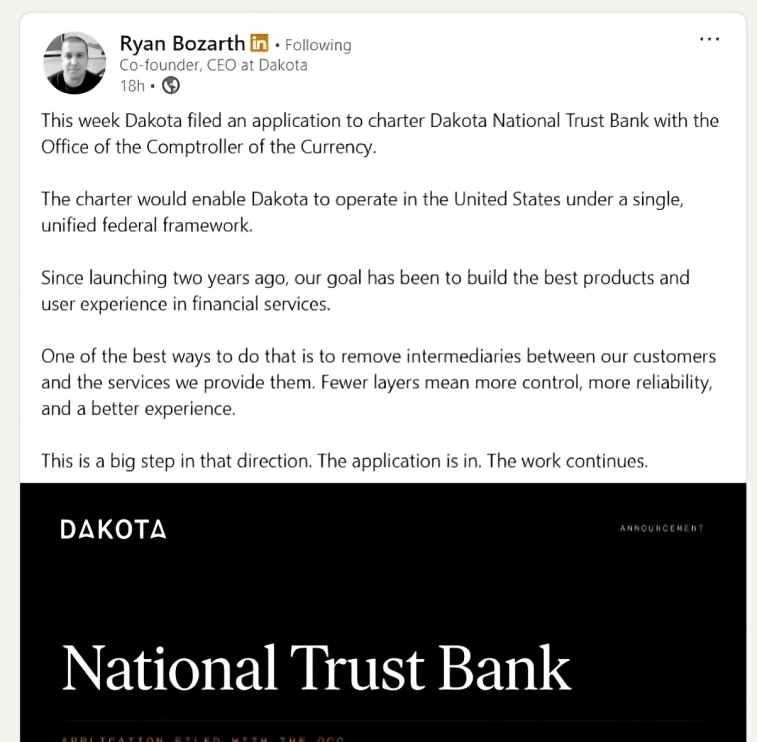
Announcing the move on LinkedIn, Dakota co-founder and CEO Ryan Bozarth said the company had filed an application to charter Dakota National Trust Bank with the OCC.

“The charter would enable Dakota to operate in the United States under a single, unified federal framework,” Bozarth wrote.

He added that the company has spent the past two years building financial infrastructure designed to improve the customer experience by reducing reliance on intermediaries.
Dakota National Bank license
Source: Linkedin Post

“One of the best ways to do that is to remove intermediaries between our customers and the services we provide. Fewer layers mean more control, more reliability, and a better experience,” Bozarth said, calling the application “a big step in that direction.”

If approved, Dakota would be able to offer trust and custody services under federal supervision. A national trust bank charter allows firms to safeguard customer assets, provide fiduciary and custody services, and operate nationwide under a single federal regulator. Unlike a traditional commercial bank, however, a national trust bank cannot accept retail deposits or extend loans.

The move comes as the U.S. regulatory environment has become more favorable for digital assets. Just today only, Senator Lummis confirms CLARITY Act Senate Floor Vote Next Week ahead of August recess. Companies expect demand from banks, asset managers, and large businesses to grow. Having an OCC trust charter positions them to serve that demand directly.

Growing Race Among Crypto Firms

The charter has become increasingly attractive for crypto firms. The reason attributes to reducing dependence on partner banks while expanding services for institutional investors and enterprises.

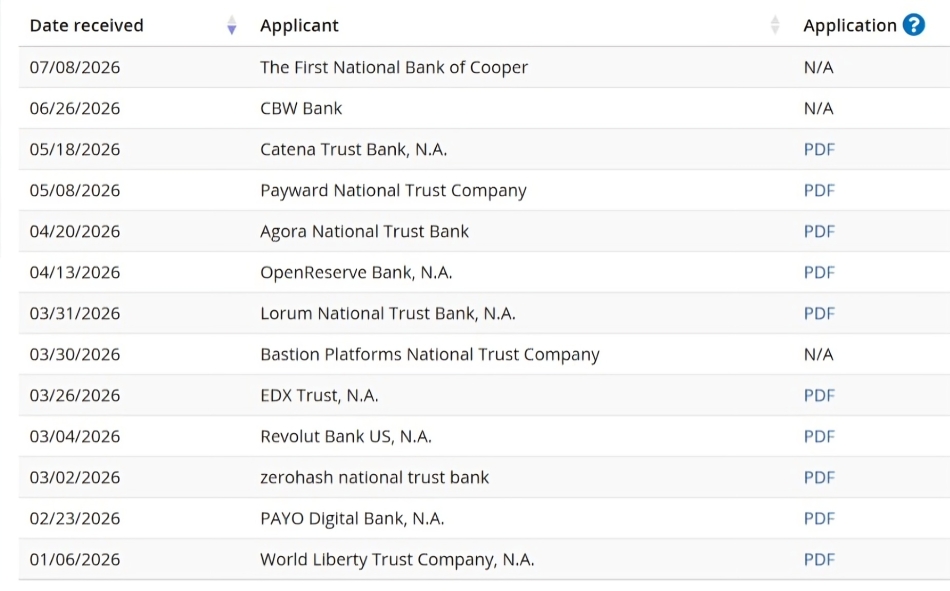
Dakota is not alone. Several digital asset companies have either secured or applied for OCC trust bank charters in recent years. Circle recently received final OCC approval to establish Circle National Trust Bank. This will allow it to oversee the custody of reserve assets supporting USDC and provide digital asset custody services.

Other firms that have announced trust bank ambitions or applications include Ripple, BitGo, Paxos, Crypto.com, Fidelity Digital Assets, and Bridge, Stripe’s stablecoin unit.
Digital Asset Companies Seeking National Trust Bank Licenses| Source: OCC Website

The renewed interest in banking charters comes as the stablecoin industry enters a new phase of growth. The global stablecoin market has grown beyond $300 billion. Tradfi institutions are increasingly exploring blockchain-based payments, tokenized deposits, and real-world asset tokenization.

A federal trust charter also gives crypto firms greater regulatory credibility. Instead of relying on multiple state licenses and banking partners, companies can operate under a single federal framework. This makes it easier to serve institutional clients across the country.

Frequently Asked Questions

Why are crypto companies seeking trust bank charters?

+
A federal trust charter provides regulatory clarity, enables nationwide operations under a single regulator, reduces reliance on partner banks, and strengthens credibility with institutional clients.

What is a national trust bank charter?

+
A national trust bank charter allows companies to offer trust, custody, and fiduciary services under federal oversight. Unlike traditional banks, national trust banks cannot accept retail deposits or issue loans.

Which crypto firms have received or applied for OCC trust bank charters?

+
Companies that have received or pursued OCC trust bank charters include Circle, Ripple, BitGo, Paxos, Crypto.com, Fidelity Digital Assets, Bridge, and now Dakota.
Why trust CoinGape: CoinGape has covered the cryptocurrency industry since 2017, aiming to provide informative insights to our readers. Our journalists and analysts bring years of experience in market analysis and blockchain technology to ensure factual accuracy and balanced reporting. By following our Editorial Policy, our writers verify every source, fact-check each story, rely on reputable sources, and attribute quotes and media correctly. We also follow a rigorous Review Methodology when evaluating exchanges and tools. From emerging blockchain projects and coin launches to industry events and technical developments, we cover all facets of the digital asset space with unwavering commitment to timely, relevant information.
Investment disclaimer: The content reflects the author’s personal views and current market conditions. Please conduct your own research before investing in cryptocurrencies, as neither the author nor the publication is responsible for any financial losses.
Ad Disclosure: This site may feature sponsored content and affiliate links. All advertisements are clearly labeled, and ad partners have no influence over our editorial content.

Something big to share?

About Author

Sneha Agrawal
Sneha Agrawal Sneha Agrawal
With over four years of experience in covering and tracking the financial markets, Sneha Agrawal is a dedicated Crypto Journalist and Editor with passion for researching and writing the crypto pieces. She is currently leading the Block of Fame, here at CoinGape. She likes to keep track of political, legal and financial happenings all around the world - without which she deems her day incomplete. Apart from her Journalistic endeavours, she is a solo traveler, museum goer, and a keen reader of books.

CoinGape is a burgeoning blockchain and crypto media company. It was recently awarded as the Best Crypto Media Company 2024 at Global Blockchain Show, Dubai. Our goal is to keep industry professionals up to date on the most recent news and developments. We are a team of experts who take great pride in offering unbiased and well researched information to help our readers make informed decisions. Read our Editorial Policy

©2026 All rights reserved