
ByCoinGape


The October 10, 2025 crypto market crash, which triggered an estimated $19–28 billion in forced deleveraging, is yet again reigniting debate among Web3’s most influential executives.
On Oct 1o, crypto experienced a shock that liquidated roughly $19 billion of leveraged positions within hours. During the peak of the event, Binance’s USDe on-venue price briefly dislocated. It reported lows were as near as $0.65 on Binance’s order book, causing 2.2 billion market-cap contraction on that venue.
But now even months after the event, competing narratives are emerging over what caused the collapse. Web3 CEOs and top leaders are debating whether the crash was driven by systemic leverage, yield-fuelled risk-taking, or exchange-specific dynamics.
Becoming the hot debate in web3, the actual reasons and blames games are now pitting exchange CEOs, market makers, and institutional investors against one another. Here’s How
The first high-profile explanation came from ARK Invest CEO Cathie Wood.
Speaking on Fox Business on January 26, 2026, Wood said Bitcoin’s sharp pullback seen in recent months actually stems from a $28 billion deleveraging event.
Referring to crypto’s 10/10 Black Friday event, she linked the cause to a “Binance software-related issue on October 10”.
According to Wood, the resulting forced selling accounted for the bulk of the downside pressure. She added that the worst of the liquidation cycle now appears to be over.
While her remarks were meant for a causual market analysis but they quickly gained traction for calling out Binance’s role in the crash.
Also Read: The Coming Institutional Crypto Hiring Wave
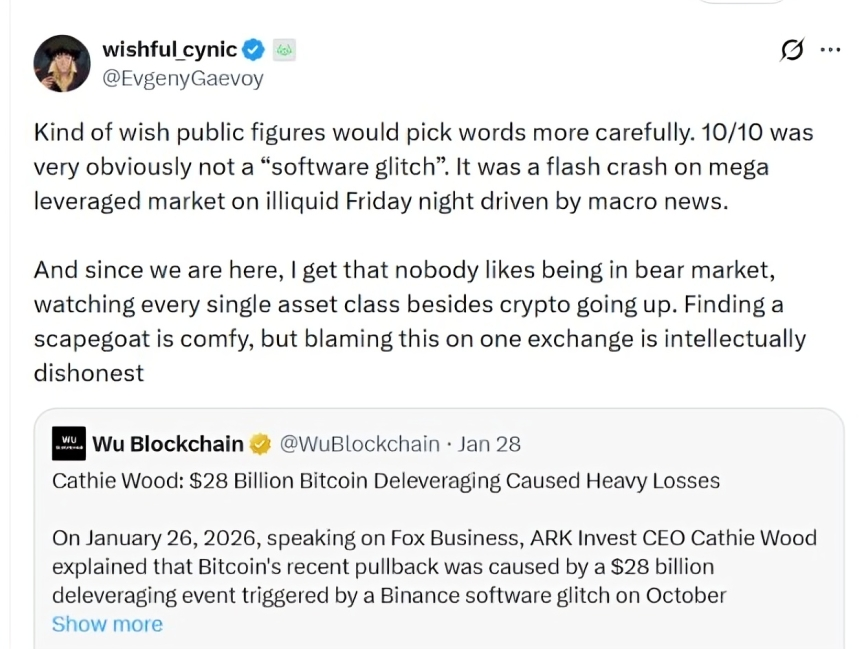
Days later, Wintermute founder Evgeny Gaevoy publicly countered Cathie Wood’s growing narrative that a single exchange or glitch caused the collapse.
Gaevoy described the event as a macro-driven flash crash. It was exacerbated by record leverage, thin liquidity, and automated risk systems pulling market-maker liquidity simultaneously across venues. He said, “Finding a scapegoat is comfy, but blaming this on one exchange is intellectually dishonest”.
But the debate didn’t end there as OKX CEO Star Xu further joined and sparked marketing angle to the debate.’
Also Read: Who’s Challenging Tether in Tokenized Gold?
The debate reached its peak when OKX CEO Star Xu published a detailed post on X, directly challenging the prevailing explanations.
“No complexity. No accident,” Xu wrote, arguing that the crash was triggered by irresponsible yield marketing and leverage incentives, not merely market structure.
According to Xu, the crash was not a random liquidity event but the result of structural incentives that encouraged excessive leverage under the guise of low risk.
He pointed specifically to a temporary Binance campaign offering 12% APY on USDe. This ran while allowing the asset to be used as collateral with treatment similar to USDT and USDC and without effective limits.

Xu argued that this was fundamentally dangerous because USDe is not a traditional stablecoin, but a tokenized hedge fund product issued by Ethena. Capital raised through USDe, he explained, is deployed into index arbitrage and algorithmic trading strategies, with the resulting fund tokenized and reused across exchanges.
Also Read: Gemini Founders Invest in ZCash
“This is structurally different from products like BlackRock’s BUIDL or Franklin Templeton’s BENJI,” Xu said, noting that USDe embeds hedge-fund-level risk rather than low-risk money market exposure.
Binance co-founder and former CEO Changpeng “CZ” Zhao responded shortly after OKX CEO Star Xu’s comments gained traction, pushing back on the narrative and questioning the motivations behind it.
Dragonfly is/was one of the largest investors of OKX. Data speaks. Time doesn’t match. Good to see people understanding facts,” CZ wrote on X, referencing criticism from Dragonfly Capital general partner Haseeb Qureshi, who had earlier dismissed Xu’s claims as “candidly ridiculous.”

Hours after Xu’s comments gained momentum, Binance finally clarified its stance. It published its official post-morte, addressing what it described as “misconceptions” surrounding the October 10 crash.
Binance attributed the event to a macro-driven risk-off shock. It cites trade-war headlines, record derivatives open interest exceeding $100 billion, and market makers withdrawing liquidity under automated risk controls. The exchange confirmed that its core matching engine and clearing systems remained operational throughout the event.
Interestingly, Binance did acknowledge temporary index deviations involving USDe, WBETH, and BNSOL However, it stated that roughly 75% of liquidations occurred before those deviations, arguing that the crash was already well underway.
https://x.com/binance/status/2017329097580712113
The exchange said it compensated affected users with more than $328 million, launched a $300 million “Together Initiative”. It further said that since then it then it has announced additional safeguards, including institutional support measures.
Thus, in what seems like never ending debate, the 10/10 crash has become more than a market event. With top CEOs and leaders still differing on the issue, the industry remains divided over whether the collapse was inevitable or avoidable.

 Sneha Agrawal
|
Newsletter
Sneha Agrawal
|
Newsletter
Subscribe to our newsletter for new updates

By signing-up you agree to our Terms & Conditions and Privacy Policy.




Share