

Solana, the prominent Layer-1 blockchain, is marking its 5th anniversary today since the first Solana block was built on March 16, 2020.
Though it was founded in 2017 by Anatomy Yakovenko alongwith Raj Gokal under the brand name of Solana Labs, its Mainnet was launched in 2020, pioneering the Proof-of-History (PoH) concept.
Five years ago, Anatoly Yakovenko, a former Qualcomm engineer, entered the Blockchain space and presented Solana with an ambitious goal: to build a high-speed, low-cost, and scalable network that could rival traditional financial systems. And cut to today’s March 2025, it boasts of enabling 408 billion transactions with nearly $987B DEX Volume, supported by 1300+ validators.
In its 5-year journey of becoming the industry’s leading Layer-1 Blockchain, it has faced several breakdowns and breakthroughs.

Join BrandTalk as we revisit the defining moments that have left a lasting mark on Solana’s incredible 5-year journey.
1. Solana’s $20M Funding from Multicoin Capital
Its journey particularly received a green light when in July 2019, Solana received $20 Million in funding, led by Multicoin Capital.
Multicoin Capital was one of the earliest and most influential investors in Solana. The venture capital firm, known for backing high-growth blockchain projects, recognized Solana’s potential early and played a key role in its rise.
Notably, when Antolly presented his vision of a “Blockchain running at NASDAQ Speed”, it was still something that investors could not easily be wooed in those early years of 2018-19.
“When you find someone who has already written code that will run on billions of phones and optimize transaction speed—this (investment) is obvious,” Multicoin Capital general partner Vinny Lingham had said during that time of the investment.

Its other early investors included Edith Yeung of 500 Startups, angel investor David Quiec, Chris MrCann, and Sam Lessin of Slow Ventures among others, according to The Information’s archived article.
However, later Multicoin Capital was heavily exposed to FTX and Alameda Research, both of which were deeply intertwined with Solana. When FTX collapsed in November 2022, SOL’s price plunged, and Multicoin too suffered major losses. Despite this, they remained committed to Solana, citing its strong developer ecosystem and technology.
Notably, Multicoin Capital still views Solana as a key investment, emphasizing its high throughput, low fees, and growing adoption in DeFi, NFTs, and payments. They continue to hold a substantial amount of SOL and have re-affirmed their long-term belief in the network.
An Investors’ Guilt on passing the Opportunity – As Solana celebrated its 5th Birthday today, Haseeb Qureshi, Managing Partner of DragonFly, reminisced that he had passed on its seed round in early 2018 and had called the “710K TPS laughable arguing “their numbers are complete bullshit”. But today he calls it “the worst investing miss of all time” as Junior VC.
2. Recurrent Outages put a stain on its credibility
Unlike Ethereum’s Layer 2 scaling solutions, Solana processes all transactions on a single layer, making it vulnerable to spikes in demand – a feature that proved both boon and bane for the blockchain.
With High TPS & Bot Activity, its cheap fees attracted bots that flooded the network with spam transactions, overwhelming validators – creating its history of network outages.
Other Articles...
Since its launch, the blockchain suffered multiple downtimes, including a 17-hour outage in September 2021 due to excessive transaction load. While the team worked to improve network resilience, critics questioned its reliability as a decentralized system.
In May 2022 again, it suffered 7-Hour Outage due to NFT minting bots flooding the network with over 4 million transactions per second. As a result, Solana halted and required a manual restart. It suffered another such outrage in October with its most recent being on February 25, 2023 – 20-Hour Degradation.
In order to solve it, in August 2022, Solana collaborated with Jump Crypto to develop Firedancer, a new validator client aimed at enhancing network efficiency and reducing downtime.
3. Hailed as a potential “Ethereum killer”
As the blockchain continued to develop, Solana earned the title of “Ethereum killer” due to its high throughput, low transaction costs, and developer-friendly ecosystem. It was seen as a strong competitor to Ethereum, addressing its scalability and congestion issues.
Further, Solana’s high-speed blockchain came as a game-changer for DeFi, NFTs, and gaming, making transactions nearly instantaneous compared to Ethereum’s slower confirmations.its scalability and congestion issues.
3. FTX Collapse Came as a Major Setback
Its narrative of being a “Ethereum Killer” received significant setback during Sam Bankman Fried-led FTX Collapse of November 2022, coming as the biggest challenge for Solana when FTX and its sister company, Alameda Research collapsed.
As a major investor in Solana, Alameda held significant SOL tokens, and its bankruptcy sent shockwaves through the ecosystem.
Solana’s total value locked (TVL) in DeFi dropped from over $10 billion to under $500 million, and its price plummeted by more than 90% from its all-time high of $260.
Many assumed that Solana would struggle to recover, but the community and developers remained steadfast.

4. (SOL) reaching ATH price of $259.96 with NFT and DeFi Boom
Solana (SOL) reached its all-time high (ATH) price of $259.96 on November 6, 2021, during the peak of the 2021 crypto bull run.
And in November 2024, Solana (SOL) broke its previous record to reach a new all-time high above $264, fueled by a prolonged market rally and optimism following Donald Trump’s re-election as US president.

The success of Solana-based NFT projects like Degenerate Ape Academy and the rise of Magic Eden (a leading Solana NFT marketplace) brought massive demand to the ecosystem.
On the DeFi front, Serum DEX, Jupiter Aggregator, Raydium, and Marinade Finance have driven Solana’s resurgence. Solana’s DeFi TVL surpassed $3 billion by early 2024, proving that it was more than just a speculative asset
Solana’s NFT ecosystem has also exploded, with marketplaces like Magic Eden and Tensor rivaling Ethereum’s OpenSea. Notably, the Mad Lads collection became a breakout success, reinforcing Solana’s dominance in the NFT space..
5. Memecoin Supported momentum with $BONK and $WIF
Solana found unexpected momentum through memecoins, particularly BONK and DogWifHat (WIF).
BONK’s airdrop in late 2022 revived interest in Solana, while WIF’s meteoric rise in 2024 turned it into one of the top-performing tokens. These events demonstrated Solana’s ability to capture viral trends and engage retail traders.
6. Launch of Solana Mobile for Bringing Web3 to Phones
Its boldest move was in year 2023 with Solana Mobile, which introduced the Saga phone—a Web3-native smartphone enabling seamless crypto transactions and NFT minting.
The Chapter 2 mobile device, announced in 2024, promises to expand this vision, positioning Solana as a leader in mobile blockchain.

Solana vs. Ethereum, BNB, and L2s: The Competition Is Fiercer Than Ever!
Solana has positioned itself as an alternative to Ethereum and BNB Chain, competing on speed, cost, and user experience. However, Ethereum’s Layer 2 networks (Arbitrum, Optimism) have narrowed the gap by improving Ethereum’s scalability.
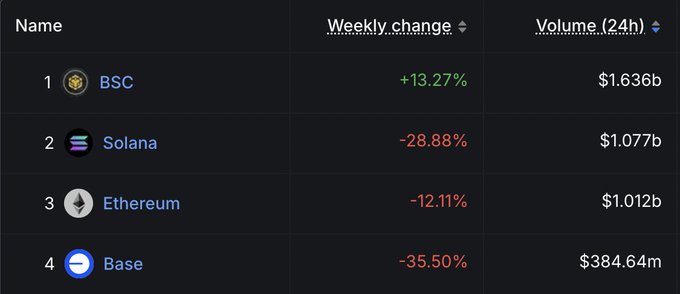
Meanwhile, BNB Chain’s recent dominance in DEX trading volume has also shown that competition in DeFi is heating up.
On Sunday, BNB Chain’s DEX trading volume reached an unprecedented $1.64 billion, surpassing Solana’s $1.077 billion during the same period. This surge represents a 13% increase over the past week for BNB Chain, while Solana experienced a 28% decline in DEX trading volume.
Thus, the challenge for Solana is to maintain its unique value proposition—high-speed transactions with low fees—while ensuring network reliability.
What’s Next for Solana Now?
As it enters its fifth year, the roadmap ahead looks promising:
1. Firedancer Implementation to fight network outages: The full release of Firedancer is anticipated in 2025, with ongoing testing and development to ensure its robustness and effectiveness in enhancing Solana’s network stability.
2. Doubling Blockspace: Anza, Solana’s main software development team, has unveiled a 2025 roadmap aiming to double the network’s blockspace. This initiative seeks to enhance transaction throughput, accommodating a growing number of decentralized applications (dApps) and users.
3. Efficiency Improvements: The roadmap includes micro-advancements such as optimizing Agave’s scheduler, scaling the Turbine protocol, and adopting a faster hashing algorithm. These enhancements are aimed at improving transaction handling and overall network performance.
4. Overhauling the Read Layer: Recognizing the need for better data accessibility, the Solana Foundation plans to revamp the network’s read layer.
A Blockchain That Refused to Die?
Solana’s journey from network outages and the FTX collapse to a vibrant DeFi, NFT, and memecoin ecosystem is one of the most dramatic comeback stories in crypto. While challenges remain, it has proven that innovation, a strong community, and a relentless focus on scalability and speed can drive long-term success.
As the blockchain industry evolves, one thing is certain: Solana is here to stay, with many more anniversaries and milestones to celebrate.

 Sneha Agrawal

Share