
ByCoinGape

Key Highlights
MiCA License:- The looming July 1 MiCA deadline is creating a rush among crypto companies across web3. Firms are accelerating their compliance efforts as Europe’s landmark Markets in Crypto-Assets (MiCA) regulation moves into a crucial phase.
The urgency stems from a stark reality. According to industry reports, only 194 firms had secured MiCA authorization across the European Union as of May 2026. That figure represents a small fraction of the nearly 3,000 crypto firms registered across the bloc. This leaves an estimated 75% of companies yet to obtain the license required to operate under the new regime.
For those that fail to secure authorization, the consequences could be significant. Once national transition periods expire, exchanges, wallets, brokers, custodians, and other crypto service providers can’t offer services to users based in the European Union. And for many firms, losing access to Europe could mean losing access to one of the world’s largest and most important crypto markets.
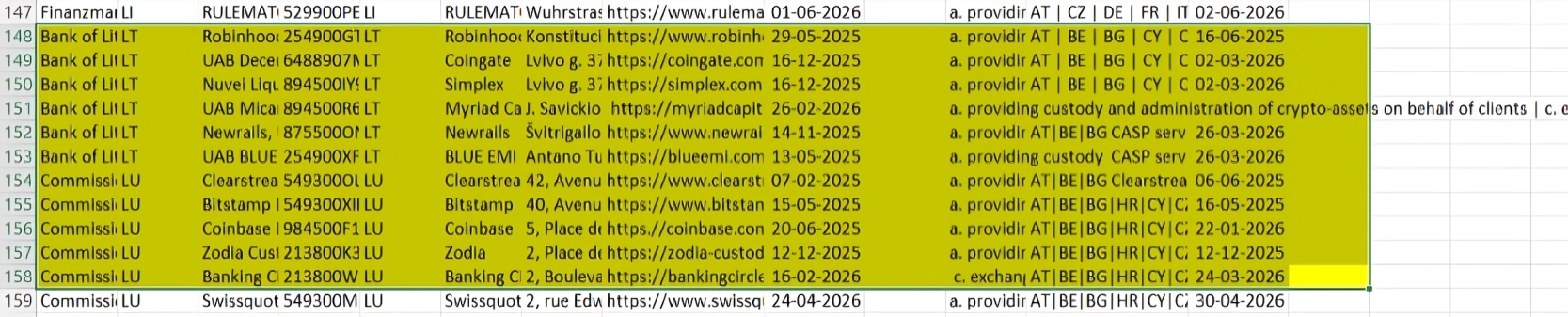
The figures raise an important question: Which major crypto firms are still outside the MiCA framework?
Among the firms yet to embrace MiCA, Tether stands out as the most prominent name.
The issuer of the world’s largest stablecoin, USDT, has repeatedly signaled that it does not intend to seek MiCA authorization for its flagship product. CEO Paolo Ardoino has been one of the regulation’s most vocal critics.
He’s been arguing that certain provisions surrounding reserve management and banking requirements could create risks for stablecoin issuers rather than strengthen the market.
Tether’s decision has already had a visible impact across Europe. This week, several major exchanges, including Coinbase, Kraken, and Crypto.com, have either restricted or delisted USDT trading for users in the European Economic Area. This comes as part of their requirememtsto comply with MiCA requirements.
The restrictions are particularly significant given USDT’s dominant position in the crypto market. With a circulating supply exceeding $150 billion and a central role in global crypto trading, USDT remains the industry’s largest stablecoin by a considerable margin. However, its absence from parts of the European market is creating opportunities for MiCA-compliant alternatives.
Circle’s USDC has emerged as one of the biggest beneficiaries of the regulatory shift. Other compliant issuers, including Ripple through its recently launched RLUSD stablecoin, are seeking to expand their footprint in Europe.
Despite the growing pressure, Ardoino has maintained that Tether has no plans to modify USDT solely to satisfy European requirements. Instead, the company appears focused on jurisdictions outside the EU. It’s been betting that global demand for USDT will outweigh the costs of remaining outside Europe’s regulatory framework.
Tether is not alone.
Beyond Tether, several major stablecoin projects have yet to secure authorization under the European regime. These include Ethena’s USDe, PayPal-backed PYUSD, Ripple’s RLUSD, and World Liberty Financial’s USD1. While some of these issuers are still pursuing regulatory approvals, none have emerged as final MiCA-authorized stablecoins yet.
Among crypto exchanges, most of the industry’s largest names have already secured MiCA authorization or established compliant European operations. These include Coinbase, Kraken, Crypto.com, Bybit, Gemini, Bitstamp, and OKX.
However, some major platforms remain outside the framework. For instance, Binance, is still not listed among MiCA-authorized firms. While the firm is pursuing MiCA, he company does not appear in ESMA’s MiCA register last updated on June 12, 2026.
There are parts of its European authorization process remain pending. It further received a setback as its application in Greece got rejected. Other offshore-focused exchanges, including HTX and BitMEX, have also yet to publicly announce MiCA authorization.
For these firms, the July 1 transition deadline could prove particularly significant as regulators tighten enforcement across the bloc.
The implications of remaining outside the framework could become increasingly severe as enforcement intensifies. Recently, Polish President vetoed MiCA.
Without authorization, crypto firms may lose the legal ability to market services, onboard new users, or provide certain products within the European Union. Exchanges could be forced to delist non-compliant assets, while users may face reduced access to certain stablecoins and crypto services.
At the same time, MiCA is expected to create a clearer divide between regulated and non-regulated crypto businesses. Companies that secure authorization gain access to the entire EU market through a single regulatory passport. The firms that remain outside the framework risk becoming increasingly isolated from institutional capital and regulated financial partners.
As the July 1 deadline approaches, the race for compliance is entering its final stretch. There are thousands of firms still awaiting authorization with several major names choosing different paths. With this, Europe’s crypto landscape may soon look very different from the one that existed before MiCA.
Frequently Asked Questions
What is the deadline for securing MiCA license?
What happens if a crypto firm does not obtain MiCA authorization?
Which major stablecoins are not MiCA-authorized?

 Sneha Agrawal
|
Newsletter
Sneha Agrawal
|
Newsletter
Subscribe to our newsletter for new updates

By signing-up you agree to our Terms & Conditions and Privacy Policy.





Share