

Iran Crypto Market:- The ongoing US-Iran war has put the country back at the center of global attention. While much of the focus has been on military tensions and geopolitics, another part of Iran’s economy has quietly grown into a multibillion-dollar market. That part is the Iran’s crypto market.
According to Chainalysis, Iran’s crypto ecosystem has surpassed $7.8 billion in 2025.This makes it one of the largest digital asset markets in the Middle East. The significance of that market was thrust into the spotlight last week when the U.S. Treasury’s Office of Foreign Assets Control (OFAC) sanctioned four crypto exchanges sanctioned four of Iran’s largest cryptocurrency exchanges. These were Nobitex, Wallex, Bitpin and Ramzinex.
Today's sanctions against Nobitex, Wallex, Bitpin, and Ramzinex target the Iranian digital asset exchanges responsible for at least 72% of all Iranian digital asset inflows in 2025.
Remember that much of the crypto going into Iran has flowed through Binance over the years. With… https://t.co/5SiHwTTGVC
— Max Meizlish (@maxmeizlish) June 2, 2026
However, the latest U.S. sanctions against these four Iranian cryptocurrency exchanges may have exposed something much bigger than a compliance risk. That is the extraordinary concentration of Iran’s crypto market. Here’ How
Growing Market Amid Sanctions and War
Iran’s crypto market has evolved into one of the largest and most strategically important digital asset ecosystems in the Middle East. According to Chainalysis, the country’s crypto economy surpassed $7.78 billion in 2025. This was driven by years of economic sanctions, persistent inflation of 40% to 50%, and a rial that has lost roughly 90% of its value since 2018.
As traditional financial options became increasingly limited, many Iranians turned to cryptocurrencies as a store of value and a gateway to global markets.
Yet the market is far from decentralized. Here’s how
Who Controls Iran’s Crypto Market
However, only a handful of exchanges dominate Iran’s crypto economy, with Nobitex at the center. According to U.S. Treasury allegations and TRM Labs data, Nobitex processed more than 50% of Iranian digital-asset inflows in 2025. The four exchanges – Nobitex, Bit Pin, Wallex, and Ramzinex – collectively accounted for roughly 78% of Iran’s attributed crypto volume.
In terms of the power Structure, Nobitex is the largest crypto exchange in Iran. It claims more than 11 million users and has processed billions of dollars in transactions.
A Reuters report past month found that Nobitex was founded by brothers Ali and Mohammad Kharrazi, members of one of Iran’s most politically connected families. The brothers reportedly used the surname “Aghamir” in business records, obscuring their ties to the influential Kharrazi family. The exchange now sits at the center of a parallel financial system used by both ordinary Iranians and sanctioned entities.
The rest of the market is concentrated among Bit Pin, Wallex, Ramzinex. According to blockchain intelligence firm TRM Labs, the four exchanges collectively accounted for approximately $7.7 billion in crypto transactions in 2025. This represents nearly 78% of Iran’s attributed crypto market volume.
Further, estimates from Chainalysis reveal that addresses linked to the Islamic Revolutionary Guard Corps (IRGC) represented roughly 50% of the country’s crypto ecosystem in the fourth quarter of 2025. IRGC-associated addresses received more than $3 billion in funds during 2025, up from over $2 billion a year earlier.
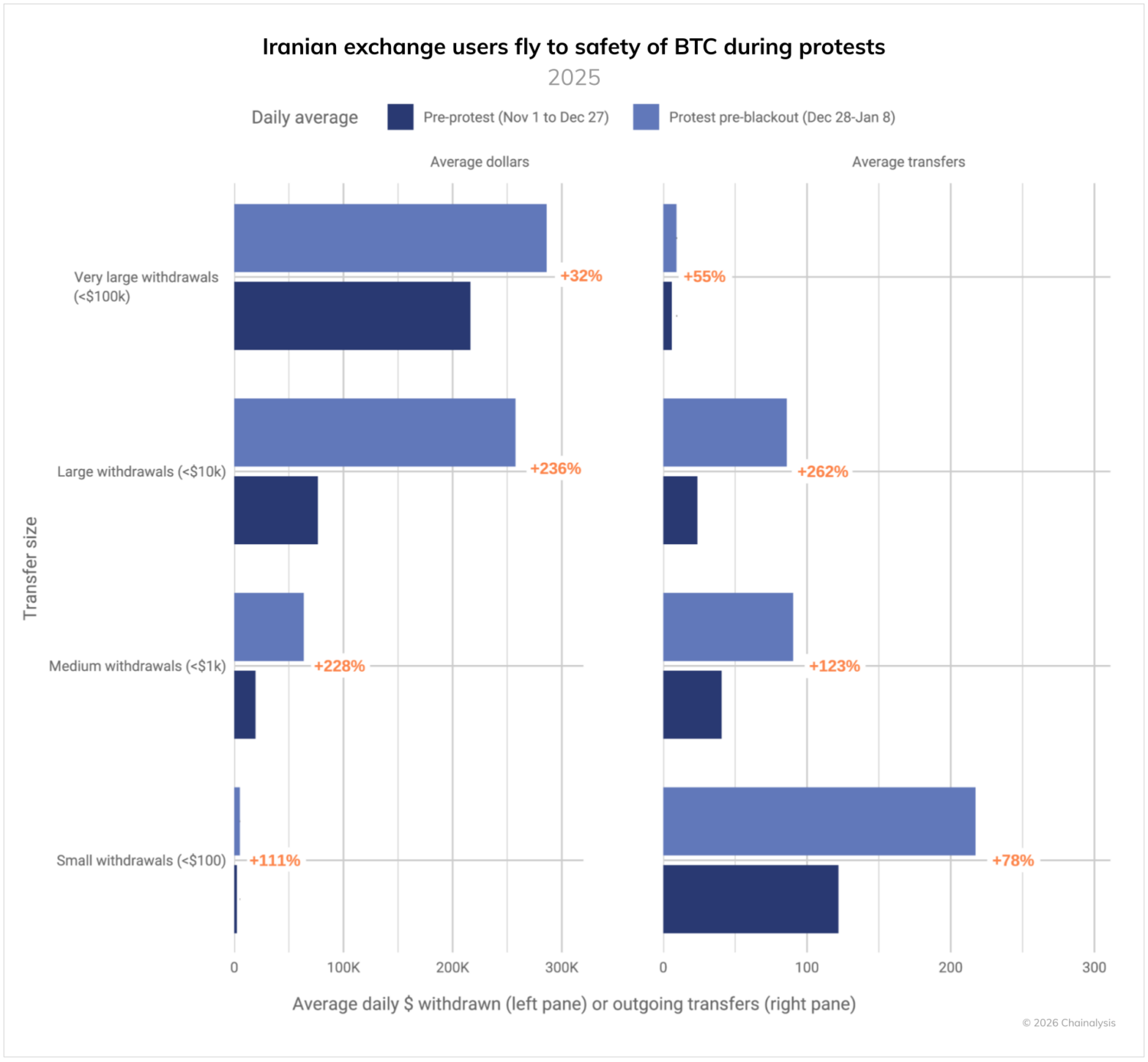
However, amid the escalating US-Iran war there has been significant spikes in Bitcoin withdrawals to self-custody wallets. Interestingly, onchain records showed that funds from Iranian exchanges, particularly Nobitex, flowed through major global blockchain ecosystems including BNB Chain and Tron.
Other Articles...


Thus, Iran’s crypto market though controlled domestically by four exchanges, but remains connected globally through a handful of blockchain ecosystems.

 Sneha Agrawal

Share