Key Highlights
Institutional prediction markets are becoming a more interesting tool for firms that need to understand what could happen next. Instead of relying only on economic forecasts, surveys, or research desks, institutions can look at a market where participants put money behind their views. Kalshi case study is one example of how this model is moving into a more regulated and institutional setting.
Financial markets already give investors live prices for stocks, bonds, commodities, and other assets. Future events are different. There may be plenty of forecasts around a Federal Reserve decision, inflation reading, election, or regulatory outcome, but there is not always one price that shows how expectations are changing in real time.
Also Read: Crypto Market Review Q2 2026
This is where institutional prediction markets come in.
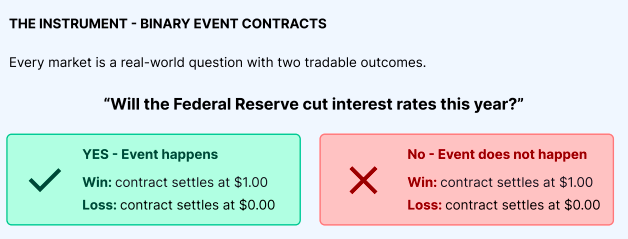
A prediction market turns a question about a future event into a tradeable contract. On Kalshi, for example, a Yes/No contract can trade between 1 and 99 cents. If a contract trades at 60 cents, the market is effectively putting the probability of that outcome at about 60%. The price can then move as new information reaches traders.
That gives institutions something traditional forecasting can struggle to provide: a live market signal.
CoinGape’s Q1 2026 Crypto Market Report also highlighted the rapid growth of prediction markets, including Kalshi’s position in regulated market activity.
Investors are used to watching prices change throughout the day. Stocks, bonds, commodities, and other assets all reflect new information as it reaches the market.
Future events are harder to price. There may be hundreds of forecasts about a Federal Reserve decision, an inflation report, an election, or a regulatory change. What is often missing is a single market price that shows how those expectations are shifting from one moment to the next.
That is one reason institutional prediction markets are attracting interest.
A prediction market turns a future event into a contract that people can trade. On Kalshi, for example, Yes/No contracts can trade between 1 and 99 cents. A contract priced at 60 cents suggests that traders see roughly a 60% chance of the outcome occurring. If new information changes that view, the price can move.
For an institution, that creates a live signal that can be watched alongside other market data.
Regulation is one reason prediction markets are getting more attention from professional investors.
Regulated prediction markets operate under rules that cover how contracts are offered, traded, monitored, and settled. Kalshi, for example, is regulated by the U.S. Commodity Futures Trading Commission (CFTC). That puts its event contracts in a different category from markets operating without comparable regulatory oversight.
For a hedge fund or asset manager, that difference is important. Before using a market, an institution has to look beyond the information it provides. It also needs to understand who oversees the market, how trades are handled, how contracts are settled, and what rules apply to participants.
That makes regulation part of the practical evaluation process. A firm can consider a regulated prediction market alongside other trading and research tools rather than treating it simply as a source of forecasts.
Kalshi’s own growth shows where this is heading. According to the case study, institutional trading volume increased 800% in six months. The company has also been pursuing hedge funds and asset managers as it expands its institutional business.
CoinGape has also covered the regulatory questions surrounding the sector, including Kalshi’s prediction-market regulatory cases. The legal environment remains an important consideration as these markets expand.
Event contracts for institutional investors offer a fairly direct way to trade a view about a specific outcome.
Instead of buying a stock or another asset that may be affected by an event, a trader can take a position on the event itself. For example, an investor following an economic release may want exposure to the outcome rather than to the wider movement of financial markets.
The price of the contract can also provide useful information. If traders change their positions as new data comes in, the market price changes with them. That gives investors a live indication of how expectations are moving.
These contracts are not a substitute for institutional research. They can, however, sit alongside it. Research may explain why an outcome could happen, while the market shows how other participants are pricing that possibility.
Kalshi’s event contracts give users the ability to trade based on their opinions about a specific yes-or-no question.
An institutional trading platform has to work at a level that professional investors can actually use. Liquidity matters. So do market depth, execution, fees, regulation, and access.
Kalshi has been broadening the range of markets available on its platform. Its coverage now stretches across areas such as economics, politics, sports, weather, finance, and culture. The company has also moved into crypto perpetual futures, taking the business beyond traditional event contracts.
That expansion changes how the platform can be viewed. It is no longer just a place to make a prediction about one future event. With more products and more participants, it starts to look more like a broader trading venue where investors can take positions on different outcomes.
CoinGape has followed this expansion through coverage of Kalshi’s AI agent and growing trading activity, as well as its broader prediction-market coverage.
There is no universal answer. The best prediction market platform will depend on what an institution wants to trade and the requirements it has for using the venue.
Regulatory status is one consideration. Liquidity, fees, market coverage, available contracts, and access are others. An institution may also have its own rules around counterparties, risk, and execution that affect the decision.
Kalshi has an advantage in the case study because of its CFTC-regulated structure, growing liquidity, wide range of markets, and focus on institutional participation. The study gives it a composite Market Impact Score of 8.9 out of 10, with particularly strong marks for regulatory standing and liquidity.
Firms also need to consider the risks and compliance requirements that come with event contracts. The CFTC has issued an advisory concerning misuse of nonpublic information and fraud involving prediction markets, including KalshiEX.
That does not mean every institution will reach the same conclusion. Firms still have to decide whether the available markets, trading conditions, and regulatory framework fit their needs.
Also visit: Bitget Case Study: How Bitget IPO Prime Is Bridging Private Markets and Digital Assets
What is becoming harder to ignore is the idea behind the market itself. Prediction markets for financial institutions turn expectations about future events into prices that can change as new information arrives. As more professional money enters the space, those prices could become another piece of information for investors to watch.
Frequently Asked Questions
How do prediction markets work for institutional investors?
What is the best prediction market platform for institutions?
How do prediction markets help financial forecasting?
What are regulated prediction markets?
How can hedge funds use prediction markets?
Download the complete report for free.

 Jane Lubale




Share