Key Highlights
Binance:- These are contrasting times for the crypto industry.
On one hand, markets continue to grapple with geopolitical uncertainty and trade in red. Yet on the other, none of it appears to be slowing crypto’s institutionalisation. If anything, Wall Street is moving in harder than ever.
From the world’s biggest asset managers to banking giants and traditional brokerages, the race to build digital asset businesses has accelerated. Few companies sit closer to that transition than Binance.
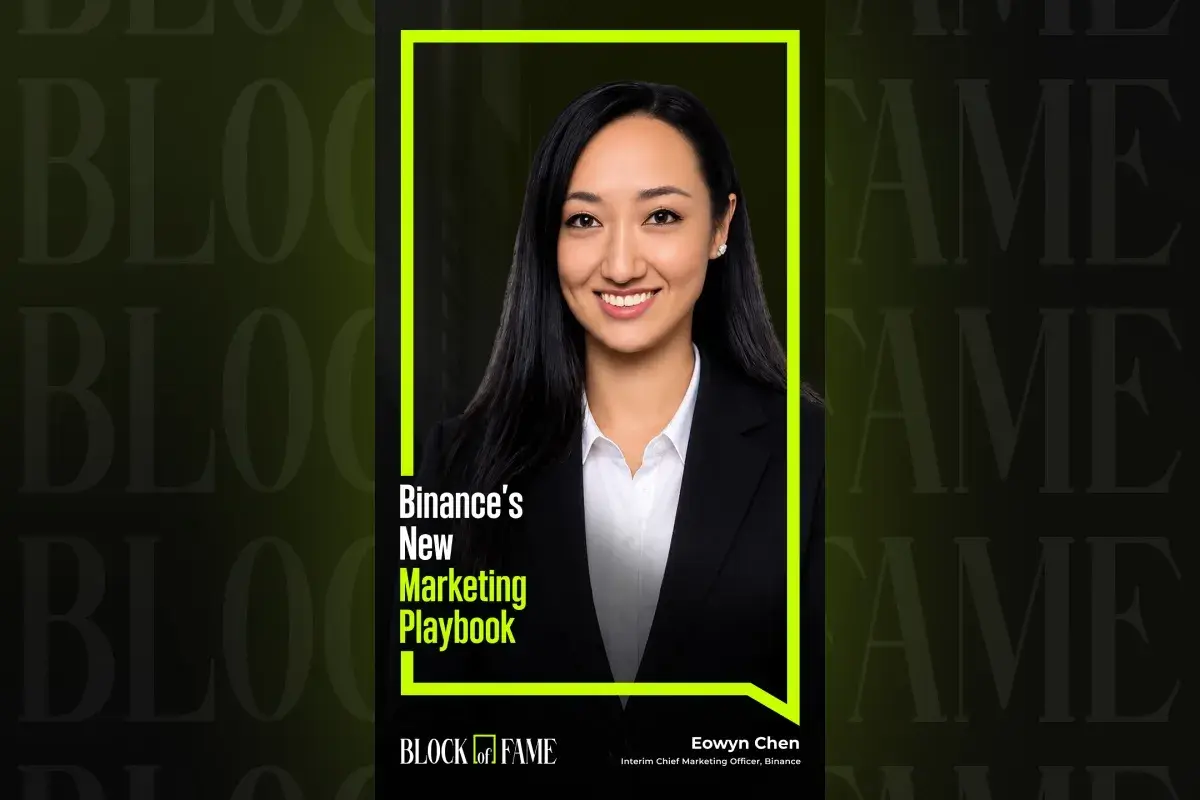
Following a major leadership reshuffle last month that saw its long-time Chief Marketing Officer Rachel Conlan step down, the world’s largest crypto exchange appointed long-time executive Eowyn Chen as its Interim CMO.
In an exclusive conversation with Block of Fame, Chen shares her priorities, her views agentic era, crypto-tradfi convergence and why she believes crypto marketing’s next job isn’t about creating hype anymore.
At a time when Binance itself is evolving from a crypto exchange into a broader financial platform, Chen is now tasked with shaping how that story is told.
Beyond spot trading, Binance now offers stock trading, pre-IPO perps trading, allows payments to yield products, wallets, and institutional services. For Chen, that shift becomes her first priority upon returning to Binance.
“My first strategic priority is clear: to help elevate Binance into the financial platform of the next era – one that gives people more access, more protection, and more power in their hands.
Binance’s next chapter will not be won by hype. It will be about making tech-powered finance safe, useful, and simple enough for everyday life.
Binance already serves more than 320 million users, but what matters isn’t the number itself. It highlights a much larger opportunity: billions of people still lack access to financial services that are fast, affordable, reliable, and built for how they actually live.
Access means someone should be able to reach real financial opportunity – U.S. stocks, gold, crypto, stablecoins, and payments -from one account, wherever they are, even with five dollars.
Protection means that access comes with safeguards built in, not bolted on. And power means giving people the tools and intelligence to understand risk and decide for themselves.
That’s the difference between building another crypto app and helping build the financial platform for the next era of money.”
As the industry matures, crypto marketing has undergone its own transformation.
Chen believes the role of a CMO today is less about creating excitement. It is more about helping people understand an entirely new financial system.
“Crypto marketing has to borrow from the logic of crypto itself: trust is earned through transparency, participation, and community – not through broadcast.
Other Articles...
As the industry becomes more institutional, we have to preserve the authenticity of community-led marketing while building the clarity and confidence institutions expect.
Over the next few years, marketing will be less about driving hype and more about building understanding—helping users navigate new products, understand risks, and make informed decisions.
The biggest job for marketers isn’t defending crypto. It’s creating the language that helps people understand this next era of finance.”
Despite its scale, Chen believes Binance continues to be viewed through the lens of its early years. She argues that one of the biggest misconceptions is that Binance is simply a crypto exchange driven by market cycles. Instead, she says the company has evolved into a broader financial platform.
“We are not trying to become a bank, a broker, or a generic fintech super app. Binance is helping build the financial platform for the next era of money.”
“Crypto is already helping people preserve value, move money across borders, access global markets, and participate in financial systems that were previously unavailable to them.”
Interestingly, web3’s evolution is unfolding against one of the most uncertain macroeconomic environments in recent history. With Bitcoin price at its lows for months and DATs selling their assets, there are few challenging the foundations of web3.
However, for Chen, those challenges are not slowing crypto adoption – they are reinforcing its relevance.
“The crypto industry has always been anti-fragile since the publication of the Bitcoin whitepaper in 2008, an extremely turbulent year both politically and economically.
Today, the industry is at another inflection point. It is moving from a niche alternative asset class to becoming the next generation of financial infrastructure.
What’s interesting is that institutional adoption and grassroots utility are converging toward the same outcome. Both point to one underlying need: stable, transparent, cross-border financial services.
Institutions increasingly view Bitcoin and Ethereum as portfolio diversification tools, while in emerging markets, stablecoins have become practical solutions for preserving value, receiving cross-border payments, and accessing global markets.
Whether it’s an individual seeking financial stability or an institution pursuing diversification, the underlying need is the same. The more uncertain the world becomes, the more options people need.”
Perhaps the most significant shift underway is the convergence of blockchain infrastructure with traditional finance. Tokenized Treasury products, on-chain money market funds, and tokenized equities are rapidly blurring the line between the two industries.
Rather than viewing crypto as a replacement for conventional finance, Chen sees the future as one where both systems complement each other.
“Binance’s role is to connect both ends of that spectrum through products that are simple, secure, and accessible.
The next era isn’t crypto replacing traditional finance, or traditional finance absorbing crypto. It’s the two merging and evolving—the openness and speed of blockchain with the asset depth and credibility of traditional markets.
That’s why we’ve introduced tokenized U.S. stocks while continuing to expand blockchain-based payment capabilities.
The goal is to enable people to move easily across asset classes and between traditional investing and on-chain finance. That’s what an open, always-on financial platform should do.”
It’s the era of agentic AI in crypto with agentic payments volume surpassing $100 million and growing beyond just $1 transactions.
But Chen believes AI’s greatest contribution won’t simply be automation. It will be empowering users while strengthening the infrastructure behind the scenes.
“I think about AI in two ways.
The first is what AI does for users. It can help everyday people understand risk, compare opportunities, and make better-informed decisions. But AI supports users—it doesn’t replace them.
The second is what AI does for platforms. Security, compliance, and fraud in the AI era require entirely new approaches.
Blockchain reinvented finance’s rails and settlement. AI is now reinventing its intelligence, defense, and control layer.
Ultimately, the goal is to make crypto feel less like something people have to study and more like something that simply works.”
With Binance entering its next phase, Chen says success will no longer be measured solely by trading volumes or user growth.
Instead, she believes the company’s real progress should be reflected in how effectively it improves people’s financial lives.
“User growth matters, but it cannot be the only measure.
I want to move beyond growth numbers to signals of genuine understanding and trust—easier onboarding, better product comprehension, lower friction, and stronger user confidence.”

 Sneha Agrawal
 More Stories






Share