


If there is one trend in crypto that has gained near-universal acceptance, it is the rapid rise of tokenization. More than $33 billion worth of real-world assets (RWAs) have already moved onto blockchain. These assets range from U.S. Treasuries and commodities to stocks, private credit, and real estate.
Yet amid the excitement around tokenized Treasuries, stocks and private credit, one asset class is quietly emerging as the next major growth engine. That is the tokenized money market funds (MMFs).
While they may not generate the same headlines as Bitcoin or stablecoins, tokenized MMFs combine the stability and yield of traditional money market funds with the speed, programmability, and 24/7 settlement of blockchain infrastructure.
According to a new report from Global Digital Finance (GDF) and the International Swaps and Derivatives Association (ISDA), the next breakthrough may come from these traditional finance’s oldest products. The money market funds. Here’s how
The report identified that out of over 5k institutions, there are two-thirds of institutions planning launches by 2027 and nearly half preparing to accept them as collateral.
Where do Tokenized Money Market Funds Stand Today
The report finds that 66% of surveyed financial institutions plan to launch tokenized money market funds (TMMFs) before the end of 2027, highlighting rapidly growing institutional confidence in blockchain-based cash management products.
More importantly, 44% of respondents expect to accept tokenized money market funds as eligible collateral. This signals that institutions are preparing to integrate these products into mainstream financial infrastructure rather than treating them as experimental digital assets.
The findings comes as onstitutional interest in tokenized money market funds is already translating into real assets.
According to the report, tokenized assets under management have reached approximately $8.4 billion as of May 2026, nearly tripling compared with 2024.
Further, according to RWA.xyz, tokenized Treasury and money market products now collectively manage well over $15 billion in on-chain assets. This makes them one of the fastest-growing segments of the real-world asset ecosystem. Hashnote’s USYC remains the market leader with roughly $3 billion in assets, followed closely by BlackRock’s BUIDL at nearly $2.9 billion. Franklin Templeton’s BENJI has crossed the $1 billion mark, while Ondo Finance’s Treasury products continue to attract institutional capital.
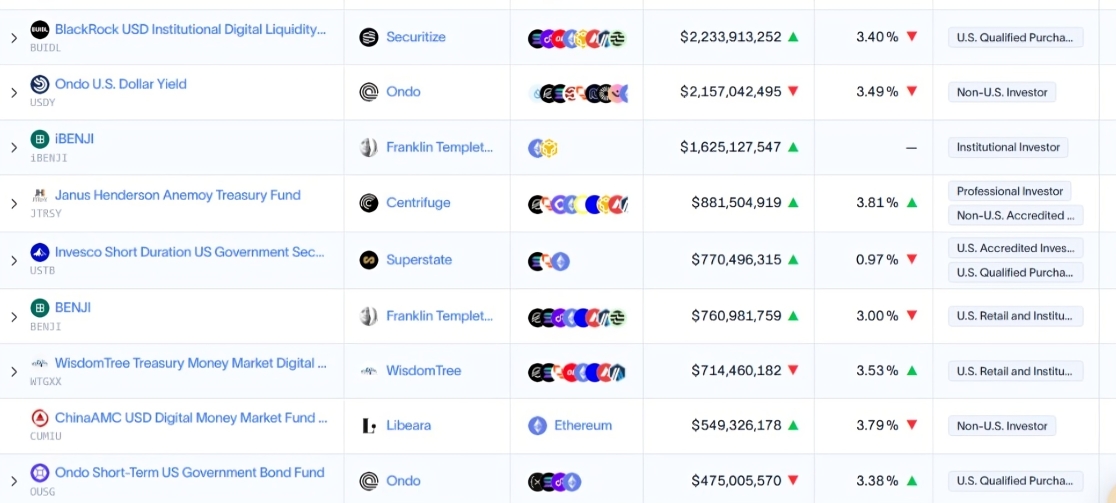
Much of that growth has come from tokenized U.S. Treasury and money market fund products launched by leading asset managers.
The momentum has accelerated further in recent weeks. Last month, J.P. Morgan Asset Management launched its OnChain Liquidity-Token Money Market Fund (JLTXX). This adds to JSTRY, although both remain significantly smaller than the market leaders as they continue building institutional adoption.
Yet the report argues that the opportunity extends far beyond today’s market size.
What’s the Next $1.6 Trillion Opportunity in Tokenization
Rather than focusing on investment returns, the report frames tokenized money market funds as a solution to one of Wall Street’s biggest operational challenges. That is collateral mobility.
Financial institutions posted or received approximately $1.6 trillion in non-cleared initial and variation margin at the end of 2025.
Every day, banks, asset managers and clearing participants move enormous volumes of collateral to support derivatives, securities financing and other capital market transactions.
Other Articles...


However, current processes remain heavily dependent on manual reconciliation, fragmented systems and settlement delays. This is particularly during periods of market stress.
“The right collateral has to be in the right place at the right time,” the report notes. It argues that operational friction often creates unnecessary liquidity pressures across financial markets.
Unlike many industry white papers, the GDF–ISDA study extends beyond theory.
The working group conducted practical simulations involving major financial institutions to examine how tokenized money market funds could function across real collateral workflows. These include repo transactions, margin calls, collateral substitution and default scenarios.
The exercises demonstrated that tokenized funds can integrate with existing institutional processes. They don’t require financial markets to rebuild their infrastructure from scratch.
Tokenized money market funds could significantly improve that process by allowing institutions to move collateral more quickly and efficiently across counterparties.
However, one of the report’s most revealing findings is that only 33% of surveyed firms believe existing money market fund processes are efficient.
That suggests nearly two-thirds of institutions see significant room for operational improvement.
Thus, even though there are an emerging trillion dollar opportunity, Operational Problems do exist for institutions to solve and adopt.

 Sneha Agrawal

Share