


Prediction markets today are handling billions of trades across everything from sports and elections to commodities and macroeconomic events. But as this market grows, another challenge is becoming impossible to ignore. That is the infrastructure powering these markets is struggling to keep pace.
But now prediction markets are trusting a startup to power that.
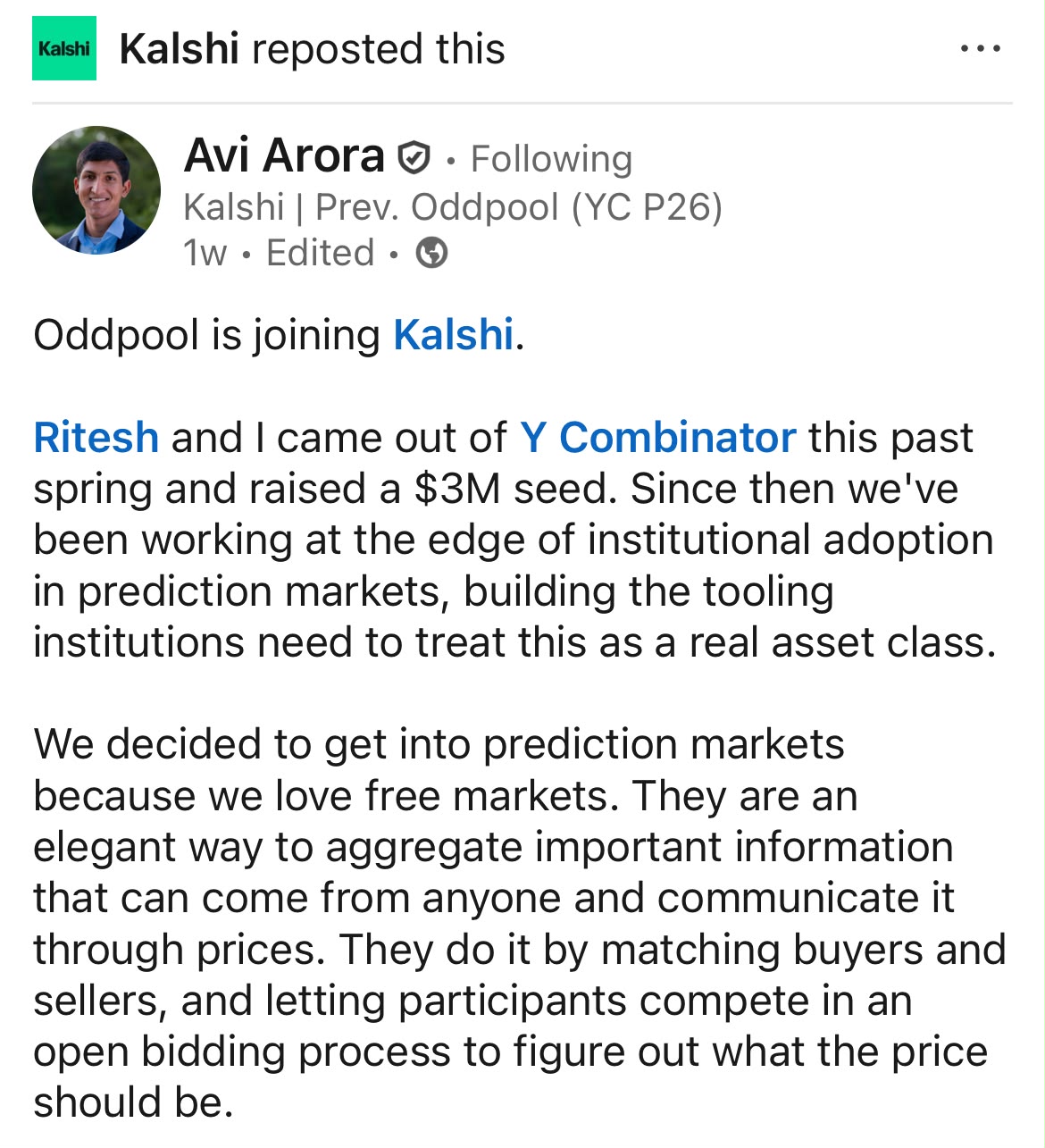
This comes as the Y Combinator-backed startup, founded by Avi Arora and Ritesh Malpani, has announced joining Kalshi just months after coming out of Y Combinator and raising a $3 million seed round. The founders had been building the tools institutions need to treat prediction markets as a serious financial asset class.
Now, they are taking that work inside Kalshi.
What Oddpool has actually built
In simple terms, Oddpool helps make prediction-market data usable for professional traders.
A trader might see a simple yes-or-no contract on Kalshi. Behind that contract, however, are orders, trades, price changes and market-depth data constantly moving in the background.
For a professional trading desk, simply seeing the current price is not enough.
They need historical data to test strategies. They need order-book information to understand how a market behaved. And if they are trading across multiple prediction markets, they need to know when two differently named contracts are actually referring to the same underlying event.
Oddpool, as per its founders and official website, is built to solve those problems.
The company says prediction markets suffer from three major issues. These are ragmentation between venues, a lack of tick-level historical data and the amount of time traders have to spend cleaning and normalizing data.
Its platform creates a common identifier for markets across venues. It provides tick-level history, full order-book depth, trades and market changes so institutions can backtest and analyze prediction-market strategies.
That is essentially the plumbing that sits underneath the trading screen.
Why Oddpool is joining Kalshi
So why would a startup that had just raised $3 million decide to join another company?
The answer comes directly from the founders.
Arora said Oddpool had been working “at the edge of institutional adoption” in prediction markets, building the tooling institutions need to treat the market as a real asset class.
But after working with Kalshi, the founders decided they could build more by becoming part of the platform rather than remaining an outside infrastructure provider.
Other Articles...

“We got incredibly excited about what we could build from within the ecosystem rather than a partner from the outside,” Arora said in announcing the move.
That makes the move important for both sides.
Oddpool gets direct access to one of the biggest prediction-market platforms in the world. Kalshi gets a team that already understands the data problems institutional traders face.
And the timing is hard to ignore.Kalshi’s market is getting bigger. Kalshi is moving far beyond the election and sports contracts that helped make prediction markets popular.
Just last week, Coingape reported that Kalshi was preparing to file for approval of a perpetual WTI crude oil contract. It has also filed proposals covering perpetual contracts tied to equity indexes, metals, foreign exchange and interest rates.
The two founders of Oddpool also bring traditional financial-market experience to the startup.
Ritesh Malpani previously worked at Bloomberg. Y Combinator says he made buy-side trading systems 40% faster and has architected systems capable of processing more than 100,000 transactions per second across trading infrastructure.
Avi Arora previously worked as a machine-learning researcher at Microsoft. YC says he built a model that saved Microsoft $6 million a year while using half the hardware.
The founders say they actually started trading prediction markets themselves and quickly ran into the infrastructure problem.

 Sneha Agrawal

Share