


The past 48 hours have been tough for Polymarket traders.
The exchange’s CLOB has faced multiple outages within just 24 hours. Trading was temporarily halted for many a times as the team worked to resolve recurring issues.
The latest disruption has been linked to delayed responses when users tried to read unfilled orders. Polymarket moved the exchange into cancel-only mode while the team worked on a fix, leaving traders unable to place new orders.
The repeated failures have now triggered a much bigger response from Polymarket’s engineering team.
Polymarket VP of Engineering for DeFi Josh Stevens said the company will rebuild its CLOB from the ground up in Rust, after concluding that the existing codebase cannot be fixed sustainably.
Polymarket to Rewrite its CLOB from Scratch in Rust
Stevens was unusually blunt about the current infrastructure, calling it “full of tech debt” and saying the codebase “can’t be saved long-term.”
The team has already scaled the existing system 10x and made it 3x faster, according to Stevens. But the underlying architecture remains the bigger problem.
“You try to fix one thing, and another thing goes wrong,” he said.
That has pushed Polymarket toward a full rewrite rather than another round of incremental fixes.
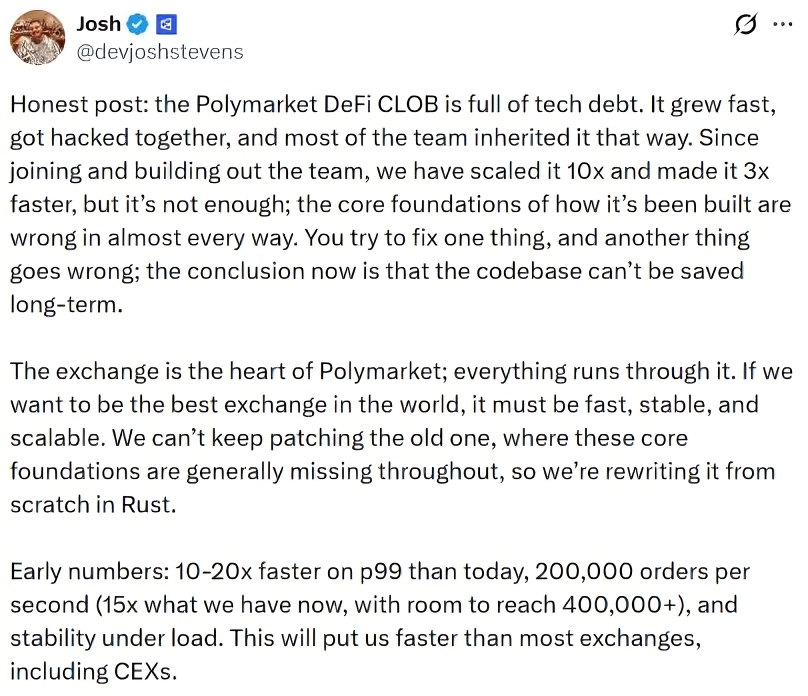
Polymarket is targeting 200,000 orders per second, around 15x its current throughput. The architecture is supposed to be eventually capable of reaching 400,000+ orders per second. The team is also seeing 10–20x faster p99 latency in early testing.
That p99 number matters because Polymarket isn’t just looking to increase raw throughput. It wants to reduce the unpredictable latency spikes that can emerge when the system is under load.
Stevens said the goal is to make the new exchange faster than most exchanges, including some CEXs.
The rewrite is also about making the exchange more predictable under heavy trading activity. Rust provides memory safety without a garbage collector, meaning the system does not have to periodically pause for garbage collection.
For a trading engine, that can help avoid unpredictable latency spikes. Its ownership and concurrency model also prevents certain classes of data races and memory-corruption bugs at compile time.
When will Polymarket New CLOB be Live
Polymarket isn’t planning to switch everything over immediately.
The company will continue operating and improving the existing CLOB while the new Rust-based exchange is developed side by side.
Other Articles...


Stevens said Polymarket is targeting Q4 2026, around the middle to end of the quarter, for the new exchange. For integrators, breaking changes are expected to be minimal and will be communicated ahead of time.
The timing makes the rebuild more urgent.
The recent outages have put the Polymarket which is among the best prediction markets, CLOB’s reliability issue directly in front of traders.

And for Polymarket, this isn’t an infrastructure problem sitting somewhere in the background. The CLOB is the core trading layer through which the platform’s markets operate.
Every additional outage means more than a website going offline. It can prevent traders from entering positions, updating orders or responding to rapidly changing market prices.
That makes Stevens’ announcement particularly significant.
Polymarket isn’t promising another patch. It is effectively saying that the current foundation isn’t good enough for the exchange it wants to become.
And Stevens made the stakes clear: “This is people’s money, not a joke.”
For now, the existing CLOB stays online. But Polymarket is betting that the next version of its exchange needs to be fundamentally different/ It is going to be more faster, more predictable and capable of scaling far beyond today’s trading load.

 Sneha Agrawal

Share