
ByCoinGape

Zand:- With the global stablecoin supply crossing $300 billion, nations are increasingly recognizing that they can no longer rely solely on USD-denominated stablecoins to serve their digital economies.
Across Asia, governments and banks are announcing efforts to issue their own currency-backed stablecoins. This is spreading from South Korea’s push for a won-based token to Japan’s launching its yen-denominated stablecoin, with discussions in other regional markets too.
Amid this, the middle eastern country of UAE has also joined the race. Zand, the Abu Dhabi-based digital bank, has launched Zand AED, the country’s first regulated stablecoin. This is a move that puts the UAE firmly into the fast-growing race among Asian and Middle Eastern economies to bring their national currencies onto public blockchains.
We are proud to announce that Zand has received final approval from the Central Bank of the UAE to launch the nation’s first regulated, multi-chain AED-backed stablecoin on public blockchains.
Fully backed 1:1 by AED reserves, transparently audited, and issued across multiple… pic.twitter.com/QCgObTdtuK
— Zand (@Official_Zand) November 17, 2025
Also Read: Stripe is Building a New Prototype for Stablecoin
The Central Bank of the UAE has granted Zand the regulatory approval for the issuance. This makes Zand AED the first officially sanctioned dirham-pegged stablecoin to be deployed by a regulated bank in the Emirates
However, to launch a stablecoin in UAE, the country’s central bank rules require fiat-pegged stablecoins to be fully backed or meet strict high-quality reserve rules. Accordingly, Zand AED is fully backed 1:1 by AED reserves, transparently audited, and issued across multiple public blockchains.
Interestingly, Zand’s approval follows earlier expressions of interest in a dirham stablecoin – most notably Tether’s announcement in 2024 that it intended to issue an AED-backed token. However, Zand’s stablecoin is the first to receive direct Central Bank authorization.
This development comes alongside Zand’s expanding role in blockchain-based payments. The bank recently partnered with Ripple, building on Ripple’s Dubai regulatory license, to integrate blockchain-enabled payments for Zand Bank and Mamo.
Also Read: Consensys and Eigen Launch Decentralized Solution for Web3
As more nations accelerate efforts to issue stablecoins backed by their own national currencies, a new regulatory challenge is emerging: stablecoin compliance fragmentation.
Across jurisdictions – from the EU’s MiCA framework to the U.S.’s evolving GENIUS rules – stablecoins must meet different legal, custody, transparency, and reserve requirements. This means that a stablecoin compliant in one jurisdiction may not be compliant in another.
A MiCA-compliant euro stablecoin may not meet the requirements of U.S. regulators. A U.S.-regulated USDT or USDC may not automatically qualify for use under the EU’s MiCA regime.
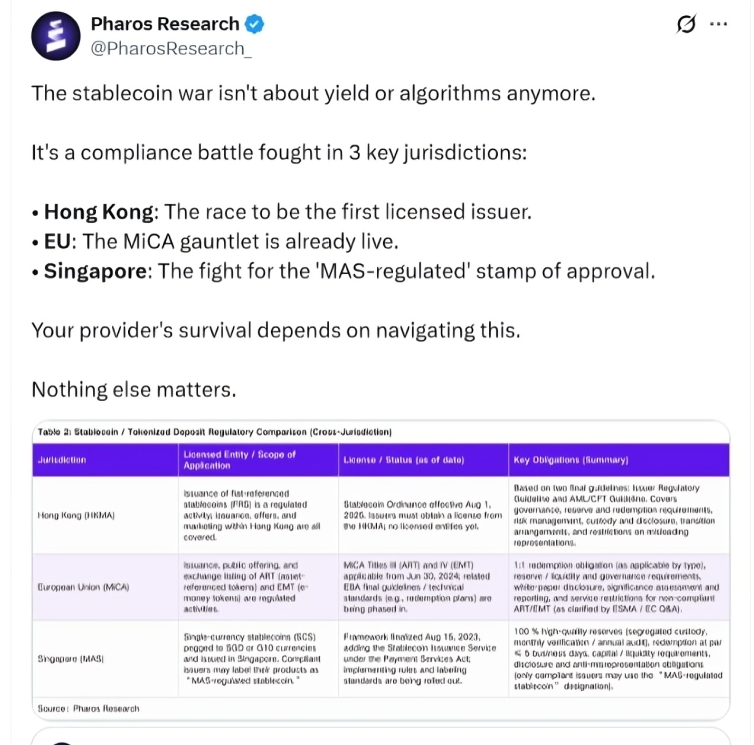
This regulatory divergence is creating a world where stablecoins are becoming geographically siloed. Compliant in one region but restricted in another.
Thus, as more countries push for their own sovereign-currency stablecoins, there are interoperability and compliance conflicts that require solutions.
Also Read: Inside Grayscale’s Solana ETF Strategy

 Sneha Agrawal
 More Stories
GUIDE





Share