

Mastercard is finally putting its $1.8 billion BVNK acquisition to work. It has launched a global money platform that brings traditional currencies and stablecoins together as it looks to expand its presence in blockchain-based payments.
Announced on October 15, the Mastercard Global Money Platform marks the first major product integration since Mastercard completed its acquisition of BVNK in August 2026. The platform will allow banks, fintechs and businesses to hold, convert and move fiat currencies and stablecoins through a single application programming interface (API).
Mastercard this year beat Coinbase to acquire BVNK for up to $1.8 billion, including $300 million in contingent payments. The deal aimed at strengthening Mastercard’s ability to connect traditional payment networks with blockchain-based financial infrastructure.
Mastercard expands stablecoin payment services
Under Mastercard’s new platform, businesses can manage multi-currency accounts, convert between fiat currencies and stablecoins, issue stablecoin-linked cards and make payouts to local bank accounts. They can also use the infrastructure to manage their own treasury, payments and settlement operations.
The platform integrates Mastercard Move, the company’s money movement service, which reaches more than 17 billion endpoints. Mastercard expects stablecoin-funded payouts to expand to more than 40 currencies across over 200 countries and territories in 2027.
As per its official docs, Customers will also be able to spend stablecoin balances and earn rewards on them across Mastercard’s network of hundreds of millions of merchant locations. The card issuance service will also be available in more than 130 countries.
In an early traction, Payments company Nuvei and card-issuing platform Marqeta are among the first companies expected to integrate the platform, alongside Ontop, Bolt Group and Almond FinTech.
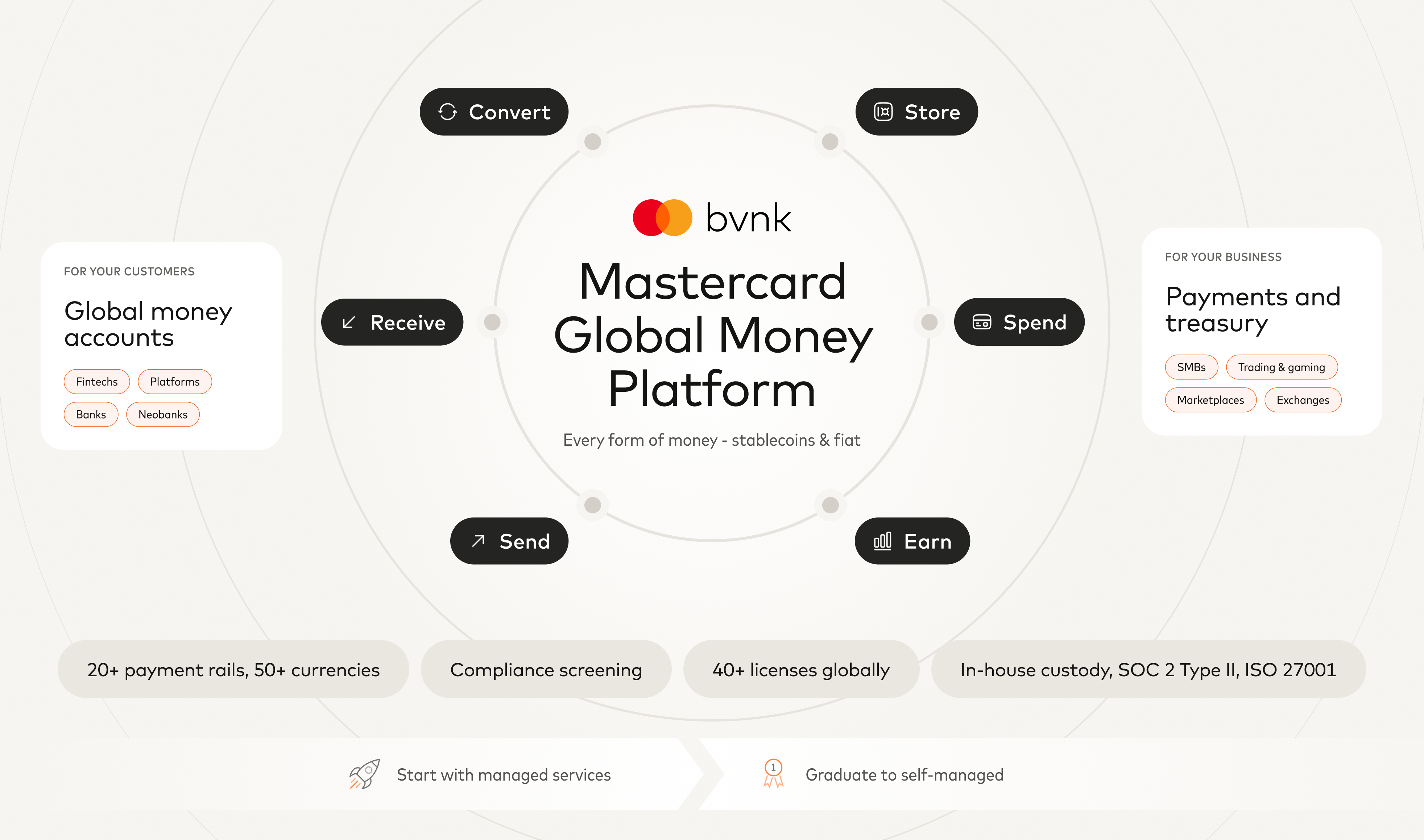
The platform will help businesses add services as needed rather than integrate separate providers for accounts, currency conversion, payments and payouts. It is paeticularly targeted for groups like Fintechs and neobanks, big tech, International banks, US banks, SMBs and enterprises, Digital asset firms and platforms among others.
For companies operating across markets, this could make it easier to manage money received in different currencies and pay suppliers internationally. It can help in reducing the need to maintain separate payment arrangements across multiple providers.
BVNK deal expands Mastercard’s digital money strategy
Mastercard completed its acquisition of BVNK on August 3, 2026, following its announcement of the deal in March. The acquisition gives Mastercard access to BVNK’s stablecoin infrastructure as it looks to connect traditional financial services with blockchain-based payments.
The Global Money Platform brings those capabilities together in one offering. It will allow businesses to move between fiat currencies and stablecoins through a single integration.
Mastercard is also preparing to support additional forms of digital money, including tokenized deposits, as well as future applications in agentic commerce.
The platform is available now through BVNK, according to Mastercard’s announcement.
The launch also comes as Mastercard faces growing competition from Visa and traditional banks seeking to expand their digital asset offerings.
Visa launched its own stablecoin platform in July 2026, allowing financial institutions, fintechs and payment providers to manage stablecoin operations through a single environment. On October 15, the company also announced that stablecoin-powered funding and cross-border money movement through Visa Direct were moving into commercial deployment.
Other Articles...

Banks are also expanding their presence in the market. Standard Chartered launched a cryptocurrency trading service for eligible affluent clients in the UAE on October 14. It will allow them to buy and sell Bitcoin and Ether through their existing bank accounts.
Thus, the move shows that traditional financial institutions are now competing against one another to bring digital assets into mainstream financial services.

 Sneha Agrawal

Share