


Polygon:- Zero-Knowledge Proofs (ZKPs) have been established as a frontier for both scaling and maintaining privacy on blockchains in web3. Ethereum co-founder Vitalik Buterin has called ZKPs as “perhaps the most powerful cryptographic technology to come out of the last decade.”
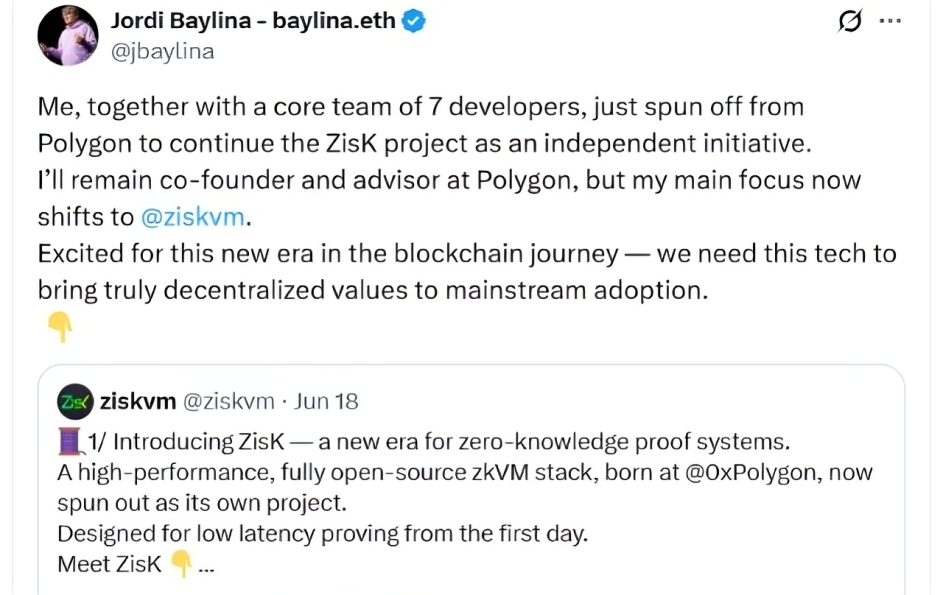
In a significant move to accelerate the development of Zero-Knowledge Proofs and zkVM stack, Polygon co-founder Jordi Baylina has announced a major “spun off from Polygon”. Now, the core team of 7 developers will separately run the entity called Zisk as an independent project.
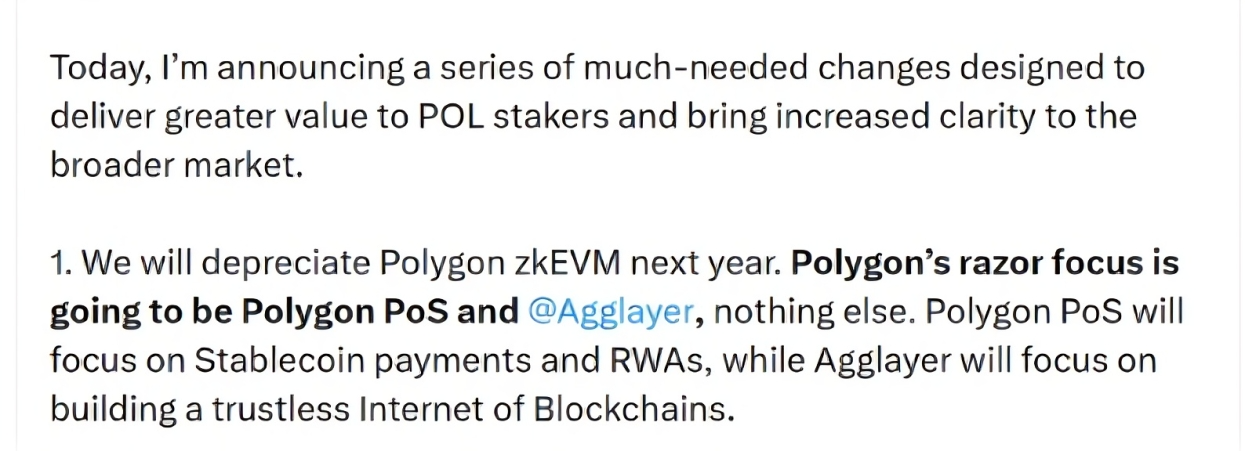
Interestingly, the announcement comes after the co-founder Sandeep Nailwal – who recently took up the role of CEO – said that the blockchain network “will depreciate Polygon zkEVM next year.” The only focus, according to Sandeep, are two things: Polygon PoS and Agglayer.
Polygon Co-founder’s New zkEVM Venture, Zisk
The new independent entity Zisk was initially incubated at Polygon Labs in May 2024. After the June 18 announcement by Jordi Baylina, its IP and the codebase have been transferred to a company owned by Baylina himself – SilentSig Switzerland GmbH, a Swiss entity.
Zisk is an open-source zero-knowledge proving toolstack that features a zkVM or the Zero‑Knowledge Ethereum Virtual Machine.
As a layer‑2 scaling solution, zkVM combines EVM compatibility with zero‑knowledge proofs to offer both scalability and security for Ethereum smart contracts. A zkEVM can execute exactly the same byte code as Ethereum’s mainnet. After batching many transactions off‑chain, the zkEVM generates a succinct cryptographic proof that attests to the correctness of all state transitions.
This proof is then posted on Ethereum, and on‑chain verification finalizes those transactions in one go. With this, Baylina’s Zisk, written in high-level languages like Rust, aims to provide low-latency on Ethereum.
While making the announcement, Baylina also said that he would continue to serve as co-founder and advisor at Polygon besides keeping his focus on Zisk. As the co-founder, he holds a governance role as a multi‑sig key holder on the 13‑member Polygon Protocol Council.
Also Read: OKX Expands into Germany and Poland
Can the project survive with millions in losses?
Jordi Baylina has spun out ZisK but he has forked the same Hermez‑based codebase that Polygon had acquired in 2021 and rebranded as zkEVM. From there, ZisK has been refactoring and extending those foundations. These include rewriting key circuits, overhauling the prover architecture, and adding multi‑language support.
With the separate entity, he and his team are aiming to transform the once “quietly abandoned” Hermez code into a high‑performance, open‑source zkVM stack.
However, the entity which was till now “Polygon‑operated zkEVM” continues to face criticism for poor handling and looming losses.
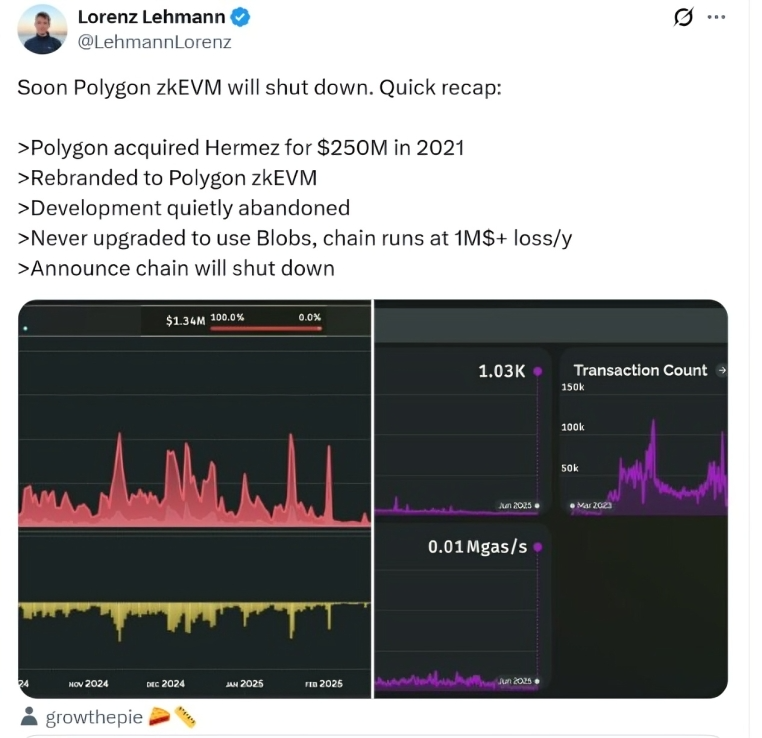
According to Lorenz Lehmann, researcher and founder of the student‑run RWTH Blockchain initiativ, Polygon’s zkEVM network continues to languish and incur over $1 million in operating losses each year.
He has called out Polygon’s prior acquisition of Hermez back in 2021 for a hefty $250 million. He explains that Polygon absorbed Hermez’s technology and rebranded it under the “zkEVM” banner, but then effectively let development stall.
Thus, the new entity’s survival depends on how well the upgrades and financial model is established.
Other Articles...


Also Read: Crypto’s First NeoBank Debuts

 Sneha Agrawal

Share