


Celo:- The voice for ensuring privacy on blockchains has never been louder as it is now. As crypto payments quietly expand across emerging markets and global remittance corridors, the need for privacy is becoming unavoidable.
Well, this is logical. A financial system that aims to compete with traditional payments cannot expose user balances, transaction histories, or behavioral patterns by default.
However, privacy on blockchains is not a new phenomenon. What is new, however, is how aggressively Layer 2 networks are now pushing zero-knowledge (ZK) technology beyond scaling and into real-world use cases – particularly payments.
This shift is pushing Ethereum L2s to rethink not just throughput and fees, but what user privacy should look like at scale.
Where Celo Fits In
Among these networks, Celo’s trajectory stands out. Founded in 2020, Celo has long positioned itself around mobile-first adoption and stablecoin payments.
Now, as Ethereum’s L2 ecosystem matures, the network is integrating ZK more deeply into its infrastructure to support payments at scale.
With its Jello hardfork activated today, Celo is transitioning to a ZK fault-proof rollup model using OP Succinct Lite. The move marks Celo’s evolution from being a fast, low-cost payments chain to one that can offer stronger cryptographic guarantees without sacrificing usability.
Rather than treating ZK as a niche privacy feature, the upgrade shows how zero-knowledge proofs may become foundational to everyday crypto payments.
But infrastructure alone doesn’t define success. The true test is adoption. This is where Celo’s payments ecosystem has quietly gained momentum too.
Also Read: Wallet in Telegram Enters Uzbekistan Market
Celo’s Bid to Make Crypto Payments Global ‘Privately’
MiniPay, a non-custodial stablecoin wallet built on Celo by Opera, has achieved extraordinary growth.
As of December 2025. over 11 million activated wallets, and more than 300 million stablecoin transactions processed since its launch in 2023.
These numbers – 11 M wallets, 300 M transactions – are not just milestones. They are evidence of demand for a payment alternative that is cheap, fast, and global. MiniPay’s typical transaction finalizes in about a second, and since 2025 the wallet has expanded reach to over 60 countries.
.@Celo just flipped every L2 in active users.
Daily Active Users – 743K
– More than Base
– More than Arbitrum
– More than every other L2 pic.twitter.com/6ydseiUMqIOther Articles...
— Immortal 💥 (@BitImmortal) December 6, 2025
Interestingly, at the just concluded Binance Blockchain Week 2025, Celo further deepened its partnership with browser‑software company Opera. Both announced a renewed commitment to bring stablecoin payments to “a billion people by 2030.”
This includes pushing stablecoin-backed payment cards, real-time merchant payments, and a joint global Mini App Roadshow across Asia and Latin America starting in 2026.
Also Read: Farcaster to Change Strategy for its Social Network
A Turning Point for Crypto Payments?
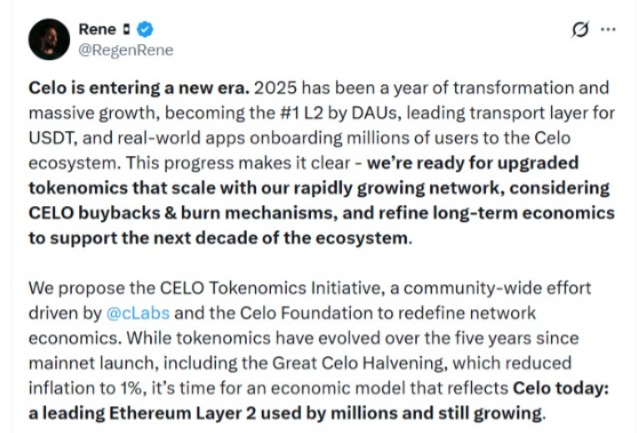
This technical shift comes alongside a broader transformation of the network. Celo co-founders Rene Reinsberg and Marek Olszewski recently outlined plans for a comprehensive overhaul of CELO tokenomics. This includes potential buybacks and burn mechanisms aimed at aligning network economics with rapidly growing onchain usage.
Together, these developments reflect a broader rethinking across Ethereum L2s. Instead of optimizing solely for decentralization and throughput, networks like Celo are prioritizing usability, accessibility, and privacy. This includes instant transfers, minimal fees, phone-number wallets, and stablecoins that integrate seamlessly into daily commerce.
For Celo, this may be the moment where infrastructure ambition finally meets real-world utility. But this is also where Ethereum L2s begin to prove that crypto payments can move from experimentation to everyday finance.
Also Read: New Staking Model Receives $5mn Funding

 Sneha Agrawal

Share