
CoinGape has been covering cryptocurrency and blockchain markets since 2017. Our editorial team evaluates projects and platforms using structured review frameworks focused on transparency, utility, and risk assessment. You can explore our review methodologies to see how we assess and rate different categories. We maintain clear editorial standards and disclose advertising or affiliate relationships where applicable.
The growth of crypto prop firms has made it possible for traders to access capital that would have otherwise required years to accumulate. However, such access involves a set of rules and pressures that depend largely on the funding structure in question.
There are two major funding structures in use now: Instant Funding and Evaluation Funding based on challenges.
At the outset, the answer to which one to use seems obvious. Instant funding gives traders easy access to funds, whereas challenge-based brokers allow traders to gain evaluation before accessing funds. However, the answer to which one to use can lead to losses of trading accounts, additional fees, traders’ emotional exhaustion, and stagnation, even for expert traders.
There is an in-depth analysis of both models here, comparing them based on fixed criteria and aiding in the selection of the correct format of the Forex strategy that suits the respective lifestyle of the traders.
Instant funding prop firms enable traders to get a funded account immediately upon payment of a large initial fee. Instant funding shifts risk asymmetrically toward the trader, which is why drawdown limits are often tighter and enforced in real time. It does not require an evaluation period, a profit goal to achieve, or a virtual time frame of trading.
After the trader buys an account, he or she commences to trade in live (or semi-live) capital immediately. The proportion of sharing profits is set, and there is a limit to the tragedies being incurred, in which a loss beyond the expected limits will lead to the termination of an account.

Instant funding is usually more expensive to implement initially than challenge-based models. Speed and convenience are a premium that is being paid by the traders. Fees depend on the size of accounts, sharing of profits, and drawdown and are usually not refundable.
This charge is also used to reimburse the company for the additional risk of providing traders with direct access to capital.
Instant funding, contrary to the name, is not something unlimited:
Such limitations are there to shield the prop company and their pooled funds.
The accounts of those traders who are not disciplined should be reset regularly. The discipline is encouraged by instant funding, but the impulsivity is severely punished.

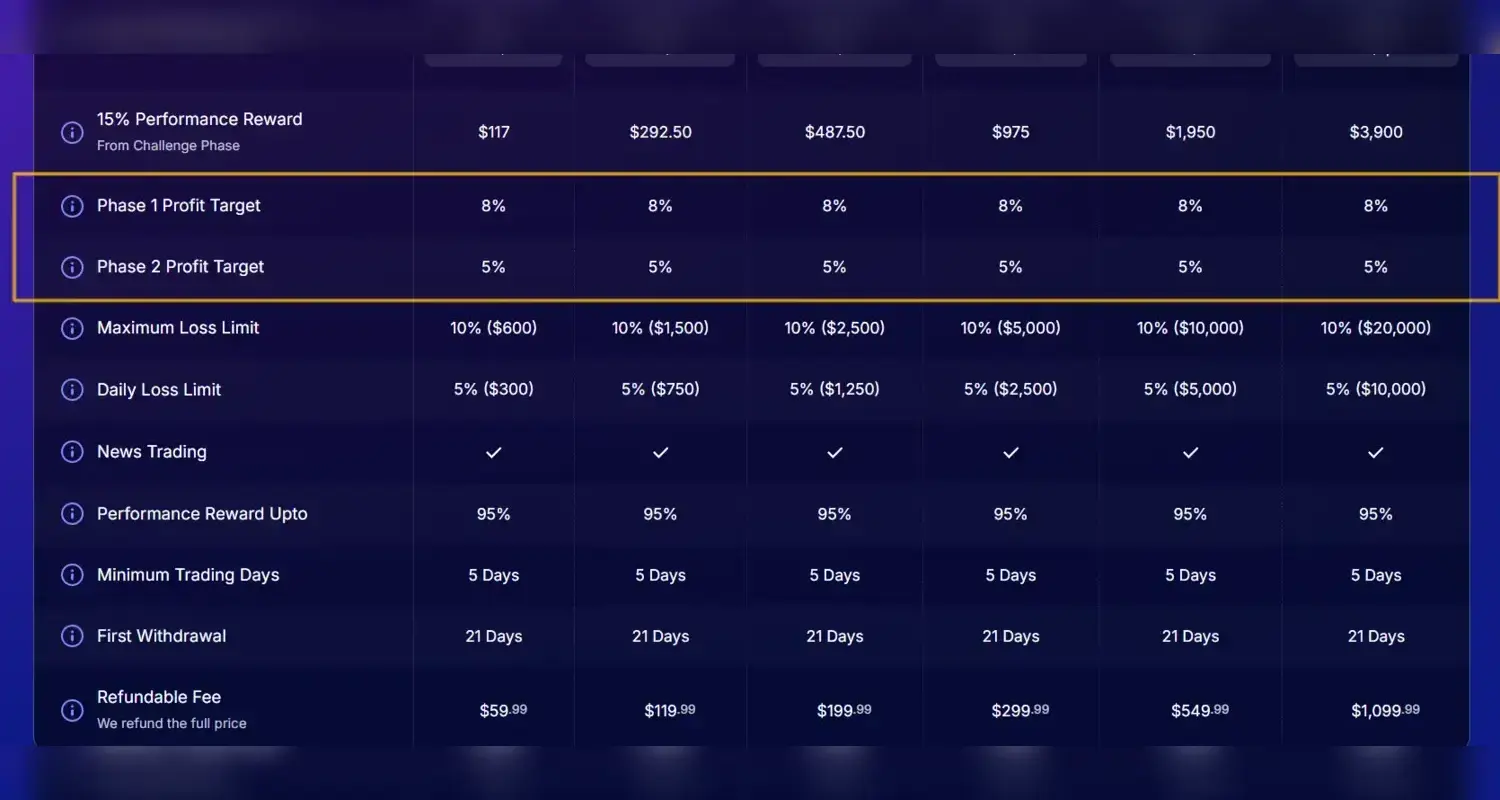
Prop firms with challenges also put traders through one or more evaluation stages before they are given a funded account. This is the model that occupies the leading position in the industry, and the new traders are usually introduced to this.
Evaluation phases are designed to filter out volatility-seeking behavior rather than to identify peak profitability.The majority of challenge-based companies use a one or two-step evaluation:
It is after these stages that the trader is given a funded account.
Fees and refund mechanics
The traders make an initial payment in order to fight the challenge. This fee will also be refunded on successful passing and receipt of the funded account, unlike instant funding.
While fees are refundable on success, most traders attempt multiple evaluations before passing, making cumulative cost a hidden risk factor.
Strictness of the rules in times of difficulties
During evaluation phases, rules are generally tougher than when trading on funds is on:
These constraints prevent traders from achieving profit targets through single high-risk trades, enforcing consistency rather than luck. Challenge-based companies also ensure that traders can comply with regulations before giving them capital.
| Decision Criteria | Instant Funding | Challenge-Based |
| Upfront Cost | High, non-refundable | Lower, often refundable |
| Risk of Account Loss | High if undisciplined | High during evaluation |
| Drawdown Strictness | Very strict | Strict in challenge, moderate later |
| Time to Trade Real Capital | Immediate | Delayed |
| Profit Split | Usually lower initially | Often higher after funding |
| Scaling Potential | Limited or slow | Strong long-term scaling |
| Psychological Pressure | Fear of instant loss | Pressure to hit targets |
Selection of the appropriate model is not a skill issue but rather a behavioral issue.
The beginners are usually better matched with challenge-based firms. The testing stage will compel traders to prepare themselves to control risks and show patience and consistency before the real money is at stake. Although failures are frustrating, they are usually less expensive than recurring losses in terms of instant funds.
Challenge-based models tend to be helpful to traders who focus on capital preservation, low leverage, and consistent growth. The form fits into their psyche, and the stage of being funded usually gives them more breathing space as compared to drawdowns of funds on short notice.
Quick capital can be appropriate for aggressive traders who have established a working system and can work with hard limits. Nevertheless, such a business needs to be fearlessly frank with itself without restraint, churning accounts.
Instant funding might be more realistic if you are willing to be in the business every day and follow profit goals. No minimum days and deadlines to trade, so there is flexibility, although you must be able to deal with risk and maintain consistency.
Waveform inversion, ignoring drawdown mechanics
There are lots of traders who pay attention to profit splits and account size and pay no attention to the calculation of drawdowns. Trailing drawdowns combined with aggressive sizing create a shrinking risk envelope that accelerates failure
Excessively spending money on instant financing
The easiest method to squander capital is paying in sizable instant accounts without demonstrating consistency. Scaling is not something that can be impulsively bought.
Considering instant funding as capital that has no risk
Free money is usually confused with instant funding. In reality, it is a prepaid risk. Gamblers of this nature end up losing several accounts almost all the time.
Rushing challenges
Traders tend to take more risk to reach totals in evaluations. The consequence of this behavior is breaches of the rules, emotional trading, and repetitive failures. The boring, slow trading endures more challenges than hero trades do.
Instant funding and challenge-based traders support the need for differing personalities, risk thresholds, and trade practices. Traders of quality are not the fastest or largest, but the ones with the best-suited approach to their trading discipline.
Therefore, if your strategy requires patience, structure, and scaling, challenge-based models are probably better suited. Alternatively, if you already have the qualities of effective risk management, emotional toughness, and consistency, instant capital will certainly be of great impetus to your progress.
In prop trading, survivability within rule constraints determines long-term success more than win rate or leverage


 2M+ Monthly Readers
 50k+ Articles


 Claim Bonus