

Jane Lubale is a crypto journalist and content writer at CoinGape, with a strong focus on blockchain, cryptocurrency, FinTech, and Web3 narratives.
Jane holds a Master’s in Business Administration, and a degree in Marketing, and blends this background with her passion for market research and digital marketing to deliver engaging price analysis, thought leadership, and educational content. Her work has also been published in leading crypto media such as Insidebitcoin, where she has contributed to the growing conversation around decentralized technologies.
With 5+ years of experience in Decentralized Finance (DeFi), Jane's writing is driven by a mission to educate and empower readers with insights that cut through hype and deliver true value. She achieves this in the form of trading strategies, regulatory updates, or blockchain adoption trends.
Away from the keyboard, Jane is a proud mother of three boys and is often found mentoring young people on career paths, personal development, and life choices, as well supporting needy teens complete school. She holds modest investments in cryptocurrency, reflecting her belief in the future of digital finance.
Financial crime is accelerating, with AI-driven scams, deepfakes, and synthetic identities pushing global crypto fraud to $17 billion in 2025.
Binance is scaling AI across compliance, with over 24 security systems that now handle a large share of fraud detection and significantly improve KYC verification.
The approach blends human oversight with AI efficiency, helping prevent billions in losses while supporting investigations, recovery efforts, and user protection.
The pace at which financial crime is evolving is no longer something most compliance systems were built to match. Today, attackers have changed the game, using deepfakes and phishing bots with the ability to target thousands of users at once. They are also relying on synthetic identities and AI-generated documents. Binance Research reported that impersonation tactics alone increased by around 1,400% in 2025. The main driver is the rapid rise of low-cost generative AI tools.
The problem is becoming more serious for compliance teams. Crypto fraud reached $17 billion in 2025, a 30% increase from 2024.. Smart contracts can now be carried out for as little as $1.22 per contract, showing how cheaply it is to launch sophisticated scams.
Binance is Rebuilding Compliance Around AI
By the end of 2025, Binance’s compliance function had expanded to around 1,500 employees, comprising a quarter of its global workforce. The crypto exchange made this achievement by investing nearly $300,000 million annually. It focused on strengthening people, systems, and capabilities together.
However, the shift has been more on how AI is integrated into those teams. Binance said it has deployed over 24 security initiatives powered by AI to help in verifying identity, monitor transactions, detect scam, and screen payment. Today, its AI systems handle around 57% of fraud control processes
The systems carry risk operations, supporting more than 80% of anti-fraud and anti-scam decision workflows, as well as assisting about 45% of human review processes.
Binance says the focus is not on replacing people, but on improving efficiency. The objective is to help human reviewers work faster and with greater precision.
The impact is already visible. Binance reports that its AI security systems helped prevent more than $10.5 billion in potential fraud losses in early 2025 and Q1 2026, protecting over 5.4 million users.
AI at the Frontline of Identity and KYC Fraud
A transaction can look legitimate on its own, but the picture changes when it’s viewed alongside account history, device data, behavioural signals, and past activity patterns.
To address this, Binance relies on internal systems that continuously refine detection models as new threats emerge, instead of depending on static rule-based updates.
The company asserts that 80% of attacks targeting its platform involve Know Your Customer (KYC) manipulation, including deepfake videos, spoofed images and AI-generated documents.
The exchange is countering this by upgrading its liveness detection and facial verification systems. It also says AI-assisted KYC now operates at roughly 100 times the efficiency of manual review processes, while reducing illicit fund exposure by 96%.
Besides prevention, the same systems are also used for intervention. Binance made more than 36,000 calls in 2025 alone, to users flagged as potentially vulnerable. This resulted in a recovery or freezing of around $114 million linked to external hacks.
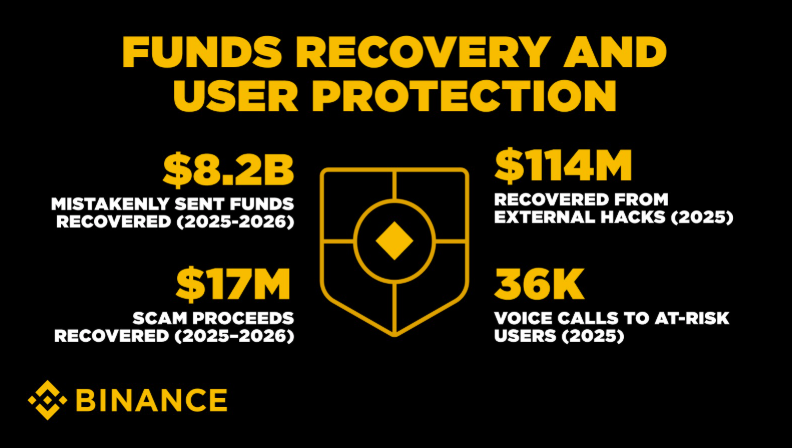
Binance Recovery and Post-Incident Response
Between 2023 and 2025, it also supported investigations that led to over $715 million in seizing assets.
As the tech sector layoff surges and debates on responsible AI in financial services, Binance’s approach stays focused on augmentation, instead of replacement. It is keeping humans in the loop while AI handles scale and speed.

Binance uses AI to detect scams, monitor transactions, verify identities, and flag suspicious activity in real time.
How effective are Binance’s AI compliance systems?
+
The systems have helped prevent over $10.5 billion in potential fraud losses and support most fraud detection workflows.
Does AI replace human compliance teams at Binance?
+
No. AI supports human reviewers by handling large-scale detection tasks, while humans focus on decision-making and oversight.
Share
Why trust CoinGape: CoinGape has covered the cryptocurrency industry since 2017, aiming to provide informative insights to our readers. Our journalists and analysts bring years of experience in market analysis and blockchain technology to ensure factual accuracy and balanced reporting. By following our Editorial Policy,
our writers verify every source, fact-check each story, rely on reputable sources, and attribute quotes
and media correctly. We also follow a rigorous Review Methodology when evaluating exchanges and tools. From emerging blockchain projects and coin launches to industry events and technical developments, we cover all facets of the digital asset space with unwavering commitment to timely, relevant information.
Investment disclaimer: The content reflects the author’s personal views and current market conditions. Please conduct your own research before investing in cryptocurrencies, as neither the author nor the publication is responsible for any financial losses.
Ad Disclosure: This site may feature sponsored content and affiliate links. All advertisements are clearly labeled, and ad partners have no influence over our editorial content.
Jane Lubale is a crypto journalist and content writer at CoinGape, with a strong focus on blockchain, cryptocurrency, FinTech, and Web3 narratives.
Jane holds a Master’s in Business Administration, and a degree in Marketing, and blends this background with her passion for market research and digital marketing to deliver engaging price analysis, thought leadership, and educational content. Her work has also been published in leading crypto media such as Insidebitcoin, where she has contributed to the growing conversation around decentralized technologies.
With 5+ years of experience in Decentralized Finance (DeFi), Jane's writing is driven by a mission to educate and empower readers with insights that cut through hype and deliver true value. She achieves this in the form of trading strategies, regulatory updates, or blockchain adoption trends.
Away from the keyboard, Jane is a proud mother of three boys and is often found mentoring young people on career paths, personal development, and life choices, as well supporting needy teens complete school. She holds modest investments in cryptocurrency, reflecting her belief in the future of digital finance.
CoinGape is a burgeoning blockchain and crypto media company. It was recently awarded as the Best Crypto Media Company 2024 at Global Blockchain Show, Dubai. Our goal is to keep industry professionals up to date on the most recent news and developments. We are a team of experts who take great pride in offering unbiased and well researched information to help our readers make informed decisions. Read our Editorial Policy
Share