Apurva Sheel is an editor and content specialist with over 12 years of experience shaping clear, accurate, and audience-focused content. Her work spans complex domains where precision, structure, and tone are critical including fintech and crypto payment solutions. With a background in communications, she focuses on making technical concepts accessible without oversimplifying them, ensuring content is informative, trustworthy, and aligned with user needs. Her editorial approach emphasizes clarity, consistency, and meaningful communication.
CoinGape has been covering cryptocurrency and blockchain markets since 2017. Our editorial team evaluates projects and platforms using structured review frameworks focused on transparency, utility, and risk assessment. You can explore our review methodologies to see how we assess and rate different categories. We maintain clear editorial standards and disclose advertising or affiliate relationships where applicable.
Investment disclaimer
The content reflects the author's personal views and current market conditions.
Please conduct your own research before investing in cryptocurrencies,
as neither the author nor the publication is responsible for any financial losses.
Ad Disclosure
This site may feature sponsored content and affiliate links, To get more information on the partner link placements visit our affiliate policy page . All advertisements are clearly labeled, and ad partners have no influence over our editorial content.
Accepting cryptocurrency payments can save your business thousands in processing fees, but only if you understand exactly what you’re paying for. While traditional credit card processors charge 2.9% + $0.30 per transaction, crypto payment gateways typically charge just 0.5% to 2%. On $1 million in annual revenue, that difference adds up to $10,000 to $24,000 in savings.
But here’s what most merchant guides don’t tell you: the advertised transaction fee is just one piece of the puzzle. Hidden conversion fees, withdrawal charges, and network costs can quickly erode those savings if you’re not careful.
This guide breaks down every fee type you’ll encounter with crypto payment gateways, compares costs across 10+ providers, and shows you exactly how to calculate your true payment processing costs.
What Are Crypto Payment Gateway Fees?
A crypto payment gateway fee is the service charge paid to a third-party processor to facilitate a blockchain transaction. In 2026, these gateways act as ‘financial interpreters’, converting the irreversible, technical nature of blockchain into the ledger-friendly data required by modern businesses.
Why Payment Gateways Charge Fees
Crypto payment gateways perform several valuable services that justify their fees:
Instant Currency Conversion: Most businesses want to receive fiat currency (USD, EUR, GBP), not volatile cryptocurrencies. Gateways handle real-time conversion, locking in exchange rates the moment your customer pays. This protects you from price swings that could occur during settlement.
Wallet Management: Instead of managing multiple cryptocurrency wallets, private keys, and security protocols yourself, the gateway handles it all. They maintain hot and cold wallet infrastructure, implement multi-signature security, and ensure regulatory compliance.
Compliance and AML/KYC: Legitimate gateways invest heavily in anti-money laundering (AML) systems, transaction monitoring software, and KYC processes. These tools flag suspicious transactions and help you avoid regulatory penalties.
Simplified Integration: Whether you’re using Shopify, WooCommerce, or a custom checkout, gateways provide plugins and APIs that integrate in minutes rather than months.
Crypto Gateway Fees vs. Traditional Payment Processing
A comparison of the fee structure allows you to clearly understand the cost advantage of crypto payments.
Payment Method
Typical Fees
Example: $100 Sale
Credit Card (Stripe/Square)
2.9% + $0.30
$3.20
PayPal
2.9% + $0.30
$3.20
Wire Transfer
$15-$50 flat
$15.00
Crypto Gateway (Average)
1%
$1.00
Crypto Gateway (Low-fee)
0.5%
$0.50
For a business processing $100,000 monthly, the difference between credit cards at 2.9% and crypto at 1% is $1,900 per month or $22,800 annually. In addition to direct fee savings, crypto payments eliminate chargebacks entirely. In 2024, merchants globally lost over $150 billion to chargeback fraud. Cryptocurrency transactions are irreversible by design, which means once a customer pays, the transaction cannot be disputed and reversed against you.
Types of Fees Charged by Crypto Payment Gateways
To calculate your true ROI , you must account for these eight distinct fee categories.
Transaction Fees (0.5% – 2%): The ‘headline rate’. This is the primary fee charged per successful order. In 2025, the market standard was 1%, though high-volume enterprises often negotiate rate as low as 0.4%
Conversion/Exchange Fees (0.1% – 5%): This is the most common place for ‘hidden costs’. If you accept Bitcoin but want USD in your bank account, the gateway must ‘swap’ the assets.
Direct Fee: a flat percentage for the swap
The Spread: the difference between the market price (e.g., $100,000) and the price the gateway gives you (e.g., $99,400); A 0.6% spread is effectively an extra 0.6% fee.
Withdrawal & Payout Fees: Moving money away from your merchant dashboard to your local bank or private cold wallet often incurs a cost.
Fiat Payouts: Fees for SEPA, ACH, or SWIFT transfers (ranging from $1 to $50).
Crypto Payouts: typically just the cost of the network’s gas fee.
Settlement Fees: Specific to enterprise gateways (like BVNK), these are charged when you ‘batch’ thousands of small transactions into a single daily or weekly settlement to simplify accounting.
Network (Gas) Fees: These are paid to the blockchain itself.
High-cost Networks: Ethereum (Layer-1) can cost $5-$50 per transaction.
Low-cost Networks: Solana, Base, and Polygon cost less than $0.01.
Note: In 2025, most gateways allowed merchants to choose whether they or the customer paid this fee.
Refund Fees (€0.25 – $1.00): Refunds are technically new transactions on the blockchain. Processors like CoinGate charge a small administrative fee to process the ‘return’ of funds to a customer’s wallet.
Monthly/Subscription Fees: While most are pay-as-you-go, white-label crypto payment gateways (designed for large brands to host their own checkout) often charge a monthly licensing fee of $500 to $2000.
Hidden Costs & Inactivity Fees: Some custodial processors charge ‘Maintenance Fees’ if a merchant account remains inactive for more than 6 months, or ‘Risk Premiums’ for high-risk industries like gaming or travel.
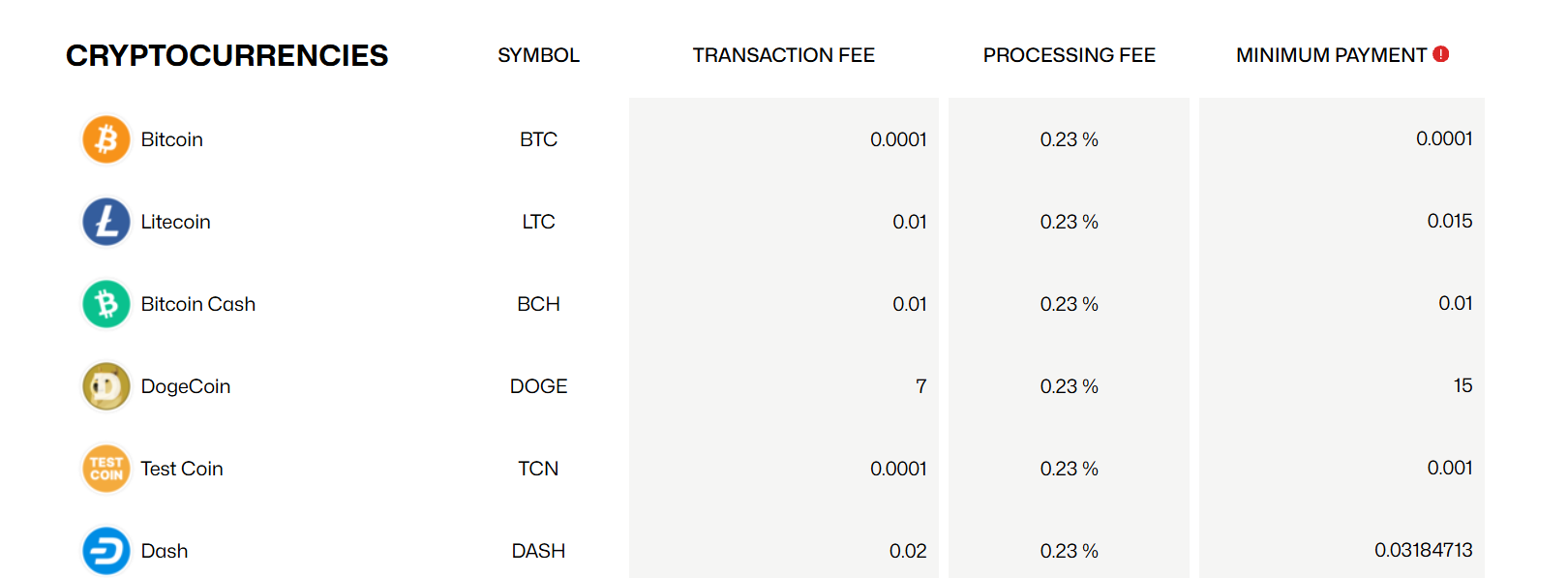
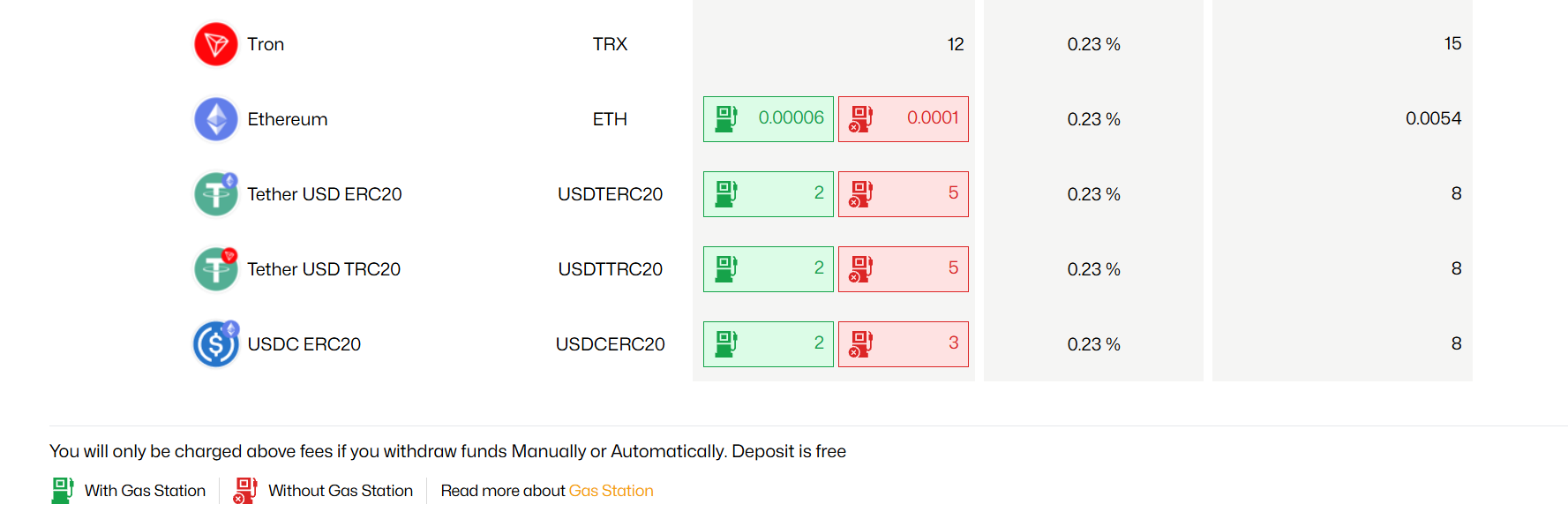
Lowest Overall Fees: Coinremitter (0.23%): Coinremitter offers the lowest flat transaction fee in the market at just 0.23%. There are no monthly fees, deposit fees, or hidden charges. It’s ideal for cost-conscious merchants who prioritize minimizing processing expenses.
Best for: High-volume merchants, price-sensitive businesses
Limitations: Less name recognition, smaller support team
Best for Multi-currency: NOWPayments (0.5-1%): NOWPayments supports more than 200 cryptocurrencies, making it ideal for businesses with crypto-native customers who want to pay with altcoins. The 0.5% fee applies when settling in the same cryptocurrency; exchange to fiat or other cryptos costs 1% (including a 0.5% swap fee).
Best for: Businesses accepting diverse cryptocurrencies
Limitations: 1% fee when conversion is needed
Best Balance of Features: CoinGate (1%): CoinGate strikes a balance between competitive pricing (1%), ease of use, and robust features. It offers plugins for major eCommerce platforms, a clean merchant dashboard, and support for more than 70 crypto currencies with fiat settlements in multiple currencies.
Best for: SMBs wanting a reliable, full-featured solution
Best for US Compliance: Coinbase Commerce (1%): Coinbase Commerce is a part of the Coinbase ecosystem, and this offers unmatched regulatory credibility in the US. The straightforward 1% fee with no hidden charges makes budgeting simple. However, it supports fewer cryptocurrencies than some competitors.
Best for: US-based businesses prioritizing compliance
Limitations: Limited crypto selection (10+), less flexible for enterprise needs
Best for Enterprise: BitPay (1-2% + $0.25): BitPay is one of the oldest and most established crypto payment processors, serving major enterprises like Microsoft and AT&T. While fees are higher than budget options, you get enterprise-grade infrastructure, dedicated account management, and robust compliance features.
Best for: Large enterprises, high-value transactions
Limitations: Higher fees, per-transaction fixed fee hurts small purchases
Best Self-Hosted (Free): BTCPay Server (0%): BTCPay Server is an open-source software that lets you run your own payment gateway with zero transaction fees. You only pay blockchain network fees. However, this requires technical expertise to set up and maintain.
Best for: Tech-savvy merchants, maximum cost savings
Limitations: Requires server management, no customer support
Crypto vs Traditional Payment Gateway Fees
The ‘true cost’ of traditional payments is much higher than the 2.9% advertised. When you add in international markups (up to 1.5%), currency conversion (up to 2%), and the ‘Chargeback Tax’, traditional payments cost businesses an effective 5% to 7%.
The $1,000,000 Annual Revenue Comparison
A mid-sized store processing $1M annually with a $100 average order value:
Traditional (Credit Cards):
Transaction Fees (2.9% + $0.30): $32,000
Chargeback Loss (1.5% rate): %15,000
Dispute Fees ($25 per incident): $3,750)
Total Annual Cost: $50,750
Crypto Gateway (NOWPayments/Cointemitter):
Transaction Fees (avg 0.75%): $7,5000
Chargeback Loss: $0
Withdrawal/Conversion (0.5%): $,5000
Total Annual Cost: $12,500
Total Annual Savings: $38,250.
For many businesses, this 3.8% ‘found money’ is the difference between a loss and a profitable year.
How to Calculate Your True Crypto Payment Gateway Costs
In 2025, merchants must use a Total Cost of Ownership (TCO) model. Use this formula to audit your processor:
Total Cost of Ownership =(Order×Trate)+(Order×Cspread)+Ngas+Wfiat
Calculation Examples:
Scenario A: Small $20 Order (Ethereum L1)
Cost: $0.20 (1% Fee) + $5.00 (Gas Fee)
Result: 26% Effective Fee (Avoid this!)
Scenario B: Small $20 Order (Solana or Lightning)
Cost: $0.20 (1% Fee) + $0.001 (Gas Fee)
Result: 1.01% Effective Fee
Scenario C: Enterprise $10,000 Transaction
Cost: $0.20 (1% Fee) + $0.001 (Gas Fee).
Result: 1.01% Effective Fee
Factors That Affect Crypto Payment Gateway Fees
The cost of your crypto payment processor is not fixed; it is dynamic based on these five variables:
Transaction Volume: Gateways are now ‘SaaS-ified’. Processing $1M/month vs $1k/month will drop your fees from 1% to 0.4% instantly.
Network Selection: In 2025, ‘Ethereum Mainnet’ is a luxury. High-efficiency merchants prioritize USDC or Base or Polygon to keep fees at sub–penny levels.
Settlement Choice (Crypto vs. Fiat): Receiving USDC for a USDC payment has near-zero conversion fees. Receiving USD for a Bitcoin payment adds a ‘Spread’ cost.
Geography & Compliance: Merchants in ‘High-Risk’ jurisdictions or those requiring deep KYC for restricted products will pay a higher base rate to cover the gateway’s insurance.
Custodial vs. Non-Custodial Solutions:
Custodial Gateways: The provider holds your funds until withdrawal. Convenient, but you pay for the custody service.
on-custodial Gateways: Funds go directly to your wallet. Lower fees, but you manage your own security and conversion.
Best Low-Fee Crypto Payment Gateways (2026 Rankings)
Based on our analysis, here are the top 5 picks for minimizing payment processing costs:
Coinremitter – Best Overall Value (0.23%)
With the lowest flat rate in the industry, Coinremitter is hard to beat on cost. It supports 20+ cryptocurrencies, offers a clean API, and has no hidden fees. The trade-off is a smaller brand presence compared to industry giants. Ideal for: Cost-conscious merchants prioritizing lowest possible fees
BTCPay Server – Best for Zero Fees (Self-hosted)
If you have technical resources, BTCPay Server eliminates gateway fees entirely. You only pay blockchain network fees. It’s open-source, privacy-focused, and gives you complete control over your payment infrastructure. Ideal for: Tech-savvy businesses, privacy advocates, Bitcoin maximalists
NOWPayments – Best for Stablecoin Settlements (0.5%)
When accepting stablecoins and settling in stablecoins, NOWPayments charges just 0.5%. This makes it excellent for businesses already operating in the crypto economy who don’t need fiat conversion. Ideal for: Crypto-native businesses, stablecoin-focused operations
CoinGate – Best User Experience (1%)
CoinGate balances competitive pricing with a polished user experience. The merchant dashboard is intuitive, plugins work seamlessly, and support is responsive. At 1%, it’s pricier than budget options but delivers reliability. Ideal for: SMBs wanting plug-and-play simplicity
Plisio – Best for Invoicing (0.5%)
Plisio combines low 0.5% fees with excellent invoicing features. If your business model involves recurring payments or invoice-based billing, Plisio’s tooling makes it easy to manage.Ideal for: B2B businesses, freelancers, subscription services
How to Reduce Your Crypto Payment Gateway Fees
Don’t settle for the default settings. Even after choosing a low-free provider, you can further minimize costs by using these ‘Optimization Rails’.
Negotiate Volume Discounts: If you process $25,000+ monthly, ask for custom pricing. Most providers have unpublished enterprise tiers. Come prepared with your volume data and competing quotes to strengthen your negotiating position.
Accept Stablecoins Primarily: Encourage customers to pay with stablecoins like USDC or USDT. These eliminate volatility risk and often incur lower conversion fees since they’re already dollar-pegged.
Settle in Cryptocurrency: If you pay suppliers, contractors, or employees in crypto, settle your gateway balance in crypto too. This eliminated conversion fees entirely and can simplify your treasury management.
Batch Your Withdrawals: Instead of withdrawing daily, batch withdrawals weekly or monthly. Some gateways offer better rates for larger withdrawal amounts, and you reduce the number of transactions subject to flat fees.
Use Layer-2 Networks: Layer-2 solutions like Bitcoin’s Lighting Network or Ethereum’s Polygon dramatically reduce network fees: from dollars to fractions of a cent. If your customers are comfortable using these networks, you’ll save on every transaction.
Consider Self-hosted Solutions: For businesses with technical capabilities, running BTCPay Server or similar self-hosted solutions eliminates transaction fees. The upfront setup investment pays off quickly at scale.
Review and Compare Regularly: The crypto payment landscape evolves rapidly. New providers emerge, existing ones adjust pricing, and your volume may unlock better tiers. Review your costs quarterly and don’t hesitate to switch if savings justify the migration effort.
Understand Network Fees vs. Gateway Fees
A common source of confusion is the distinction between blockchain network fees and payment gateway fees. Here’s the difference:
Network Fees (Blockchain Fees)
These are paid to validators who process and conform transactions on the blockchain. They exist regardless of whether you use a payment gateway.
Bitcoin: variable based on network congestion; typically $1-$10 per transaction
Ethereum: Gas fees range from $0.50 to $50+ depending on network demand.
Solana: extremely low, usually under $0.01
Layer-2s (Lightning, Polygon): fractions of a cent
Gateway Fees
These go to the payment processor for their services: wallet management, currency conversion, compliance, customer support, and integration tools.
Who pays network fees?
Some gateways absorb network fees into their transaction fee.
Others pass them directly to the merchant.
A few pass them to the customer as a checkout surcharge.
Always confirm with your provider how network fees are handled to avoid surprises.
Conclusion: Choosing the Right Crypto Payment Gateway
The right crypto payment gateway depends on your specific situation:
Prioritize lowest cost? Go with Coinremitter (0.23%) or self-host BTCPay Server (0%)
Want plug-and-play simplicity? CoinGate or Coinbase Commerce offer smooth integrations
Processing high volume? Negotiate enterprise rates with BitPay, BVNK, or B2BinPay
US Compliance critical? Coinbase Commerce offers regulatory peace of mind
Whatever you choose, remember that the advertised transaction fee is just one component of your total cost. Factor in conversion fees, network fees, and withdrawal policies to calculate your true processing expense.
For most businesses, even a moderately-priced crypto gateway will cost significantly less than traditional credit card processing, while eliminating chargeback fraud and opening your business to the 600+ million global cryptocurrency users ready to spend their digital assets.
Disclaimer: Fee structures change frequently. We recommend verifying current rates directly with the provider before making a decision. This guide is for informational purposes and does not constitute financial advice.
Frequently Asked Questions (FAQs)
1. How much does a crypto payment gateway cost?
Transaction fees typically range from 0.5% to 2% per payment. Additional costs may include conversion fees (0.1% to 5%), network fees ($0.01 to $10+ depending on the blockchain), and withdrawal fees (usually free to 1%). The total cost depends on your transaction volume, cryptocurrency, and settlement preferences.
2. What is the cheapest crypto payment gateway?
Coinremitter offers the lowest flat fee at 0.23%. For zero fees, BTCPay Server is a self-hosted open-source option where you only pay blockchain network fees. NOWPayments offers 0.5% for stablecoin-to-stablecoin transactions.
3. Are crypto payment gateways cheaper than credit cards?
Yes, in most cases. Credit cards charge 2.9% + $0.03 per transaction on average, while crypto gateways typically charge 0.5% top 1.5%. For a business processing $1 million annually, this difference represents $14,000 to $24,000 in savings. Additionally, crypto payments eliminate chargeback fraud, which costs merchants over %150 billion globally each year.
4. Do crypto payment gateways charge monthly fees?
Most don’t. Providers like CoinGate, NOWPayments, and Coinbase Commerce operate on pure transaction-based pricing with no monthly minimums. Some enterprise solutions may include monthly platform fees as part of custom packages.
5. What are the hidden fees I should watch for?
Common hidden fees include: FX spreads on currency conversion (0.5% to 3%), minimum withdrawal thresholds, refund processing fees, inactivity fees, and premium charges for instant settlement. Always request a complete fee schedule before signing up.
6. Can I accept crypto without a payment gateway?
Yes. You can simply publish your wallet address and have customers send payments directly. However, this means manually managing wallets, handling conversions yourself, monitoring transactions, and dealing with payment verification. For most businesses, gateway fees are worth the convenience and the security they provide.
7. How do I avoid high conversion fees on crypto payment gateways?
Accept stablecoins (USDC, USDT) which are already pegged to fiat currencies, reducing conversion complexity. Alternatively, settle in cryptocurrency if your business can use crypto for expenses. Choose providers that bundle conversion into their transaction fee rather than charging separately.
8. Do customers pay the crypto gateway fees?
Typically, merchants absorb gateways fees, just like with credit card processing. However, some businesses choose to pass network fees to customers as a checkout surcharge. This is more common with high-value transactions where blockchain fees are significant. Check your local regulations before passing fees to customers.
Apurva Sheel is an editor and content specialist with over 12 years of experience shaping clear, accurate, and audience-focused content. Her work spans complex domains where precision, structure, and tone are critical including fintech and crypto payment solutions. With a background in communications, she focuses on making technical concepts accessible without oversimplifying them, ensuring content is informative, trustworthy, and aligned with user needs. Her editorial approach emphasizes clarity, consistency, and meaningful communication.
Disclaimer: The presented content may include the personal opinion of the author and is
subject to market condition. Do your market research before investing in cryptocurrencies. The author or the
publication does not hold any responsibility for your personal financial loss.



 2M+ Monthly Readers
 50k+ Articles


 Claim Bonus