
 Claim Bonus
Trump Tariffs: U.S. Supreme Court Sets January 9 for Possible Ruling


Highlights
- The U.S. Supreme Court has set January 9 as an opinion day.
- The court could rule on the legality of these tariffs on that day.
- Trump has urged the court to rule in his favor for the sake of national and financial security.
- Crypto traders are betting on the court ruling against the tariffs.
The Trump tariffs are back in the spotlight as the U.S. Supreme Court could rule on the president’s levies as soon as January 9. This is significant, considering the impact it could have on the crypto market, even as traders bet on the ruling.
Supreme Court Could Rule On Trump Tariffs This Week
The Supreme Court’s schedule lists this Friday as an opinion day, signaling that it could rule on the legality of the president’s tariffs as soon as this week. This will mark the first opinion day of the year as the justices return from a four-week recess.
Notably, the Supreme Court has so far expedited the case on the Trump tariffs, which is why there is a possibility that the justices could deliver a ruling that day. It is also worth noting that the U.S. president has been defending the tariffs in recent times ahead of a potential decision.
In a Truth Social post today, he indicated that the tariffs were responsible for the U.S. markets hitting new highs and remarked that he hopes the court allows the country to continue its “unprecedented march toward unparalleled greatness.”
While addressing House Republicans today, the U.S. president also alluded to the Supreme Court case on the Trump tariffs. “I hope they do what’s good for our country. I hope they do the right thing. The president has to be able to wheel and deal with tariffs,” he said.
The global tariffs were a major highlight last year, following the famous ‘Liberation Day’ when Trump announced reciprocal tariffs on about 90 countries, including China and the European Union. This sparked huge volatility in the crypto market, with the Bitcoin price notably dropping to as low as $74,000 during that period.
However, the market recovered, with BTC eventually hitting a new all-time high (ATH) of around $126,000 as the U.S. reached trade deals on the Trump tariffs. The Fed rate cuts last year also largely contributed to the new highs for the market.
Crypto Traders Bet On A Court Ruling Against Trump Admin
Crypto traders are currently betting that the Supreme Court will rule against the Trump administration. Polymarket data shows only a 24% chance that the court will rule in favor of these tariffs.
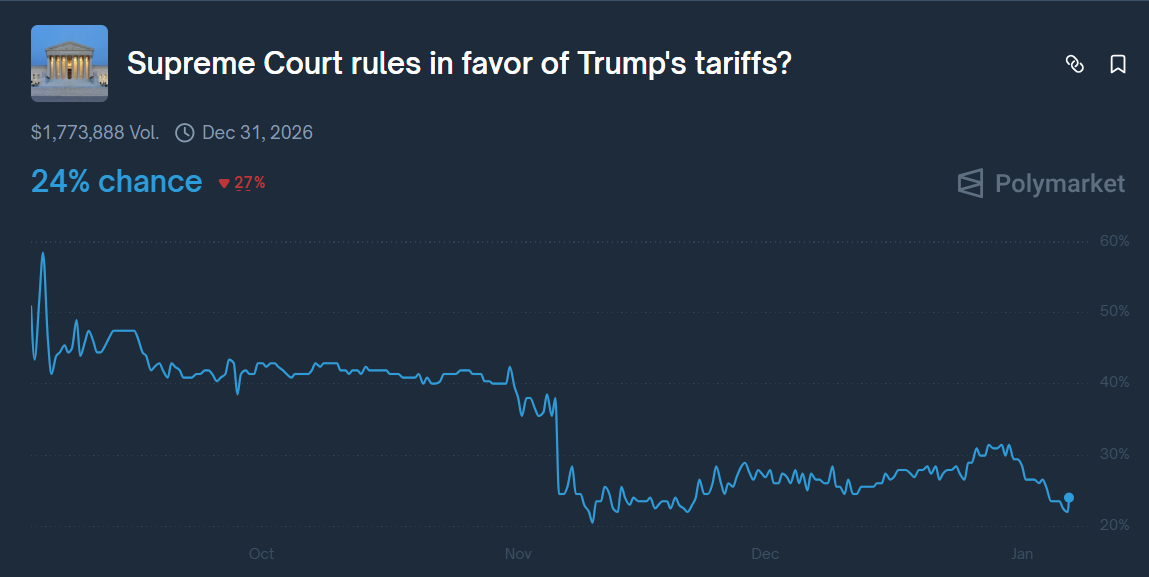
It is worth mentioning that the justices already sounded skeptical about the legality of these tariffs during a November 2025 hearing. However, the White House has maintained that the president has the power to issue these tariffs under the International Emergency Economic Powers Act of 1977 (IEEPA).
Meanwhile, as CoinGape reported, the White House is already preparing a Plan B in case the court rules against the Trump tariffs. It also remains to be seen how the crypto market will react to the potential ruling.
Interestingly, the December job report also drops on January 9. As such, the market could see significant volatility on the day as traders weigh what the developments mean for crypto prices.

Why Trust CoinGape
CoinGape has covered the cryptocurrency industry since 2017, aiming to provide informative insights Read more… to our readers. Our journal analysts bring years of experience in market analysis and blockchain technology to ensure factual accuracy and balanced reporting. By following our Editorial Policy, our writers verify every source, fact-check each story, rely on reputable sources, and attribute quotes and media correctly. We also follow a rigorous Review Methodology when evaluating exchanges and tools. From emerging blockchain projects and coin launches to industry events and technical developments, we cover all facets of the digital asset space with unwavering commitment to timely, relevant information.



Delivered every day.
- Insights that move markets
- 100,000 active subscribers
Related Articles






- BitMine Adds 20,000 ETH As Staked Ethereum Surpasses Half Of Total Supply
- Wells Fargo Predicts Bitcoin Rally on $150 Billion ‘YOLO Trade’ Inflow
- Will Crypto Market Crash as U.S.–Iran War Reportedly Imminent?
- Bitcoin Quantum Threat: CryptoQuant’s CEO Flags Risk of Losing Satoshi’s 1M BTC Stash to Hackers
- Crypto Regulation: Hyperliquid Launches Policy Group to Push DeFi Integration in U.S. Markets
- BMNR Stock Outlook: BitMine Price Eyes Rebound Amid ARK Invest, BlackRock, Morgan Stanley Buying
- Why Shiba Inu Price Is Not Rising?
- How XRP Price Will React as Franklin Templeton’s XRPZ ETF Gains Momentum
- Will Sui Price Rally Ahead of Grayscale’s $GSUI ETF Launch Tomorrow?
- Why Pi Network Price Could Skyrocket to $0.20 This Week
- Pi Network Price Beats Bitcoin, Ethereum, XRP as Upgrades and Potential CEX Listing Fuels Demand