CoinGape has been covering cryptocurrency and blockchain markets since 2017. Our editorial team evaluates projects and platforms using structured review frameworks focused on transparency, utility, and risk assessment. You can explore our review methodologies to see how we assess and rate different categories. We maintain clear editorial standards and disclose advertising or affiliate relationships where applicable.
Crypto prediction markets allow you to trade shares on specific outcomes. In layman’s language, you place money behind a bet that predicts the outcome of events across crypto markets, sports, politics, economics, pop culture, and more. According to Coingecko research, in the past year alone, prediction markets volume grew by 302.7% to hit $63.5b.
The reason? Crypto fixed prediction markets’ most significant flaw: settlement. Now, money is locked on-chain, rules are written in code, and payouts are automatic.
This shift has also unlocked how people use prediction markets. Instead of relying on centralized betting platforms, people can now get in on the action and trade directly on crypto price movements, political and economic decisions, sports and entertainment, and even DAO governance.
Key Takeaways
However, as adoption grows, not all prediction markets offer the same experience. Liquidity depth, fees, market coverage, and regulation vary widely.
This guide is for investors and traders seeking alpha on market sentiment. We have covered the top prediction market platforms to help you choose based on your needs, and walk you through key details, pros, and cons.
| Name | Regulatory Status | Fees | Best for | Market Type | Liquidity Model | Primary Chain | Rating | |
|---|---|---|---|---|---|---|---|---|
|
1

Polymarket |
Regulatory Status
CFTC Approved
|
Fees
Up to 3% taker
|
Best For
beginners, us investors
|
Market Type
crypto, politics, sports, economics
|
Liquidity Model
CLOB
|
Primary Chain
Polygon
|
||
|
2

Hedgehog |
Regulatory Status
Decentralized
|
Fees
Fee-on-success (varied)
|
Best For
defi users
|
Market Type
crypto, politics, sports
|
Liquidity Model
Hybrid
|
Primary Chain
Solana
|
||
|
3

Predict |
Regulatory Status
Decentralized
|
Fees
0.018% - 2% taker
|
Best For
defi users
|
Market Type
crypto, sports
|
Liquidity Model
Orderbook (CEX style)
|
Primary Chain
BNB Chain
|
||
|
4

Probable |
Regulatory Status
Decentralized
|
Fees
Zero (gas only)
|
Best For
beginners, defi users
|
Market Type
crypto, sports
|
Liquidity Model
Orderbook
|
Primary Chain
BNB Chain
|
||
|
5

Myriad Markets |
Regulatory Status
Decentralized
|
Fees
~3% fees
|
Best For
beginners
|
Market Type
crypto, politics, sports
|
Liquidity Model
AMM
|
Primary Chain
Abstract, Linea, BSC
|
||
|
6

Opinion |
Regulatory Status
Decentralized
|
Fees
0% - 2% taker
|
Best For
pro traders
|
Market Type
crypto, politics, sports
|
Liquidity Model
CLOB
|
Primary Chain
BNB Chain
|
||
|
7

SX Bet |
Regulatory Status
Decentralized
|
Fees
0.33% withdrawal
|
Best For
pro traders
|
Market Type
sports
|
Liquidity Model
Orderbook
|
Primary Chain
Arbitrum Orbit
|
We tested 17 crypto prediction markets using the CoinGape review methodology and evaluated what each platform promises versus what it delivers in practice. From this, we handpicked 7 platforms that best meet the metrics shared earlier.
In no particular order, here are the best crypto prediction markets in 2026.
Best Prediction Platform For Newly Emerging Events
Polymarket is a crypto prediction market with one of the largest user bases in the industry. It runs on the Polygon blockchain and uses an on-chain order book with settlement in USDC. Polymarket is known for fast market listings, often putting up new events minutes before news breaks on CNN, FOX, or other popular TV outlets. This creates a hyper-fast trading environment where prices move quickly.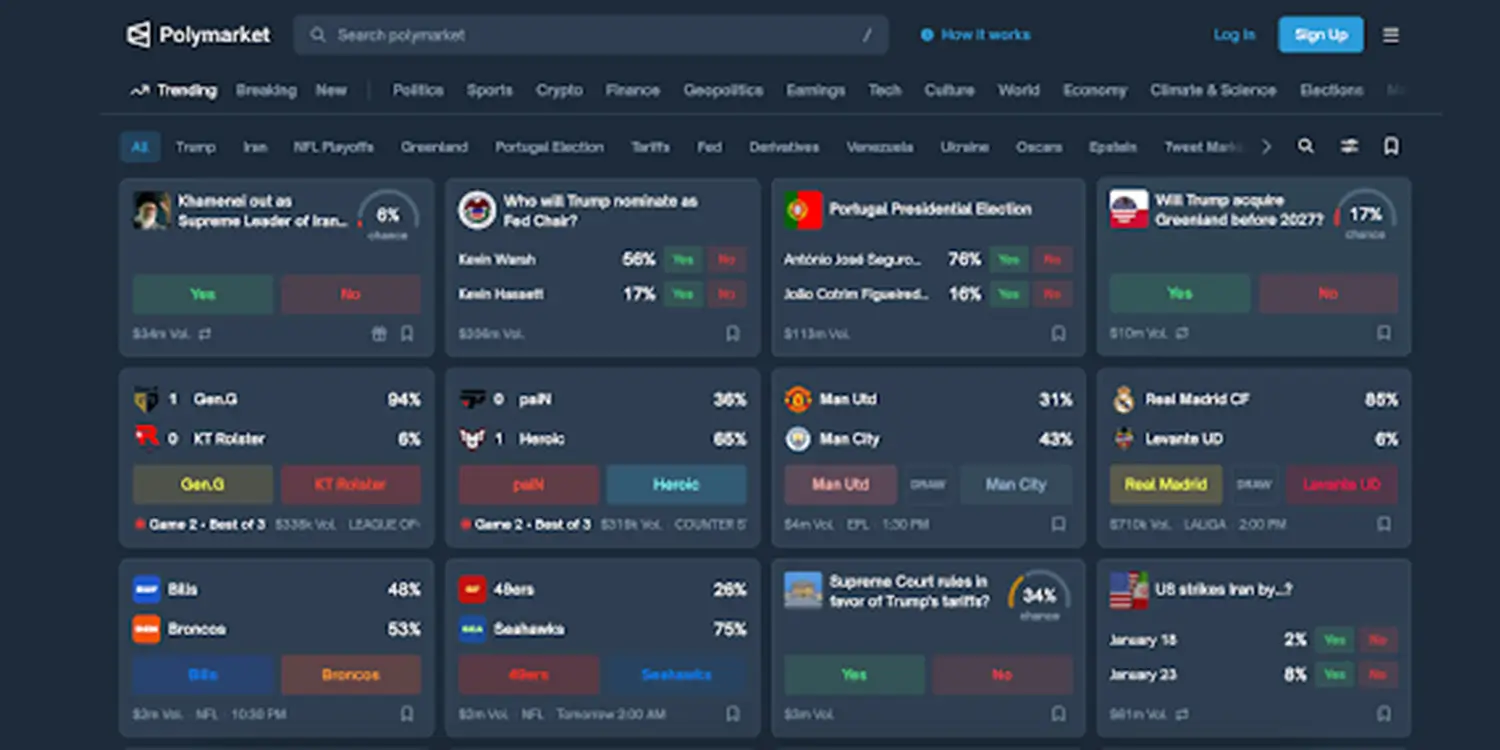
Author Review
At a glance, Polymarket is easy to use because of its clean interface. The homepage shows active markets with bold percentage bars and the total money wagered. Categories across the top also make it easy to move between topics and find the markets you want.
| Key Parameters | Details |
| Fee structure | Up to a 3% taker fee |
| Supported deposit option | USDC |
| Platform type | Hybrid-decentralized (regulated by the CFTC since July 2025) |
| Regional restrictions (if any) | 33 countries |
| Minimum amount (in USD) | $10 |
| Security audits | Quantstamp |
| Monthly active traders | 383,484 (according to Dune Analytics) |

Best Prediction Platform For Experimental Bettors
Hedgehog is a Solana-based prediction market that supports both peer-to-peer markets and an automated market maker (AMM). It lets users create their own markets, trade on existing ones, and even stake on outcomes. 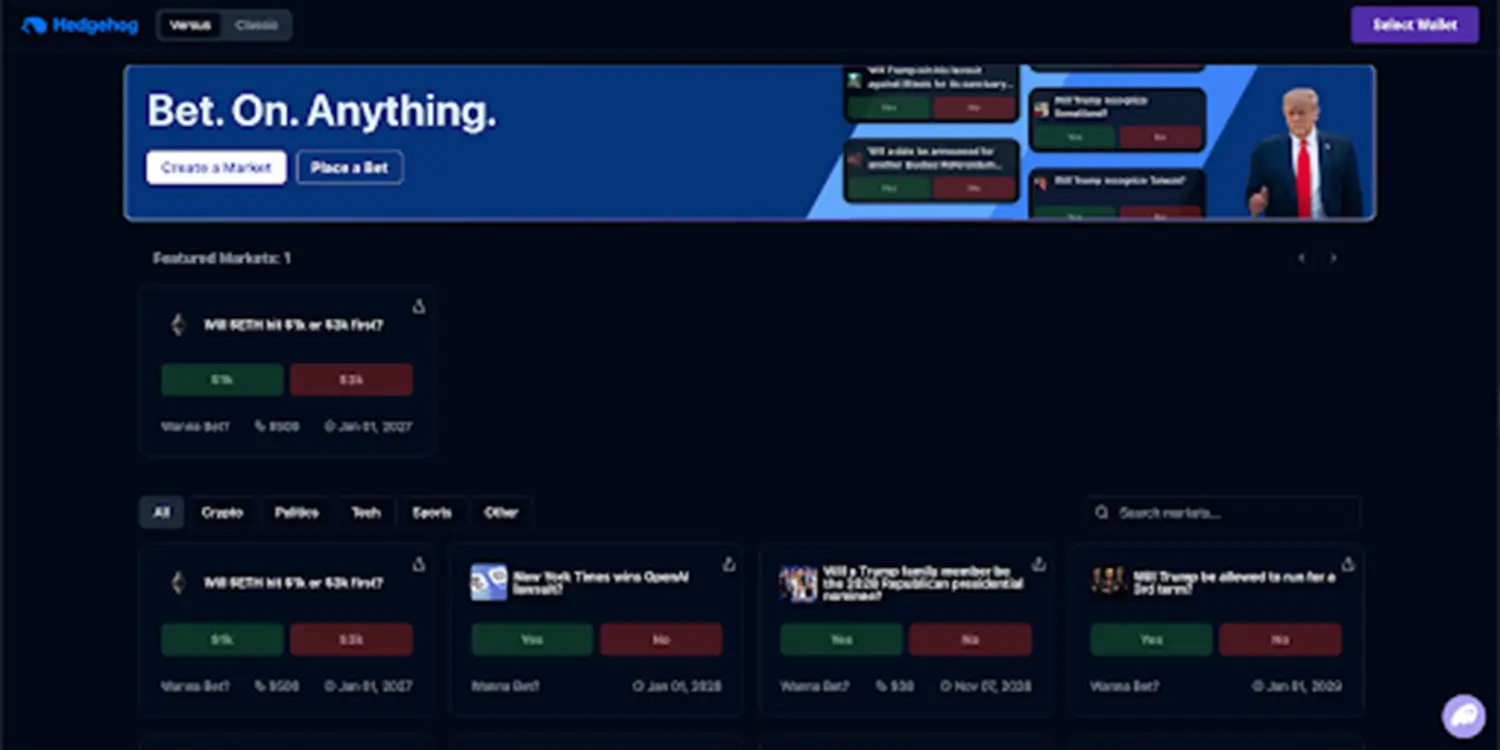
Author Review
Having a mix of P2P markets and AMMs gives users more options. I also like that you can earn HOG by providing liquidity to the Hedgehog ecosystem.
| Key Parameters | Details |
| Fee structure | Not disclosed |
| Supported deposit option | Any token from any chain or fiat |
| Platform type | Decentralized |
| Security audits | Chainsecurity |

Best Prediction Market for DeFi Users
Predict is built on the BNB Chain. Upon signup, you get an internal trading wallet that is linked to your Web3 wallet. You deposit funds into that address, and the platform uses it to place and manage your trades. The platform also has a points system called Predict Points to reward activity. You earn points by trading, providing liquidity, holding positions, and getting into markets early.
Author Review
Predict. fun markets uses a UMA-style oracle where each event resolves to YES, NO, or 50/50. In practice, it means an AI system proposes an outcome, which is then reviewed by Predict’s in-house team using news sites, and the final result is submitted to the oracle. This makes resolutions fast, but it also means users have to trust the team to be fair, since there is no dispute process.
| Key Parameters | Details |
| Fee structure | 0.018% to 2% taker fee |
| Supported deposit option | USDT on BNB Chain |
| Platform type | Decentralized |
| Security audits | Sherlock and TenArmor |

Zero Trading Fees And Frictionless Deposits
Probable is a BNB Chain prediction market, backed by PancakeSwap and YZi Labs. It uses an order-book trading mechanism to match traders with opposite views, so prices are set by users who place bids. UMA’s oracle secures the market outcomes, and unlike Predict.fun above, results are posted on-chain and can be disputed if incorrect. This gives Probable a more open and trust-minimized way to resolve events.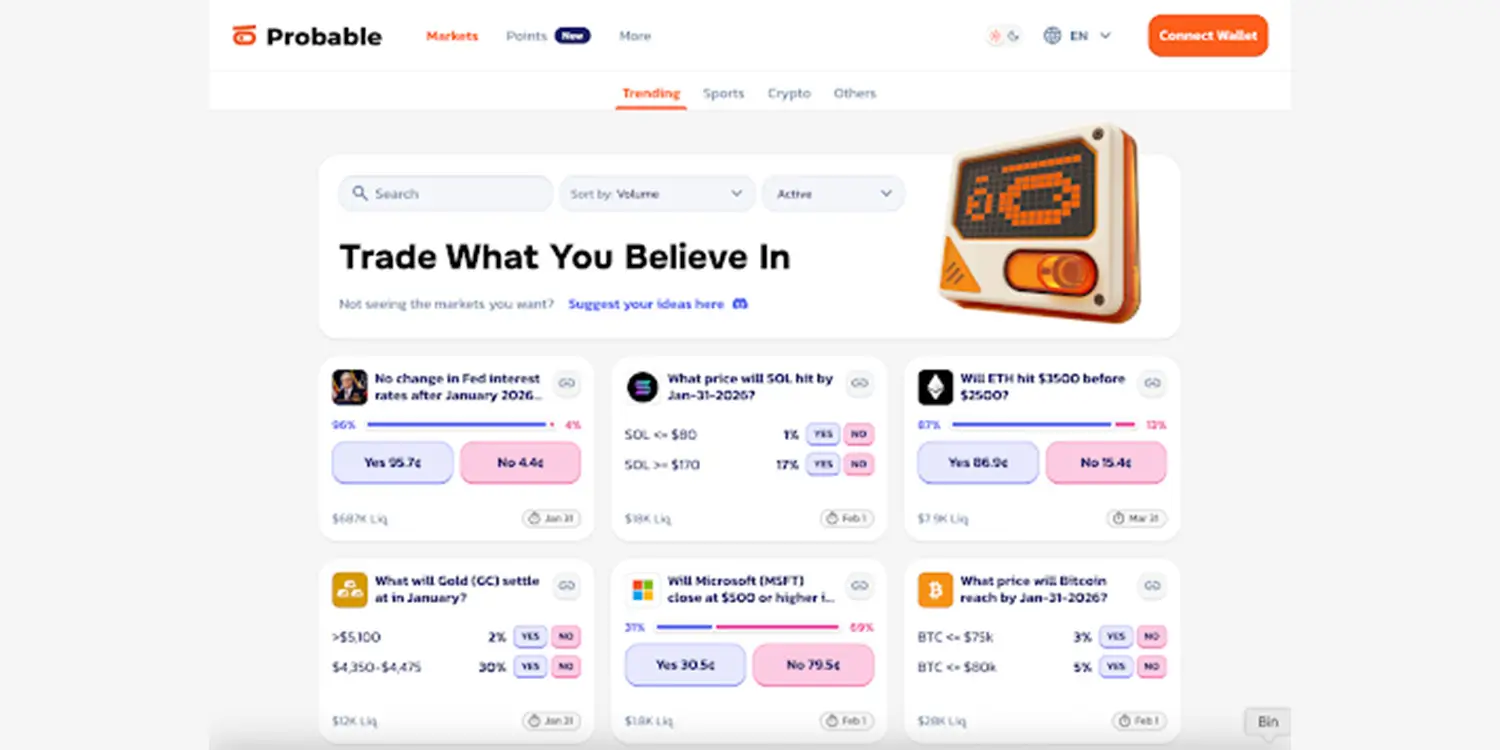
Author Review
Probable is easy to use, even for beginners in prediction markets. You deposit any token, and Probable automatically converts it into USDT on BNB Chain. It does this without swapping or bridging, removing any friction or expected fees. However, since Probable uses orderbook liquidity and markets depend on active traders, some events can feel thin outside the most popular ones.
| Key Parameters | Details |
| Fee structure | Zero fees (except gas fees for deposits/withdrawals to your wallet) |
| Supported deposit option | USDT on BNB chain |
| Platform type | Decentralised |
| Regional restrictions (if any) | Iran, Syria, Cuba, North Korea, and the Crimea, Donetsk, and more |
Best Platform For Beginners with Good UI
Myriad markets first launched on the Abstract blockchain and later expanded to Linea and BSC to keep gas fees low. It is also available as an in-wallet app inside Trust Wallet, making it the first prediction market built directly into a wallet. 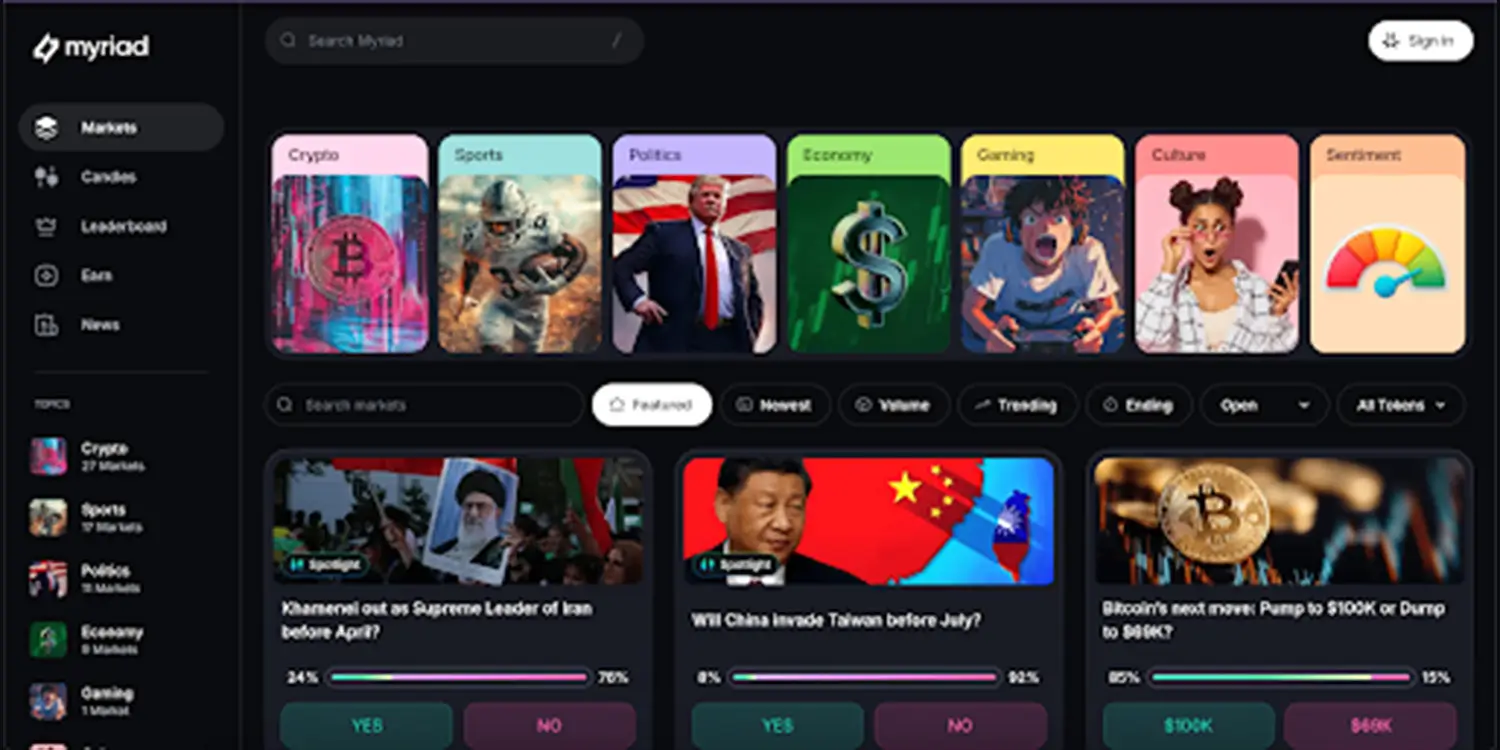
Myriad uses an automated market maker (AMM) to set prices and provide constant liquidity. It supports nuanced odds with gradual price changes, so markets can adjust in real time as new information comes in.
Author Review
Myriad is one of the easiest prediction markets to navigate. The layout is clean, and you can see the number of active events in each category, so you know where activity is happening. Myriad also has a points system.
You earn points by connecting social accounts, reading and engaging with content from partners like Decrypt and Rug Radio, and by making correct predictions. Then, you can use these points to practice before risking real money.
| Key Parameters | Details |
| Fee structure | 1% to reward liquidity makers, 1% to the distributors, and 1% fee to fund Myriad Markets development |
| Supported deposit option | USDC |
| Supported chains | Linea, Abstract, BSC |
| Platform type | Decentralized |

Best For High-volume Traders Who Want CEX-like Order Books
Opinion is built on the BNB Chain and uses a central limit order book (CLOB) similar to those used by centralized crypto exchanges.
Market outcomes are first resolved by Opinion AI, the in-house agentic oracle and market-creation tool, which analyses information from predefined sources. Then, it’s reviewed by a jury of models and agents, including Gemini, OpenAI, and Claude, before independent human reviewers evaluate and verify the final determination.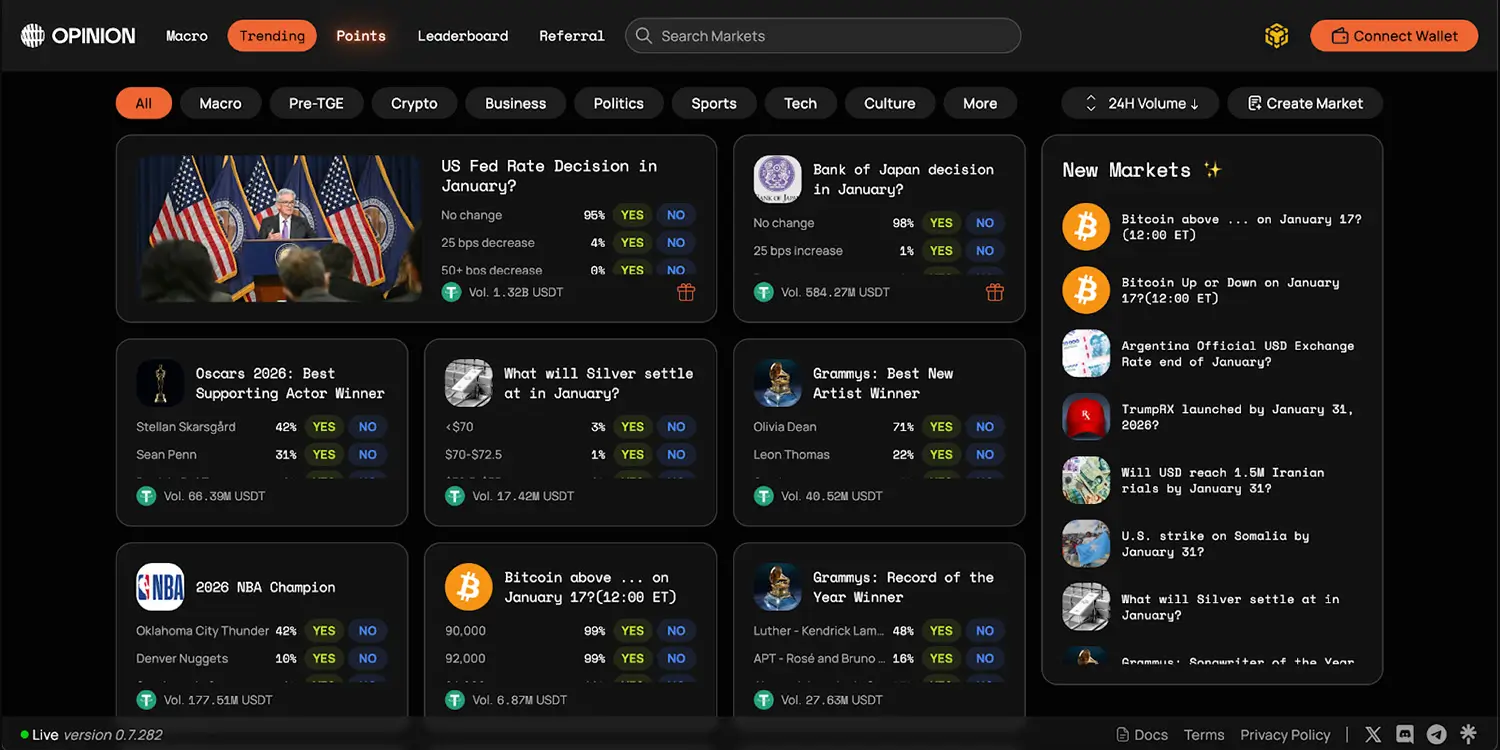
Author Review
The order book setup makes pricing feel precise and familiar. I also particularly like the OPN points program, which rewards trading, liquidity provision, and holding positions. It’s a strong driver of activity on the platform, growing Opinion into one of the highest-volume prediction markets, currently ranking behind ahead of Polymarket.
| Key Parameters | Details |
| Fee structure | 0% to 2% taker fees ($0.5 minimum fee) |
| Platform type | Decentralized |
| Regional restrictions (if any) | Iran, Syria, Cuba, North Korea, Crimea, and more. |
| Minimum amount (in USD) | $5 |
| Total unique users | 174,107 (Dune Data) |
| Security audits | ScaleBit and Zellic |

Best Prediction and Betting Platforms For Sports Bettors
SX Bet is primarily a sports betting platform, but it works very differently from traditional betting sites. It runs on its own Arbitrum Orbit rollup, called the SX Protocol, and all bets are peer-to-peer instead of against the house.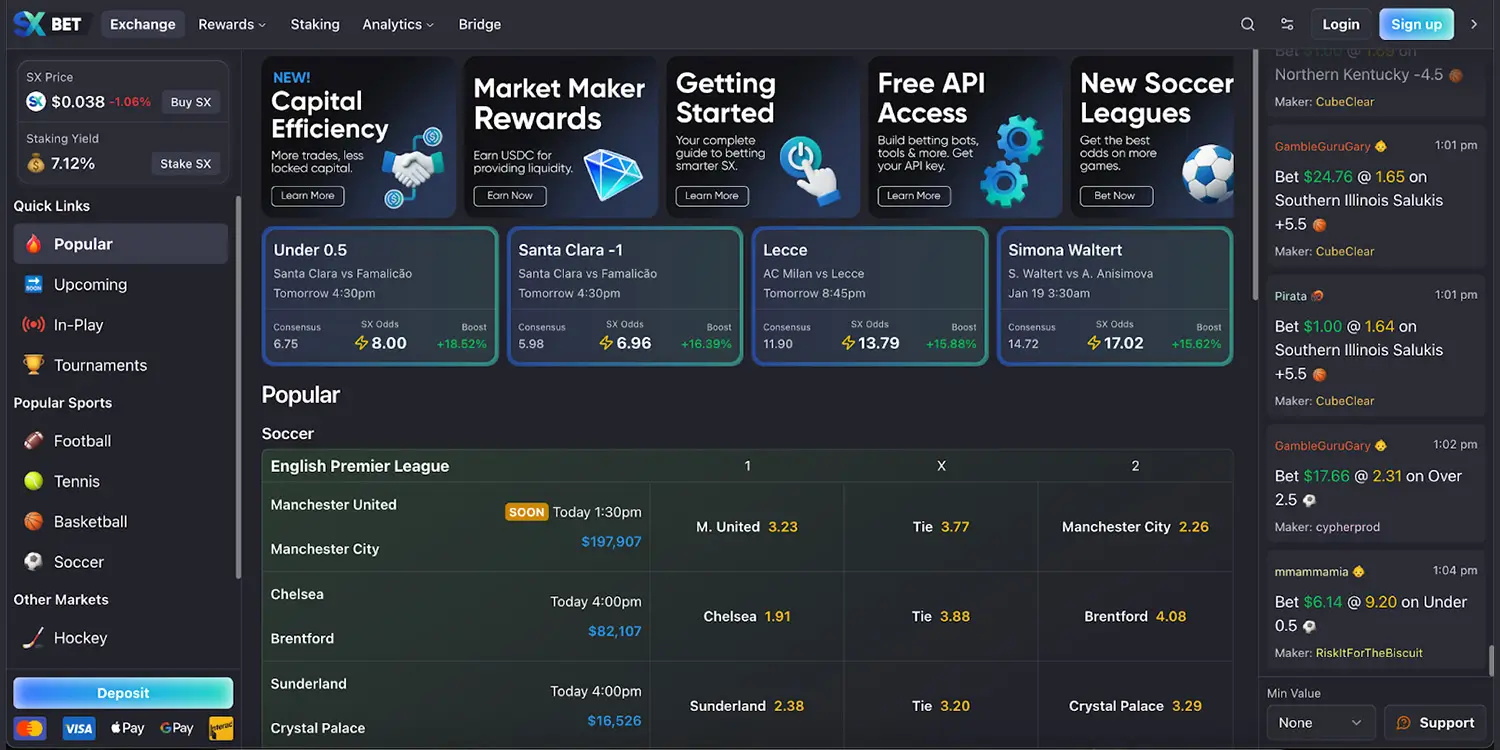
Betting markets are created programmatically with a sports market API or manually through the market creator GUI dApp. Bets start when a maker posts an order and a taker fills it. The API matches the maker and taker orders and records the trade on-chain through the FillOrder contract. Funds are locked in Escrow until the game ends. Then, the market’s creator reports the result via the ReporterService, and once verified, the BetPayoutService automatically releases funds to the winners.
Author Review
SX Bet looks a lot like a traditional sports betting site, so it feels familiar if you already bet on sports. The difference is that you can see order book odds and liquidity for each event, similar to a crypto exchange. This gives you more control over pricing. However, the token purchase and bridging process can feel confusing, especially if you are not used to crypto wallets and on-chain trading.
| Key Parameters | Details |
| Fee structure | Withdrawals are subject to a 0.33% fee and 3% taker fee on Arbitrum and Berachain |
| Supported deposit option | USDC |
| Platform type | Decentralized |
| Regional restrictions (if any) | Australia, Austria, Comoros, France, Germany, and more |
| Payout/resolution time | 12 hours |
| Minimum amount (in USD) | None |
All prediction markets follow the same principle: creation — movement — resolution. Understanding this flow makes it easier to see how different prediction markets implement the same idea in slightly different ways.
Crypto prediction markets are built around real-world events such as elections or sports results. To prevent future confusion, each market clearly states the outcome conditions and the data source used to determine the result.
Based on how outcomes are defined at creation, prediction markets broadly divide into three types:
Yes/No markets: Also called binary markets, they ask questions with only 2 possible outcomes. It’s also the easiest market type to understand, and the quickest to resolve, which is why leading prediction markets like Polymarket use it.
If “Yes” shares trade at $0.40, buyers are betting there’s a 40% chance it happens, while others buy “No” if they think it won’t. If rising tensions make an invasion more likely, “Yes” prices go up and “No” prices fall, and when the market resolves, the correct outcome is worth $1 per share while the other option becomes worthless.
Scalar markets: As the name implies, this market type offers scale-based options, rather than a Yes or No outcome.
Multi-outcome markets: A market can also have multiple options and outcomes, like an election with multiple candidates or a tournament with many teams, where only one can be true.
Crypto prediction markets rely on trading mechanisms that determine how liquidity is provided and how prices are formed. In practice, these markets use one of two mechanisms: automated market makers (AMMs) and order-book-based markets.
Oracle resolution is the penultimate step that ties market creation to settlement. When the set date and time for an event reach, trading stops, and the system moves from allowing bets to verification. At this point, an oracle steps in to determine the real-world outcome and report it on-chain.
Many crypto prediction markets rely on optimistic oracles, where an outcome is proposed based on data sources and assumed correct unless someone challenges it. For example, once a market is proposed for resolution on Polymarket, it enters a two-hour challenge window to allow disputes if the proposed result is incorrect. If no dispute is raised, the outcome is finalized automatically.
When a market resolves, the payout and settlement process kicks in. If you hold winning shares, you receive $1 per share through the smart contract, while losing shares become worthless and have no claim. The timeframe depends on the platform and Oracle design.
Prediction markets that use optimistic oracles usually settle within 2 hours if there are no disputes. However, if a dispute arises, the settlement takes longer, as the oracle needs more time to review evidence and finalize the outcome.
Next, claiming winnings requires an on-chain transaction, which means you’ll pay network fees (gas fees). On lower-fee chains like Arbitrum and BSC, gas fees are almost negligible, but on more congested networks, they can be slightly higher. To reduce this, some markets batch settlements or allow delayed claiming so users can redeem payouts when gas fees are lower.
Another way to categorize prediction markets is based on the type of outcome people are trying to predict. Some markets focus solely on sports, like SX Bet, while others combine crypto, politics, and sports.
1. Crypto Price & ETF Outcome Prediction Markets: These markets let you predict whether a crypto price or ETF-related event will hit a specific condition by a particular time.
2. Political & Election Forecasting Markets: Political forecasting markets focus on elections, policy decisions, and government actions.
3. Sports & Entertainment Prediction Markets: Sports prediction markets often include entertainment-related events. As such, you can predict outcomes in basketball, soccer, football, tennis, rugby, single games, tournaments, award shows, and entertainment events.
4. DAO Governance & On-Chain Decisions: DAOs regularly vote on proposals that affect how a protocol works, how funds are spent, or what changes get shipped, and you can predict around these decisions.
Traders analyze governance forums, voting power distribution, and public sentiment to decide whether to buy Yes or No shares.
We tested each prediction market and compared its performance in real time utilizing Coingape review methodology. The metrics below reflect what mattered most during use. We added a percentage to each one in order of its importance to the overall experience.
| Metric | Description | Weightage (%) |
| Liquidity model and depth | How easily can a user enter and exit positions without large price swings or delays? | 20% |
| Security and audit | Has the platform been audited, tested, and proven resilient against exploits? | 18% |
| Trading mechanism | How are prices formed? | 15% |
| Market coverage | Does the platform have many categories and list relevant markets when new events emerge? | 12% |
| Oracle & resolution process | Who decides the outcome and what happens in case of a dispute? | 10% |
| Ease of sign-up and onboarding | How simple is it to start trading? | 10% |
| User interface & experience | Is it easy to understand odds, positions, and risk at a glance? | 10% |
| Fees | What are the withdrawal and deposit fees and gas costs? | 5% |
In the United States, prediction markets are often treated as derivatives or event contracts and are subject to financial regulation. In the EU and the UK, regulators view them as within the scope of the Gambling Commission, with rules varying by country and regulator.
On the other hand, prediction markets are either loosely regulated, explicitly banned, or exist in legal grey areas in parts of Asia, depending on whether they resemble betting, financial products, or informal markets.
The key reason for this variation is the market type and asset. Critics claim that election-based markets can influence election results, markets tied to economic data attract financial regulators, and sports or entertainment outcomes are treated as gambling. Crypto-based markets add another layer of complexity because they involve digital assets, on-chain settlement, and decentralization.
Prediction markets are regulated by the US Commodity Futures Trading Commission (CFTC). The CFTC views these markets as commodity derivatives, especially when they involve economic indicators, elections, and policy outcomes. As such, regulated event contracts must receive explicit CFTC approval.
Prediction markets like Polymarket are currently regulated by the CFTC, meaning they must comply with strict regulatory requirements, including limits on market size, restrictions on who can use them, KYC requirements, and strict reporting and compliance rules.
Decentralized prediction markets are typically permissionless. They do not require identity checks and allow anyone with a compatible wallet to predict and bet. However, some platforms now add compliance layers such as KYC checks, country-based geo-blocking, transaction monitoring, or restricted asset usage to operate more safely within specific legal frameworks.
This is because the legal risk is much higher for operators, who may face regulatory action, fines, or forced compliance. In comparison, the risk for users is relatively low and usually limited to only account restrictions or loss of access.
The legal status of decentralized prediction markets depends on your local regulations. So, make sure to check your local laws before using any of them. In practice, regulators focus more on platform operators than individual users, since platforms create the markets, define the rules, and handle resolution.
That said, tax responsibility remains with you, the user. From a tax perspective in the United States, gains and losses from prediction markets are taxable, and if a taxpayer ends the year with a net loss, up to $3,000 can be deducted against ordinary income.
Prediction markets are often accurate, especially when they attract enough participation and capital. They have repeatedly matched and outperformed expert forecasts and have become a go-to for breaking news before news outlets report it.
For instance, just before President Trump announced the capture of Venezuelan president, Maduro, an event on Polymarket had already predicted the outcome, leading to a $436,000 win from a $32,537 bet.
The best crypto prediction market for you depends on your interests, trading style, your goals, and the level of risk you’re comfortable taking. As a rule of thumb, start with categories you already understand.
If it’s politics, focus on political markets first before branching out. If it’s sports, trade familiar leagues and events until you’re comfortable with how odds move and markets resolve.
With that in mind, here are some use cases to remember:
Additional Resources
The biggest prediction market by volume is Kalshi. It has over $2.14B 7-day volume as of the writing of this article.
Myriad Markets is the best for beginners. It has an easy-to-navigate dashboard and a points system that rewards you for doing simple tasks. You can use those points to practice before risking real money.
The prediction market odds represent the probability of an outcome. A contract trading at $0.40 implies a 40% chance of that event occurring.
If it’s regulated, regulators oversee an orderly wind-down where users can withdraw funds. If it’s decentralized, access and resolution depend entirely on the smart contracts and oracles.
If the market uses a UMA Optimistic Oracle, UMA token holders vote on the outcome based on publicly verifiable facts, and the market settles. In the absence of a dispute mechanism or if the oracle fails, the funds remain stuck in the contract indefinitely.
Yes, they are taxable. In the US, gains and losses of prediction market trades are reported via Form 1099-B to the IRS.
It depends on the prediction market. Regulated markets require full KYC, while decentralized prediction markets do not.
Event contracts are regulated prediction markets with standardized contracts, whereas prediction markets include both regulated platforms and decentralized markets.
Yes, prediction markets can be manipulated, especially in low-liquidity situations. A single large trade can temporarily push prices away from their real values.
Treat prediction markets as sentiment and probability signals alongside fundamental analysis, rather than as a standalone investment thesis.
The recommended wallets for decentralized prediction markets are Metamask, Trust Wallet, and Coinbase Wallet. They support different chains and are compatible with Web3 dApps.


 2M+ Monthly Readers
 50k+ Articles


 Buy $GGs