CoinGape has been covering cryptocurrency and blockchain markets since 2017. Our editorial team evaluates projects and platforms using structured review frameworks focused on transparency, utility, and risk assessment. You can explore our review methodologies to see how we assess and rate different categories. We maintain clear editorial standards and disclose advertising or affiliate relationships where applicable.
Decentralized crypto banking refers to non-custodial, smart contract-based financial services that replicate core banking functions without relying on traditional intermediaries. In simple terms, a decentralized crypto banking solution allows you to store digital assets in wallets you control while accessing everyday financial services.
By the numbers, decentralized finance continues to expand. According to a 2026 report from Coinlaw, DeFi’s total value locked (TVL) across all chains is between $130 billion and $140 billion, up from $123.6 billion in mid-2025. This growth is driven by rising demand for self-custody, borderless access without intermediaries.
In this article, we review the leading decentralized crypto banking solutions in 2026 and evaluate their performance in real-world use.
| Wallet Name | Best For | Core Services | Supported Chains | Custody Type | Audit Status | Ratings |
|---|---|---|---|---|---|---|
 1. MetamaskRead More | Advanced DeFi Traders | Self-custody wallet, payments, debit card, buy, swap, staking & perps | ETH, ARB, Avalanche, Base, POL, OP, BSC | Non-custodial | ChainSecurity and Guardian | 4.7 |
 2. WeFiRead More | High-Risk Yield Traders | Savings, payment, storage, yield | WeChain and LayerZero | Custodial | Solidproof | 3.2 |
 3. Uniswap WalletRead More | On-Chain Swaps | Self-custody wallet, swap, buy, sell, bridge | ETH, ARB, Base, OP, POL, SOL, & 10 more | Non-custodial | Trail of Bits | 4.5 |
 4. Crypto.comRead More | Full-Service Crypto Users | Buy, send, receive, swap, bridge, perps, staking, debit card | 36 chains, including ETH, Bitcoin, BSC, and more | Hybrid (self-custody & custodial) | Kudelski Security | 4.0 |
 5. NexoRead More | Long-Term Yield Seekers | Earn interest on savings, borrow, spend, swap | 20+ chains including ETH, SOL, and more | Custodial | A-Lign | 3.8 |
 6. WirexRead More | Crypto-Backed Everyday Spending | Buy, sell, receive, send, borrow, debit card | ETH, BSC, Tron, Base, Stellar, Bitcoin, Avalanche-C | Hybrid (self-custody & custodial) | NA | 4.0 |
 7. Ready (formerly Argent)Read More | Conservative Stablecoin Savers | Self-custody wallet, swaps, staking/yield, debit card | Starknet | Non-custodial | ChainSecurity and Consensys Diligence | 4.6 |
 8. Trust WalletRead More | DAO Treasury Managers | Self-custody wallet, swaps, staking, DApp browser | 100+ chains, including BSC, SOL, and ETH | Non-custodial | Kudelski, Certik, Halborn, Cure53, Salus, Quantstamp | 4.8 |
We tested 14 popular decentralized crypto banking platforms using the CoinGape review methodology and evaluated what each platform promises versus what it delivers in practice.
Based on this, we narrowed the list to eight platforms that consistently met our standards.
Best for Advanced DeFi Traders
Metamask is one of the largest non-custodial crypto wallets, with over 100 million users worldwide. It’s open-source and stores private keys locally in your browser or mobile device, meaning only you control your funds.
Metamask is available as a browser extension (Chrome, Firefox, Brave, Opera, Edge) and as a mobile app. It supports the Ethereum network and most EVM-compatible chains like BNB Chain, Polygon, Arbitrum, Optimism, and Avalanche. Like traditional banks, you can swap currencies (tokens), save to earn interest (stake ETH), and interact directly with DeFi apps without giving up custody.
| Key Parameters | Details |
| Fee Structure | 2% on ATM withdrawals for free-tier. No fee up to $1,200 / mo, then 2% on metal tier. 1% fee on cross-border merchants for the free tier |
| Supported Chains | Ethereum, Arbitrum, Avalanche, Base, Polygon, Optimism, BNB Smart Chain |
| KYC Requirements | No KYC needed except to apply for a Metamask card |
| Risk model | Non-custodial |
| Supported Regions | Available across the world except Iran, North Korea, Cuba, Syria, Crimea, Donetsk, and Luhansk |
| Security & Audits | ChainSecurity and Guardian |
| No of Active Users | 30 million monthly active users |
What stands out most about MetaMask is its universality. Nearly every DeFi protocol integrates with MetaMask by default. On the innovation front, MetaMask acquired Web3Auth to introduce alternative login and recovery methods beyond the traditional seed-phrase model, including social login. This helped to reduce onboarding friction for new users.
Best for High-Risk Yield Traders
WeFi advertises itself as a decentralized crypto banking platform offering global payments, yield products, ATM withdrawals, and on-chain banking accounts. It supports over 7,000 crypto assets and reports 150,000+ users across 80+ countries. The platform is accessible via web and mobile apps. Beyond standard wallet functionality, WeFi offers a cloud-mining feature that lets users mine without physical hardware.
| Key Parameters | Details |
| Fee Structure | 1.5% fee for card transactions |
| Supported Chains | WeChain and LayerZero |
| KYC Requirements | KYC needed |
| Risk model | Custodial (Assets held by a third party) |
While WeFi markets itself as fully non-custodial, parts of its terms of service state that it may “disable access to exchange services for maintenance, emergency repairs, or as deemed necessary.” That introduces a level of platform control that feels closer to a CEX than self-custody.
Another thing worth noting is fee transparency. Some fees, like foreign exchange conversions and fiat withdrawal charges, are disclosed at the point of transaction rather than clearly outlined upfront. This is a deal breaker for users who value full clarity over a feature set.
Best for On-Chain Swaps
Uniswap Wallet is a self-custody wallet designed for swapping, sending, bridging, and connecting to on-chain apps across 16+ networks. Being non-custodial also means users can move between cash and crypto using a debit card or bank account without providing their name, email, or phone number.
| Key Parameters | Details |
| Fee Structure | Interface fee is up to 1.0% with other DeFi, and 2.0% for CeFi |
| Supported Chains | Ethereum, Unichain, Arbitrum, Avalanche, Base, Blast, BNB Smart Chain, Celo, Monad, Optimism, Polygon, Solana, ZKsync, Zora |
| KYC Requirements | No KYC needed |
| Risk model | Non-custodial |
| Supported Regions | Available in all countries except Belarus, Cuba, Iran, Iraq, Côte d’Ivoire, Liberia, North Korea, Sudan, Syria, and Zimbabwe |
| Security & Audits | Audited by Trail of Bits |
| No of Active Users | 3.2 million monthly active users |
I particularly love that Uniswap wallet includes built-in MEV protection to reduce frontrunning and sandwich attacks. In addition, Uniswap’s routing engine optimizes execution behind the scenes by splitting trades across multiple liquidity pools to reduce slippage.
With the launch of Uniswap V4 and the introduction of hooks, developers can customize pool behavior within a single consolidated architecture. Over time, this translates into better pricing, dynamic fees, and greater liquidity for users.
Best for Full-Service Crypto Users
Crypto.com serves over 150 million users globally and offers one of the broadest crypto ecosystems in the market. Its biggest strength is convenience. You can move from fiat to crypto, send, bridge across chains, stake, and trade over 1,000 tokens across major chains without leaving the interface. For advanced traders, Crypto.com offers access to a perpetual decentralized exchange with long and short positions, up to 100x leverage.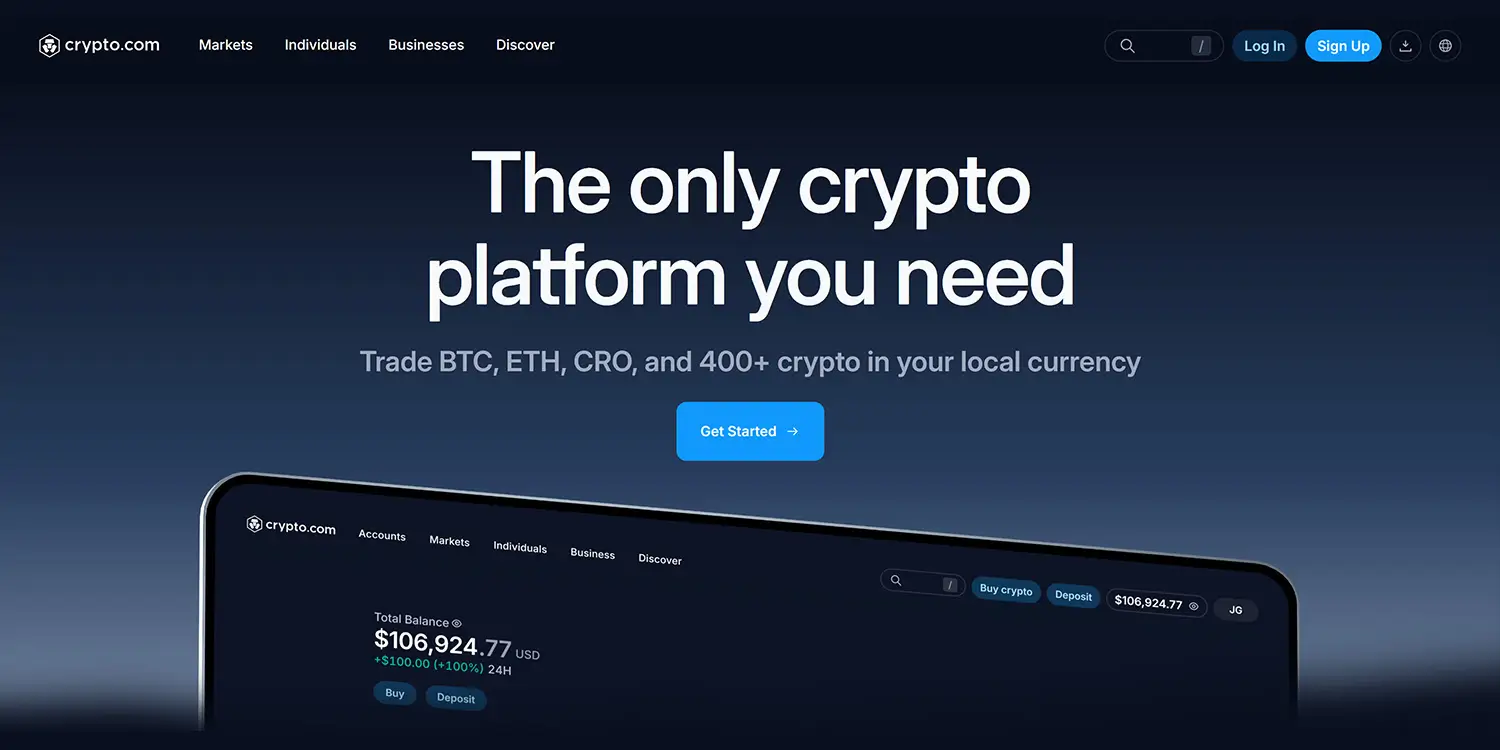
| Key Parameters | Details |
| Fee Structure | Up to 4% on debit/credit crypto purchases, €1 bank withdrawal, 1% credit card top-up, 2% above ATM free limit, €50 account closure, €5 inactivity fee after 12 months, 0.2% EU purchases, and 2% outside EU |
| Supported Chains | 36 chains, including Ethereum, Bitcoin, BNB Smart Chain, Fantom, Arbitrum, Optimism, and Solana. |
| KYC Requirements | Yes, required |
| Risk model | Hybrid (custodial and non-custodial) |
| Supported Regions | 105 countries, including the United States, France, Germany, and the United Kingdom |
| Security & Audits | Audited by Kudelski Security |
If you want scale, global support, and an all-in-one experience, Crypto.com delivers. That said, fees are where things start to add up. 1% debit/credit card top-up fee. 2% ATM withdrawal fee above the monthly free limit. €50 account closure fee. Card replacement fee. €5/month inactivity fee charged after 12 months of no card transactions. 0.2% purchase fee within the EU, 2.0% outside the EU.
Best for Long-Term Yield Seekers
Nexo is a fully custodial crypto banking platform built around three core functions: earn, borrow, and spend. You can grow your digital assets with yields advertised up to 16% annually, borrow against your crypto holdings, and use a crypto card that supports both credit and debit modes. You can also fund your account via bank transfers in your own name (USD, EUR, GBP accounts) or deposit crypto across 20+ blockchain networks.
| Key Parameters | Details |
| Supported Chains | 20+ networks, including Ethereum, Solana, and Tron |
| KYC Requirements | Yes, required |
| Risk model | Custodial |
| Supported Regions | Available globally, except few regions like, Afghanistan, Canada, Central African, the state of New York (U.S.), and more. |
| Security & Audits | Audited by A-Lign |
Nexo’s interface is clean. I love that you can easily switch between earning, borrowing, spending, and card modes with one tap. The ability to spend without selling your crypto is also one of its strongest features, especially during volatile markets.
Best for Crypto-Backed Everyday Spending
Wirex is trusted by over 7 million users, and it’s available in 130+ countries. It combines a crypto wallet, bank account features, and a Mastercard debit card into one app. You can spend crypto or traditional currencies online, in-store, or withdraw cash from ATMs. 
Wirex also advertises up to 8% cashback in its native token (WXT), which users can exchange, send to external wallets, or spend again through the card, and up to 14% interest on stablecoins. However, rewards being paid in WXT mean you’re exposed to the token’s price volatility.
| Key Parameters | Details |
| Fee Structure | 2% ATM fee after the monthly limit |
| Supported Chains | Ethereum, Binance Smart Chain, Tron, Base, Stellar, Bitcoin, Avalanche-C |
| KYC Requirements | Yes, needed |
| Risk model | Hybrid (self-custody + custodial) |
| Supported Regions | Available in 130 countries, including the United States, the United Kingdom, the United Arab Emirates, and Spain. |
Wirex’s strong suit is how easily you can move between crypto and real-world spending with its Visa card. Fees are generally low compared with alternatives such as Crypto.com, with most services free. Although a 2% ATM fee applies after exceeding the monthly free withdrawal limit.
Best for Conservative Stablecoin Savers
Ready is a self-custody crypto banking platform available in 150 countries. You can deposit in six currencies and have them automatically converted to USDC for spending. The Ready Card is split into two options: Metal and Lite. 
Metal members pay nothing on FX, while Lite members pay 1% FX. Also, Metal members can withdraw up to $800 per month fee-free, while Lite is capped at $200 before a 2% fee applies. Lastly, Ready offers 3% cash back (paid in STRK) on up to $5,000 in monthly spending, capped at $150 in STRK per month or $1,800 in STRK in a year.
| Key Parameters | Details |
| Fee Structure | 1% FX fee (Ready Lite card)
2% ATM fee after the monthly limit |
| Supported Chains | Starknet |
| KYC Requirements | No KYC for wallet. But card services require verification. |
| Risk model | Non-custodial |
| Supported Regions | 150+ countries, including the United Kingdom, United Arab Emirates, and India. |
| Security & Audits | Audited by ChainSecurity and Consensys Diligence |
Ready stands out for seamlessly converting fiat to USDC for instant card spending. I love that there are so many options to fund your wallet. You can buy crypto through Ramp or Banxa using Apple Pay or Google Pay, bridge assets from exchanges to Ready within seconds, transfer from another Starknet wallet, or buy directly from your bank account to Ready. Its smooth StarkNet integration and low-cost transfers are also attractive features.
Best for DAO Treasury Managers
Trust Wallet is a popular self-custody crypto wallet trusted by over 200 million users. It supports millions of assets across 100+ blockchains, including BNB Chain, Ethereum, and Solana, and is available as a mobile app and browser extension. You can buy crypto directly in the app, deposit from exchanges, sell, swap tokens, earn staking rewards, and explore DApps without leaving the interface.
| Key Parameters | Details |
| Fee Structure | No wallet usage fees. Users only pay network gas fees |
| Supported Chains | 100+ blockchains, including BNB Smart Chain, Solana, Sui, and Ethereum |
| KYC Requirements | No KYC required |
| Risk model | Non-custodial |
| Supported Regions | Available in 190 countries, including the United States, Brazil, France, Germany, the United Kingdom, and Canada |
| Security & Audits | Audited by Kudelski, Certik, Halborn, Cure53, Salus, and Quantstamp |
| No of Active Users | 17 million monthly active users |
A standout feature of Trust Wallet is that it does not charge fees for holding or sending crypto, and there are no app usage fees. You only pay network gas fees, which vary depending on congestion and the blockchain you’re using.
To make that even better, Trust Wallet recently launched a gas sponsorship feature that removes the gas fee barrier entirely in certain cases. If you initiate a swap on BNB, Solana, or Ethereum and don’t have enough native tokens for gas, the wallet automatically covers the fee for you.
Decentralized crypto banking solutions give you the ability to use banking-like services without a traditional bank holding your money. They do this using blockchain networks, cryptocurrencies, and smart contracts instead of centralized bank balance sheets and intermediary clearing houses.
Some of the banking-like services offered by decentralized banking platforms include:
With decentralized crypto banking solutions, you can borrow crypto by locking up digital assets as collateral. Loans are typically overcollateralized, meaning you deposit more value than you borrow to secure the position. Conversely, you can lend your crypto to liquidity pools and earn interest from borrowers. Rates adjust automatically based on supply and demand.
You deposit stablecoins to earn interest (or yield) through lending markets, staking, or automated vaults. Tokenized vaults go further by automatically deploying your assets into different strategies and compounding returns on your behalf.
You deposit a pair of tokens into a liquidity pool on a decentralized exchange to ensure that traders can swap between those tokens efficiently with minimal slippage when pool depth is high. In return, you earn a share of the trading fees, and in some cases, additional rewards.
Some decentralized crypto banking solutions, such as Ready, Wirex, and Nexo, offer crypto debit cards that let you spend stablecoins or other digital assets wherever traditional card networks are accepted. This bridges decentralized finance with everyday real-world payments.
The difference comes down to accessibility, custody and control, infrastructure, security, and innovation.
To identify the best decentralized crypto banking solutions, we tested multiple platforms firsthand and reviewed popular recommendations across leading industry publications. We applied a consistent evaluation framework focused on security, liquidity depth, multi-chain support, risk controls, governance transparency, protocol resilience, and overall user experience.
Then, we assigned each metric a percentage weight based on its importance to long-term safety, usability, and capital efficiency. Security and risk management were given the highest weighting, as these factors directly impact capital protection.
| Metric | Description | Weightage (%) |
| Smart contract audits and security history | Has the crypto bank been independently audited, stress-tested, and proven resilient against exploits? | 20% |
| Total Value Locked (TVL) | Does the protocol maintain strong liquidity? | 17% |
| Supported chains | Is the banking solution available across Ethereum, Layer 2 networks, and other major blockchains? | 10% |
| Risk management model | Does the platform have collateralization ratios, liquidation systems, and price oracles to minimize systemic risk? | 20% |
| Governance transparency | Are governance proposals, treasury decisions, and voting processes publicly accessible and transparent? | 8% |
| Protocol longevity and resilience | Has the platform demonstrated stability across multiple market cycles and high-volatility events? | 15% |
| User experience and wallet compatibility | Is the interface intuitive and beginner-friendly, and does it integrate smoothly with major non-custodial wallets? | 10% |
While DeFi is riskier than traditional banks due to smart contract bugs, phishing attempts, and hacks, not all decentralized banking platforms carry the same level of risk.
In the previous section, we outlined the evaluation framework and metrics we prioritized when ranking the best options. Beyond our methodology, here’s what you should personally look out for before choosing a decentralized crypto bank and depositing capital.
The first thing to verify is whether the bank’s smart contracts have been independently audited. Reputable crypto platforms publish audit reports from established security firms and maintain transparency about past vulnerabilities.
Safer decentralized lending platforms require borrowers to deposit more value than they borrow. This overcollateralization model and clearly defined liquidation mechanisms reduce default risk and help protect lenders during volatile market conditions.
Some protocols maintain safety modules or internal reserve funds designed to absorb unexpected losses. They provide an additional layer of protection during extreme market stress or smart contract hacks.
Protocols with publicly visible proposals, on-chain voting records, and transparent treasury management reduce uncertainty. Clear governance structures make it easier to assess how risk parameters are adjusted and how protocol changes are implemented over time.
The more liquidity a platform has, the easier it is to borrow, lend, swap, or withdraw funds. Banking solutions with deeper total value locked (TVL) are generally more stable because they can absorb large transactions and market volatility more smoothly.
A protocol’s track record during previous bear markets is one of the strongest indicators of resilience. Platforms that have maintained solvency and continued operating smoothly through major crypto crashes demonstrate stronger risk controls and stress-tested infrastructure.
Decentralized banking platforms typically operate without government oversight or deposit insurance. However, this does not automatically make decentralized platforms unsafe; it simply means you are relying on protocol design and smart contract security, rather than legal guarantees or institutional protections.
Regulation of DeFi remains unclear and varies by country. Some governments are exploring regulatory frameworks, while others adopt a more restrictive approach. As such, while many decentralized platforms do not require KYC, others implement identity verification to comply with local laws.
After reviewing these decentralized crypto banking platforms, it’s evident that the right choice depends entirely on how you use crypto and the level of control you want over your assets.
For instance, a DeFi trader would prefer MetaMask for its integrations, multi-chain access, and advanced on-chain capabilities. Meanwhile, a DAO treasury manager would likely choose Trust Wallet for its support of 100+ blockchains and ability to manage diversified token holdings from a single interface.
With that context in mind, here’s how the eight decentralized crypto banking solutions rank across common use cases in 2026:
They are relatively safe if they have been independently audited, use overcollateralization models, maintain deep liquidity, and have a track record through market downturns.
Most decentralized banking platforms do not require KYC. You only need a crypto wallet. However, some crypto debit cards or integrated services may require KYC to comply with local regulations.
Decentralized banks generate yield by putting your crypto to work. Returns come from borrowers paying interest on loans, traders paying fees, or staking rewards earned by securing blockchain networks.
Yes, a decentralized platform can fail if its smart contracts are exploited, its risk model breaks during extreme market volatility, or liquidity dries up.
It depends on your country and the service’s structure. In many countries, the use of decentralized platforms is legal, while in others, financial laws are more restrictive.
In general, non-custodial wallets with strong security audits, deep liquidity, and a long track record, like Trust Wallet, MetaMask, and Ready, are considered safer than newer or unaudited ones.
It depends on your country. Interest from lending and liquidity rewards is often taxed as income. Likewise, selling or withdrawing crypto at a profit may trigger capital gains tax.


 2M+ Monthly Readers
 50k+ Articles