 Buy $GGs
DEX vs. CEX Futures Trading – What’s the Difference and Which is Safer?


Cryptocurrency trading is a vast phenomenon where traders have multiple options to pick, and one of them is futures trading. As the name suggests, it is the buying and selling of cryptocurrencies at a future date. Now, both centralized exchanges (CEX) and decentralized exchanges (DEX) support future trading.
However, the support is within their respective boundaries. As a trader, it is essential to evaluate the pros and cons of both options. Let’s begin with understanding the working mechanism of DEX in the context of future trading.
How does DEX Support Future Trading?
Decentralized exchanges (DEX) support future trading, focusing on perpetual features. They utilise smart contracts for trade automation, collateral management, liquidation handling, and more. The decentralized platforms offer many things, along with security, no censorship, and no involvement of centralized authority.
How does CEX Support Future Trading?
The centralized exchange (CEX) offers a regulated and highly liquid platform that works somewhat similarly to traditional financial systems. These platforms act as trusted intermediaries while managing the off-chain trades. They offer high leverage to augment potential gains.
Key Differences Between DEX and CEX
|
Basis |
DEX |
CEX |
|
Operations |
Decentralized |
Centralized |
|
Trading |
Peer-to-peer trading |
Buy and sell through the exchange |
|
Asset Control |
Non-custodial |
Custodial |
|
Speed |
On-chain/L2 (variable) |
Off-chain (high speed) |
|
Regulatory framework |
Not regulated |
Subject to regulation |
|
Fees |
Low fees |
Higher fees |
|
Privacy |
Anonymous No-KYC trading |
KYC/AML (Id) required |
|
Risks |
Smart contract vulnerabilities |
Counterparty & Insolvency |
Also Read – List of Lowest Fees Crypto Exchanges
Which is Safer, DEX or CEX?
Crypto exchanges provide a specific set of features that are primarily geared toward the needs of traders. If you want to be anonymous while also having complete control, DEX is the best option. However, if you prefer a more centralized and regulated platform, CEX fits the bill.
Now, for some, privacy and safety of their funds are above all. Generally, DEX and CEX entail respective security anomalies. Dex is highly feasible for professionals and seasoned traders but carries smart contract vulnerabilities. On the other hand, centralized exchanges are recommended by beginners but have been hacked or shut down.
A decentralized exchange gives you control over your respective private keys. There are no chances of fund freezing or bankruptcy. But the wallet security falls on the user themselves.
A centralized exchange provides users with speed, security, fiat on-ramps, high liquidity, and customer support. However, the funds may be frozen, mismanaged, or cause a regulatory shutdown.
CLOB vs. vAMM: How does the Order Actually Reach the Market?
Centralized exchanges typically use the Central Limit Order Book (CLOB), whereas decentralized exchanges use the Virtual Automated Market Maker (vAMM). The former is based on a traditional financial system, whereas vAMM is used for more complex operations like derivatives.
Central Limit Order Book (CLOB)
CLOB, or Central Limit Order Book, is order-driven and fashioned by CEXs, or traditional banks.
Step 1: Order submission: The buying and selling orders are submitted, which have information on quantity, time, and price.
Step 2: Mechanism: The registered order is then sent to a central system, where these orders are displayed in a dashboard.
Step 3: Matching process: The central system matches the incoming orders (buy/bid and sell/ask) with existing orders by following the two basic rules.
Price Priority: Matches the price with the highest bid with the lowest ask.
Time Priority: Orders with the same prices are matched on the basis of time.
Liquidity: Liquidity is provided by market makers and active traders. They receive fees on the occasion of order fulfilment.
Virtual Automated Market Maker (vAMM)
It is a decentralized innovation used for derivative trading in which real assets are not swapped directly. Here’s how it works.
Step 1: Order Submission: Users interact with the smart contract via simple swap without specifying a price limit.
Step 2: Mechanism: The trades take place against the virtual liquidity pool, wherein all parameters are set by a mathematical algorithm.
Step 3: Matching process: The smart contract calculates entry and exit points, as well as trades, while altering assets based on liquidity.
Liquidity: The collateral collected is stored in a separate vault. The liquidity is virtual; thus, it uses a programmed algorithm for price discovery. Generally, the AMM uses assets offered by liquidity providers in the liquidity pool, but vAMMs keep price calculation separate from collateral.
Also Read – CLOB vs AMM vs Peer to Pool
Where is the Liquidity Sourced, and Why does it Disappear During Volatility?
Exchanges obtain liquidity from market participants, which may include trading firms, institutional investors, banks, or others. Because of the numerous factors involved, liquidity dries up during times of volatility. One of them is panic selling, in which participants act identically and try to sell together; this event is known as “crowd exit.”
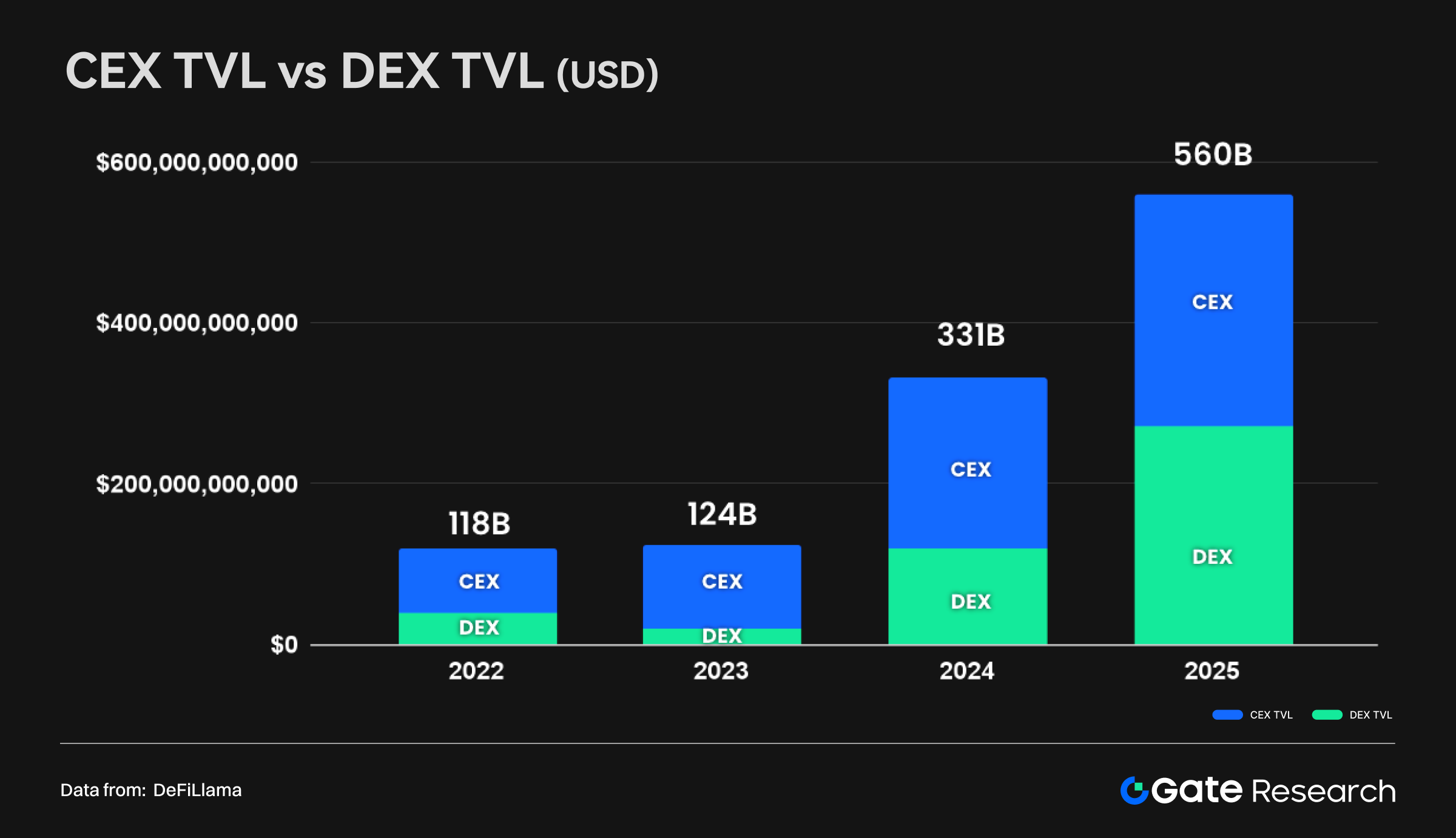
Image Source – Gate.com
Market makers tend to withdraw during the volatility to avoid uncertainty and cut losses. They also widen their bid and ask spreads during the fluctuations. Another factor is the breakdown of interbank lending. During the heavy volatile period, institutions are often concerned about the creditworthiness of their participants.
Which Safety are You Choosing – Counterparty Trust or Code Integrity?
The user can prioritize the requirements and determine which is more important to them.
The counterparty trust is entirely dependent on the legal framework, reputation, and the parties’ good faith. Centralized exchanges follow this model. However, it did contain vulnerabilities for fraud and mismanagement.
Code integrity entails cryptographic proofs and transparency. It reduces reliance on human trust and enforces immutable logic. The safety of this model is based on mathematical logic, but it is vulnerable to bugs and hacks.
Overall, the perspective of safety could only be determined by the needs of the individual participant. It is critical to evaluate and then make a decision.
Conclusion
Trading in any form, whether cryptocurrency, commodities, or stocks, involves risk. And now, with growth and development, there are options such as centralized or decentralized. The answer is based on your requirements. Before making a decision, understand the specifics of each exchange.
According to our findings, people who want regulated and reputable institutions should use centralized exchanges. However, if logic and reasoning are more important than anything else, decentralized exchanges can be the resort.