
 Buy $GGs
What is the Perpetual Futures Funding Rate, and How to Calculate it?


Unlike other derivatives trading contracts, perpetual futures contracts do not expire. Traders are allowed to hold on to their positions for as long as they wish, provided they maintain the trading factors and their collateral to avoid liquidation.
One of these trading factors is the funding rate. As a perpetual contract trader, you must understand how the funding rate works and how it affects your daily trading strategies.
Key Takeaways
- In perpetual futures trading, Funding Rates are premiums exchanged between long and short positions according to the difference between the spot and perpetual price of the traded asset.
- Funding rates are paid in intervals usually between 1-8 hours, depending on the exchange. In each interval, one side of the trade pays the other according to the presiding funding rate.
- Funding rate is a dynamic incentive intended to maintain a balance between the spot and perps price of an asset.
What is the Funding Rate in Decentralized Perpetual Trading?
Funding rates are regular fees exchanged between short and long position holders in a perpetual trading contract. They are determined using the difference between the perp and spot price of the concerned asset. 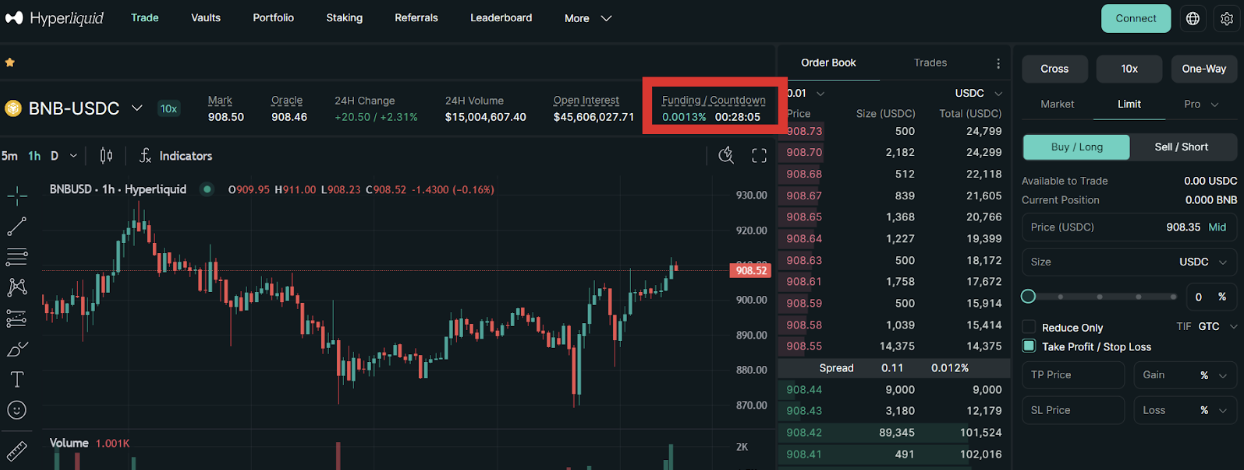
Funding rates are expressed as a percentage and represent the amount paid to the opposing contract. These payments are referred to as funding fees and are incentives to traders who hold positions against the prevailing market sentiments.
Importance of Funding Rate in Perps Trading?
In response to the dynamics of demand and supply, the price of assets on decentralized perpetual’s trading platform may deviate from the price on regular spot trading platforms. Other factors that may cause this deviation include trading liquidity and larger positions funded by leverage.
As spot prices are regarded as the accurate price of assets, the perpetual’s price is expected to maintain this (spot) price as well. Traditional futures trading handles this automatically as the trades settle at the normal spot price when the contract expires. This is not the same for perpetuals due to the non-expiration of the contracts. Funding rates are designed to maintain the spot and perpetual prices at zero or minimal deviation.
How Does the Funding Rate Work?
Funding Rates may be positive or Negative
1. Positive Funding Rate: Occurs when the price of the asset on the perpetual trading platform is higher than the price on spot trading platforms. Usually seen in a bullish market. When the funding rate is positive, long position holders pay short position holders.
2. Negative Funding Rate: Occurs when the price of the asset on the perpetual trading platform is lower than the price on spot trading platforms. Usually seen in a bearish market. When the Funding rate is negative, short position holders pay long position holders.
In summary,
- If you are holding a LONG position and funding rate > 0, you PAY
- If you are holding a LONG position and the funding rate < 0, you RECEIVE
- If you are holding a SHORT position and the funding rate > 0, you RECEIVE
How are Funding Rates Calculated?
Here, we will guide readers through the process of calculating the funding rate on perpetual trading platforms.
Important metrics to understand
For a better understanding of the Funding rates calculation, here are some important metrics you must understand;
- Spot Price: The average trading price of the asset on spot trading platforms.
- Perps Price: The Trading price of the asset on the Perps futures trading platform
- Time-Weighted Average Price (TWAP): Instead of the instant price, exchanges use TWAP as a fair metric for the price of the asset across spot and perps trading platforms. TWAP is the adjusted price of the asset that considers the different prices over time. TWAP protects traders from unfair funding rates caused by dramatic and short-lived price spikes.
- Dampening Factor: Some exchanges apply a dampening factor to smooth the funding rate and prevent outrageous funding rates. Dampening factors range from 0.5 to 1.0
- Funding intervals per day: Funding intervals per day is the number of times the funding payment is deducted per day. This is calculated as 24 divided by the platform’s funding structure by 24.
For instance, if a Dex uses the 8-hour funding system, their Funding interval per day is 24/8 = 3
Calculating the Funding rate and Funding fee
Funding rates are generally calculated as:
F = Interest Rate + Premium Index.
Interest Rates are fixed rates determined by the trading platform.
The premium index is the main driver of the Funding rate. It is the percentage difference between the spot and perp’s price.
Premium Index is calculated as
(perp price – spot price) / spot price
Most exchanges use the TWAP price to calculate the Premium Index.
For instance, if the Interest rate on the exchange is +0.008 and the premium index is +0.012;
The funding rate = 0.008 + 0.012 = +0.02.
Calculating funding fee
Using the funding rate, you can calculate the fee you pay or receive for your position.
Funding fee = Value of your position x Funding rate
For instance, if you hold a $100,000 BTC long position and the current funding rate is +0.02%
You will pay: $100,000 × 0.0002 = $20 every interval. If the exchange uses an 8-hour interval, you pay $20 every 8 hours ( $60 per day)
What does the funding rate mean for Perp Future traders?
Here’s the impact of funding rates on Perps traders
Funding rate deductions: If you are on the funding side of the market, Funding fees are deducted from your margin (your collateral account) every interval. The funding fees add to the total cost of holding your Perps position.
The trading platform may liquidate your position if you do not have enough funds to cover your funding fees. It is important to consider this while trading.
Arbitrage opportunities: Funding rates incentivize traders to open positions in a direction opposite the prevailing market sentiment. You can explore profitable trading strategies by employing funding rate arbitrages.
Gauging market sentiments: The Funding rate may indicate the general market sentiment. A strong positive funding rate is bullish, while a strong negative funding rate is bearish.
Conclusion
Funding rates on Perps futures trading platforms keep the spot and Perps trading prices in check. But for Perps traders, it expands the scope of their regular trading. As a trader, it is important to understand what this means in your day-to-day trade and how you can apply it to your advantage or prevent significant losses.
In the article, we explained how to calculate Funding rates on Decentralized exchanges; the process is similar for centralized trading platforms. Leverage the information in this article to scale your perps trading.
Additional Sources