

 Get €3000
Bringing Compute Power to the Masses in a Sustainable, Decentralized Manner


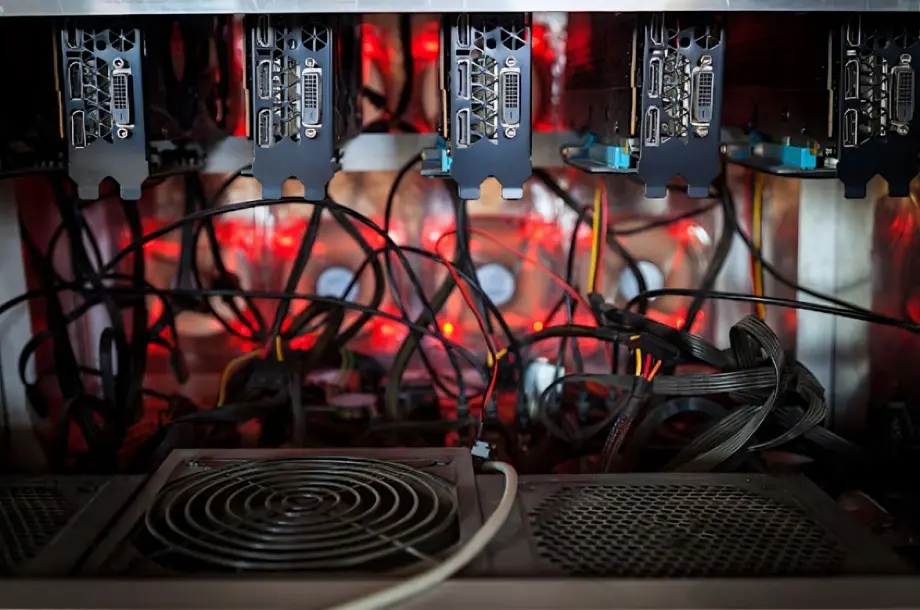
Since the turn of the decade, graphics processing units (GPUs) have quickly seen their role change, becoming critical components of the modern computing ecosystem (especially AI, crypto mining and big data analysis) rather than being confined to the realm of gaming alone.
In fact, the distributed GPU cloud market is set to reach a $17 billion valuation by 2035, primarily because it addresses three core concerns, i.e. performance, cost, and security, for users worldwide. By tapping into thousands of remote GPUs worldwide, it is possible to deliver massive parallel processing (high speed and low latency) all while utilizing a pay-as-you-go pricing model that reduces finance burdens on the end consumer majorly (especially when compared to buying dedicated hardware).
It is therefore no secret that many Web2 companies and tech enthusiasts have naturally moved their data-intensive tasks onto the cloud, or more specifically Decentralized Physical Infrastructure Networks (DePINs). And with global Web3 dev activities expanding (with hardware demand outpacing supply) and GPUs/data centers relying on finite raw materials and complex global supply chains; shortages of chips or rare-earth components and trade tensions are already severely constraining capacity.
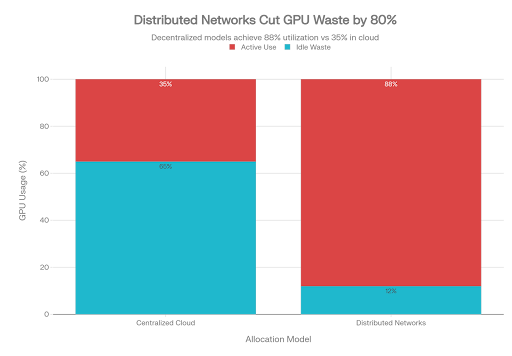
Reduction in wasted compute when using distributed networks (source: Hivenet)
From a purely numbers standpoint, NVIDIA has already cut consumer GPU production by up to 40% through the first half of the year, meaning that fewer cards are available for gamers and creators as well as higher purchase costs for the end user in general (with buyers required to pay 10-20% more for GPUs over the next few months).
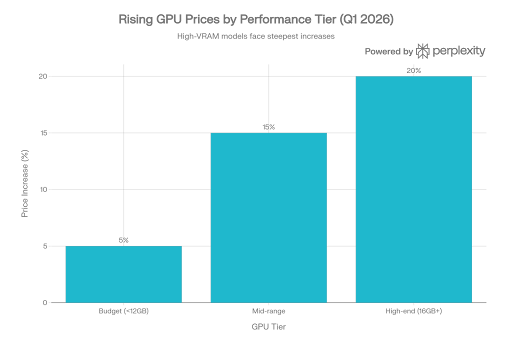
Rising GPU performance per hardware performance tier (source: Quasa)
Here’s why Salad and Golem’s partnership matters in this context
As a result of such bottlenecks, industry observers have rapidly forayed into exploring “borderless” compute networks that use blockchain-centric principles. Without a central data center, these networks are more resistant to censorship or shutdown by any single government. At the same time, distributing tasks over many independent nodes can enhance security by removing single points of failure.
A concrete illustration of this shift has been the recent partnership between Salad.com and the Golem Network. Salad is a startup that operates a “compute-sharing” GPU cloud, tapping idle PC graphics cards around the world, while Golem is one of the earliest decentralized computing protocols to have entered the market.
Earlier this month, Salad revealed that it was running an engineering trial using Golem’s peer-to-peer (P2P) network to process some of its native workloads. As part of the operation, a portion of Salad’s GPU jobs are set to be routed through Golem’s distributed compute layer with the goal being to see whether such an approach can handle heavy GPU tasks like AI model inference or 3D rendering.
Salad + @golemproject were mentioned in this article about decentralization!
“…the engineering trial between https://t.co/WvboWS0kbC (a key player in the GPU cloud platform industry) and Golem Network (one of the first decentralized computing protocols) seeks to explore what…
— Salad (@Salad_Chefs) January 29, 2026
Perhaps most importantly, the trial incorporates blockchain-native methods for measuring throughout. For instance, payments for compute can be made in crypto rather than dollars while Golem’s smart-contract system can be used to assign and verify jobs (changes that stand to reduce operational costs and improve efficiency compared to conventional cloud billing by a substantial margin).
In a recent interview, Salad’s CEO Bob Miles, emphasized that the aim of all this is to democratize access to high-end compute power so that their offering can rival even “the strongest supercomputers in existence.” He further added:
“By pairing Salad’s distributed infrastructure with Golem’s decentralized compute layer, we’re exploring how customer workloads, revenue, and rewards can flow through DePIN. This reflects our shared vision of democratizing computational power by enabling millions to contribute underutilized devices.”
Feeding Global Demand, Sensibly
As the appetite for computing power continues to grow, decentralized distributed clouds offer an attractive means of feeding this uptrend. Additionally, with future GPU cycles increasing the demand for high quality hardware, the Salad–Golem trial will be watched closely as an early test case because if it continues to gain traction, it may very well spark more projects and even larger networks to blend Web2 resources with the emerging Web3 paradigm.
In any case, one thing seems clear: democratizing GPU power could profoundly change how we provision high-performance computing in the Web3 era. Thus, for Web3 and crypto audiences, this partnership stands to be a powerful test of how Web2 GPUs can be repurposed to power decentralized cloud services. Interesting times ahead!

Why Trust CoinGape
CoinGape has covered the cryptocurrency industry since 2017, aiming to provide informative insights Read more… to our readers. Our journal analysts bring years of experience in market analysis and blockchain technology to ensure factual accuracy and balanced reporting. By following our Editorial Policy, our writers verify every source, fact-check each story, rely on reputable sources, and attribute quotes and media correctly. We also follow a rigorous Review Methodology when evaluating exchanges and tools. From emerging blockchain projects and coin launches to industry events and technical developments, we cover all facets of the digital asset space with unwavering commitment to timely, relevant information.



Delivered every day.
- Insights that move markets
- 100,000 active subscribers