






Quick Verdict
EtherFi Next Card is unique to users who are engaged in Ethereum and DeFi. It does not provide flat rewards, whether Bitcoin or fiat, but instead lets users remain in yield exposure when spending, which is uncommon in the crypto card industry. Although it does not offer the benefits of traditional credit cards, it balances it out with transparency, self-custody, and on-chain efficiency. The most appropriate for high crypto users.
What sets EtherFi apart is that funds linked to the card can remain staked or restaked within the EtherFi ecosystem. This means users do not need to unstake ETH just to make payments. In theory, this allows users to earn yield while still having access to liquidity for daily spending.

This model contrasts sharply with exchange-issued cards, where funds typically sit idle until spent. EtherFi’s approach targets users who prioritize capital efficiency over predictable cashback.
Coingape's Rating
CoinGape’s Review on EtherFi Next Card
Having reviewed the documentation, ecosystem design, and public roadmap of EtherFi, our verdict is as follows:
The EtherFi Next card is not a regular credit card. Borrowing is not restricted by any limits or APRs. Rather, it operates as a spending card that is DeFi-linked, allowing the assets of the user to keep earning interest. Rewards are dynamic and are based on Ethereum network rules and performance in staking.
No fees are imposed on an annual or penalty basis, though the user has to be acquainted with gas fees and protocol operations. We have curated a rating section on which the card is graded.
We reviewed EtherFi’s documentation and found the following:
- No APR or borrowing fees
- Gas fees apply for blockchain interactions
- Yield is variable and not guaranteed
Additional Costs (if any)
Users are advised that Ethereum gas charges may change drastically when there is high network congestion. This can have an impact on common transactions or minor purchases.
How Are EtherFi Next Card Fees Applied?
When you make a purchase of $100 worth of ETH with the card, it is reflected in the wallet account. Interest and carried balance are nonexistent. But gas costs might be incurred based on the routing of the transaction in-chain.
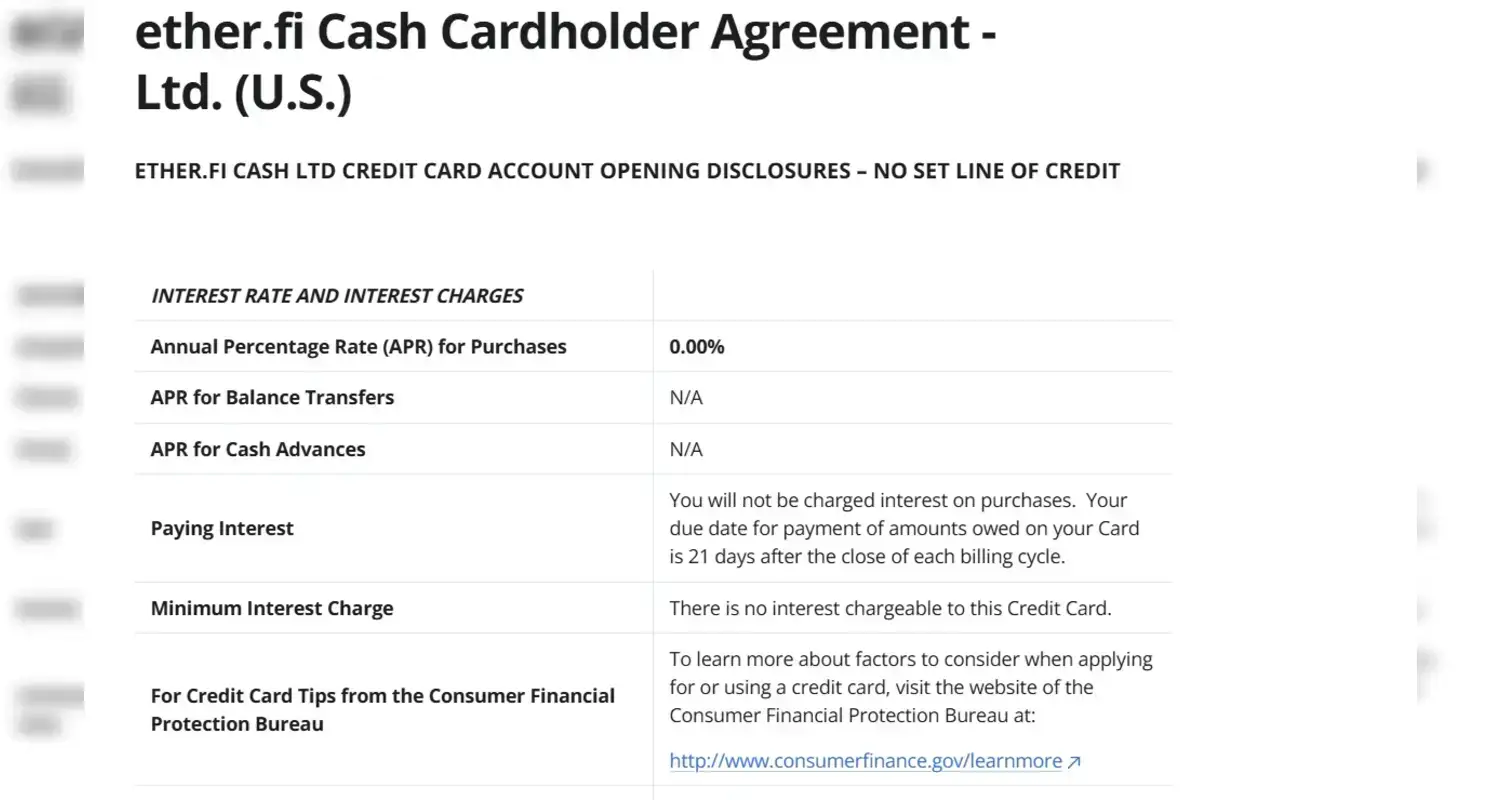
- DeFi-Native Spending : Users can spend crypto without fully exiting staking positions.
- Self-Custody : Full ownership and control over assets at all times.
- No APR or Credit Risk : No borrowing means no interest accumulation or debt cycles.
- Transparent Fee Structure : No hidden penalties or surprise charges.
- Yield Volatility : Rewards are not guaranteed and fluctuate with market conditions.
- Ethereum-Only Focus : Limited asset support compared to multi-chain cards.
- Complex for Beginners : Not ideal for users unfamiliar with DeFi concepts.
- Limited Availability : Card rollout is still restricted by region.
Security, Regulation, and Trust Signals
About the Company
EtherFi is a decentralized Ethereum staking project that aims at liquid restaking and user-controlled assets. The Next Card is not a financial product, but it is an expansion of its DeFi infrastructure.
Regulatory Compliance
The card is issued by controlled banking partners and is based on card networks. EtherFi is merely a decentralized protocol, not a conventional financial institution.
Insurance and Risk
- No explicit card insurance disclosed
- Smart contract risks apply.
- User-side security is critical
Past Scams or Hacks
No known card-related scams or security issues. Nonetheless, like any DeFi product, the protocol risk cannot be completely removed.
Conclusion
EtherFi Next Card is not targeted at everybody, and that is its advantage. It is best suited to users who are already living on-chain and do not wish to forgo yield or custody to spend. This might not be suitable for you if you like predictable cashback and other standard card benefits. However, if you respect the efficiency of DeFi and rewards that are Ethereum-native, EtherFi Next is among the most innovative cards to observe.
Alternatives to EtherFi Next Card

Did you find this review helpful?
Our Review Methodology
We review crypto cards using a consistent framework focused on real-world use, fees, risk, and usability. Here’s a quick look at how each card is evaluated before it’s ranked.
1. Real-World Testing
We review crypto cards based on how they behave once you actually start using them. This includes onboarding, spending, settlement speed, and how balances and rewards update in practice.
2. Fees & Terms Checked
Fees, limits, FX costs, and reward rules are verified using official issuer terms and fee schedules. Temporary promotions or targeted offers are not included in scores.
3. Risk & Reliability
We look at custody setup, issuer background, regulatory signals, and past operational issues to understand where user risk really sits.
4. Independent Scoring
All cards are scored using the same framework. Rankings are not pay-to-play, and commercial relationships do not influence ratings.


