


Crypto Market at Risk as U.S.–Iran War Threatens Inflation With Oil Price Surge



Highlights
- A full blown U.S.–Iran war could spark higher inflation with oil prices already rising.
- Iran has reportedly moved to close the Strait of Hormuz, potentially putting 20% of the global oil supply to a halt.
- Higher inflation lowers the odds of rate cuts this year, which puts further pressure on crypto prices.
A U.S.–Iran war could have significant implications for the crypto market, especially if Iran were to close the Strait of Hormuz, which serves as a pathway for up to 20% of the total global oil supply. Rising oil prices typically have a negative impact on inflation, a move which could further delay rate cuts and put more downside pressure on crypto prices.
Analyst Flags How A U.S.–Iran War Could Impact Global Liquidity
In an X post, market analyst Ted Pillows noted that a move to close the Strait of Hormuz amid the rising tensions would be a liquidity event as roughly 20% of global oil flows through that path. He warned that shutting it down would cause energy prices to surge.
Notably, oil prices had surged to as high as $72 per barrel yesterday, even prior to the ongoing U.S.–Iran war, which began with airstrikes today. This marked the highest price level since July 31, 2025, just over a month after Israel attacked Iran back then.
Pillows stated that rising oil prices translate to an inflation shock, which in turn leads to liquidity constraints for central banks and ultimately puts risk assets under pressure. The analyst also mentioned that equities will reprice if this happens, with the high beta assets bleeding first before leverage gets punished.
This pressure on risk assets is also likely to spill over to crypto assets, with prices at risk of a further decline. Notably, the crypto market crashed earlier today as the U.S.–Iran war escalated with strikes from Israel and the U.S. before retaliatory strikes from Iran.
Meanwhile, Pillows noted that rising oil prices and the inflation shock that could follow don’t mean that an instant collapse would happen. Instead, he explained that it means volatility expansion and forced positioning, and that could take months before the recession risk becomes real.
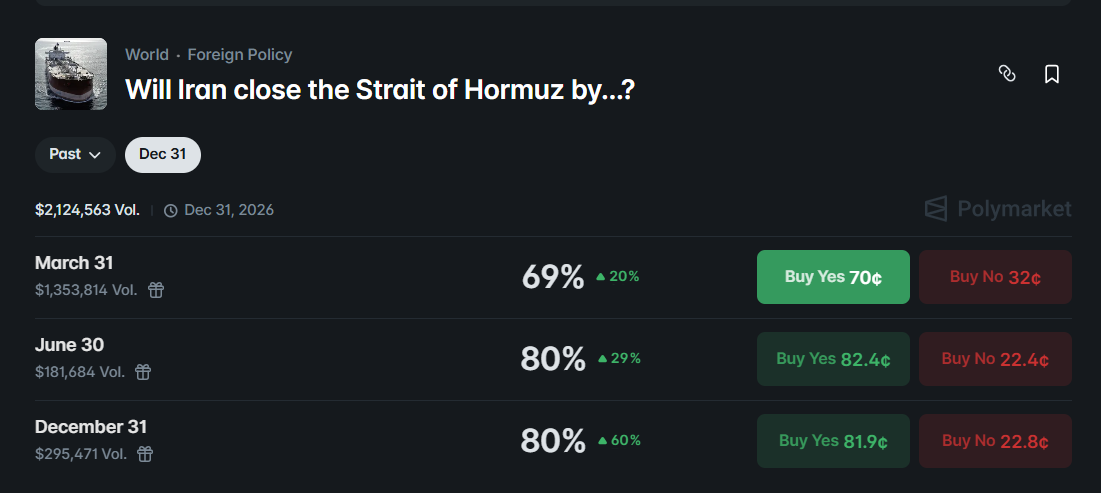
Reuters already reported that Iran’s Revolutionary Guards have told ships that passage through the Strait of Hormuz is now allowed. Meanwhile, crypto traders are betting that Iran will close this route mouth. Polymarket data shows a 69% chance that Iran will close this oil export pathway by March 31.
Expert Says Iran Unlikely To Close the Strait of Hormuz
Economist Daniel Lacalle noted that Iran has never been able to close the Strait of Hormuz, suggesting that the U.S.–Iran war is unlikely to change that. He also mentioned that almost 80% of the traffic goes to China, which is Iran’s largest partner. As such, closing this pathway will just be Iran shooting “itself in the foot.”
#Iran Let us debunk some myths before social media starts to go crazy:
1) Iran has never been able to close the Strait of Hormuz. Furthermore, almost 80% of the traffic goes to China, Iran’s largest partner. It would shoot itself in the foot. pic.twitter.com/DGlHI7pyuh
— Daniel Lacalle (@dlacalle_IA) February 28, 2026
Furthermore, Lacalle explained that Iran’s production is currently 3.3 million barrels daily, but it exports only 1.5 million, most of which goes entirely to China. As such, he believes that other OPEC members could quickly offset any production disruption, which could keep oil prices steady.
It is worth noting that U.S. inflation is already on the edge, with the recent PPI and PCE inflation data showing that inflation is trending towards 3% at the moment, well above the Fed’s 2% goal. As such, a U.S.–Iran war risks sending inflation past the 3% mark, which could ultimately delay rate cuts, and in turn, negatively impact crypto prices.
Renowned economist Peter Schiff also raised concerns about how tensions between the U.S. and Iran could worsen the state of the economy. This came as he noted that the U.S. economy and labor market were already weakening while inflation was strengthening.
The U.S. economy and labor market were already weakening, and inflation strengthening, before the war with Iran began. Now, as those problems get worse, Trump can blame them on a war he will insist we had no choice but to fight. Stagflation will be sold as the cost of freedom.
— Peter Schiff (@PeterSchiff) February 28, 2026
Play 10,000+ Casino Games at BC Game with Ease
- Instant Deposits And Withdrawals
- Crypto Casino And Sports Betting
- Exclusive Bonuses And Rewards



Why Trust CoinGape
CoinGape has covered the cryptocurrency industry since 2017, aiming to provide informative insights Read more… to our readers. Our journal analysts bring years of experience in market analysis and blockchain technology to ensure factual accuracy and balanced reporting. By following our Editorial Policy, our writers verify every source, fact-check each story, rely on reputable sources, and attribute quotes and media correctly. We also follow a rigorous Review Methodology when evaluating exchanges and tools. From emerging blockchain projects and coin launches to industry events and technical developments, we cover all facets of the digital asset space with unwavering commitment to timely, relevant information.


Delivered every day.
- Insights that move markets
- 100,000 active subscribers






- Breaking: CLARITY Act Advances as Senate and White House Reach Deal On Stablecoin Yields
- U.S.-Iran War: U.S. To Deploy More Troops to Middle East as Bitcoin Slips Below $70K
- Bank of America Warns of Fed Rate Hike Risk as Crypto Market Faces Pressure
- Bitget’s Daily CFD Volume Tops $6B Amid Demand for Gold, Oil Derivatives
- Why the Crypto Market Is Seeing a Relief Rally Today (March 20)
- Bittensor (TAO) Price Surges 20% After Nvidia CEO Comments
- Dogecoin, Shiba Inu, and Pepe Coin Price Prediction If BTC Holds $70k Level
- Cardano (ADA) Price Prediction Amid SEC/CFTC Policy Shift and ETF Update
- Crypto Stock to Watch As Bitcoin Price Crashed Below $70k; CRCL, COIN, MSTR, HOOD
- Why Is XRP Price Crashing Today (March 19th)
- Pi Network Price Forecast After PI Mainnet Upgrades To Protocol 20