
CoinGape has been covering cryptocurrency and blockchain markets since 2017. Our editorial team evaluates projects and platforms using structured review frameworks focused on transparency, utility, and risk assessment. You can explore our review methodologies to see how we assess and rate different categories. We maintain clear editorial standards and disclose advertising or affiliate relationships where applicable.
Institutional crypto exchanges are trading platforms designed for hedge funds, asset managers, market makers, and proprietary trading firms that trade millions to billions of dollars in digital assets.
It’s a different world altogether, and platforms built for casual traders aren’t designed to support that level of activity.
That’s where institutional crypto exchanges come in. They’re built to handle heavy volumes and offer advanced tools, robust dashboards, API access, and tailored fee structures. However, the real challenge is choosing the right one, especially when many platforms make similar promises.
Key Takeaways:
In this article, we cover the best crypto exchanges for institutional investors to help you understand their features and choose the one that best meets your needs.
| Crypto Exchange | Best known for | Things we liked | Things we didn’t like | Coingape Rating |
|---|---|---|---|---|
| Largest cryptocurrency exchange by trading volume |
|
| 4.7/5 | |
| Security and transparency |
|
| 4.3/5 | |
| Speed and execution |
|
| 4.5/5 | |
| Regulatory compliance and institutional trust |
|
| 4.6/5 | |
| Widest selection of altcoins |
|
| 3.9/5 | |
| Low fees and a wide range of tokens |
|
| 4.6/5 | |
| All-in-one trading |
|
| 4.4/5 | |
| Advanced trading and risk management |
|
| 4.5/5 |
This article was written by the CoinGape editorial team using a clear and consistent review process designed for institutional crypto investors. We evaluated each exchange based on security, regulatory compliance, liquidity and execution quality, asset coverage, trading tools and APIs, fees, reporting, and the availability of dedicated account managers. The exchanges listed here were reviewed and rated only after comparing them across these factors.
Ratings on individual exchange review pages may differ, as those reviews assess platforms more broadly across both retail and institutional features.

Binance is the world’s largest crypto exchange by trading volume, user count, and assets, so testing its institutional platform came with high expectations. What stood out immediately was the advanced dashboard. You have access to trading tools, trade history, performance breakdowns, OTC, and account management in one place, making daily operations efficient for high-volume trading and multiple strategies.
Another feature we particularly liked is support for fiat currencies. Binance allows institutions to deposit and withdraw in 100+ currencies. This is useful for globally distributed funds operating across multiple regions.
And let us not forget the low trading fees: maker fees range from 0.01% to 0.09%, and taker fees from 0.023% to 0.1%. There’s also an added incentive: a 25% discount on standard spot fees when you pay fees with BNB, which adds up to meaningful savings at high volumes.

In addition, Binance offers access to 2,000+ trading pairs across spot and futures for institutional investors, backed by the deepest liquidity in the market. As of writing this article, Binance reserves stand at over 167 billion dollars, with over 100 trillion dollars traded.
Binance institutional service at a glance:
| VIP minimum amount | ≥ 1,000,000 USD 30-day spot trading volume |
| Maker fees | 0.0110% for ≥4B to 0.09% for ≥1M based on a 30-day trading volume (plus a 25% discount on standard spot fees when fees are paid with BNB) |
| Taker fees | 0.0230% for ≥4B to 0.1% for ≥1M based on a 30-day trading volume (plus a 25% discount on standard spot fees when fees are paid with BNB) |
| Trading pairs | 2,000+ across spot and futures |
| Fiat support | Deposit and withdraw in 100+ fiat currencies |


While testing Kraken’s institutional platform, what stood out immediately was its availability in 190 countries, making it the most globally accessible exchange for investors. Kraken also has a reputation for security and transparency, and in practice, that translates into features such as FIDO2-compliant 2FA, SSL encryption, and a bug bounty program to keep the platform continuously secure.
But Kraken doesn’t stop there. Investors can trade and manage multiple subaccounts, access OTC trading for large orders, and borrow against assets held in custody while simultaneously earning yield on those assets.
That said, reports of Kraken’s slow customer service reduced our scoring, as reliable and responsive support is critical for institutional investors. Even occasional delays can be costly at scale, especially during market stress or operational issues.
Kraken institutional platform at a glance:
| API integration | Connect via API, WebSockets, REST, and FIX 4.4 |
| Listings | Over 270 ERC-20 listings and 25 stakeable assets. |
| Maker fee | 0.00% for ≥500M to 0.06% for ≥1M based on a 30-day trading volume |
| Taker fee | 0.05% for ≥500M to 0.16% for ≥1M based on a 30-day trading volume |

When you spend time on Bybit’s institutional platform, the focus on speed and execution is hard to miss, with responsive tools and API rate limits of up to 300 API requests per second. This made a noticeable difference during our testing. Institutions can run automated, arbitrage, and multi-venue strategies without worrying about request throttling or delayed order placement.
Bybit also offers a unified trading account that allows institutions to manage all trades and balances in one place, rather than logging into separate accounts, making day-to-day portfolio management cleaner and more organized.
Additionally, institutions on Bybit have access to its loans, which allow them to borrow against collateral. From a security standpoint, it maintains a 1:1 reserve for all user assets and uses multi-layered security protocols, which builds trust with institutional users.

Lastly, it’s appreciable how Bybit has support in multiple languages. This reduces friction for global teams when issues come up and makes coordination overall smoother.
Bybit institutional platform at a glance:
| VIP minimum amount | ≥ 1,000,000 USD 30-day spot trading volume |
| API integration | Bybit’s V5 API supports up to 300 API requests per second |
| Maker fee | 0.03% for ≥100M – 0.0675% for ≥1M based on a 30-day trading volume |
| Taker fee | 0.045% for ≥100M – 0.08% for ≥1M based on a 30-day trading volume |


Like Binance, Coinbase is a household name in crypto, but spending time on its institutional platform makes it clear why it has earned that reputation with leading financial institutions worldwide.
It has a wide range of tradable assets, including 275+ assets and 340+ trading pairs, which makes it easier to deploy capital without running into coverage constraints. Moreover, during testing, liquidity and execution held up well on larger order flow, with fills coming through cleanly and no noticeable slippage.

This range, coupled with Coinbase’s focus on security and compliance, is why more hedge funds are choosing Coinbase, bringing their 2025 Q3 institutional trading volume to US$236 billion.
Coinbase institutional platform (Coinbase Prime) at a glance:
| Maker fee | 0.00% for ≥400M to 0.08% for ≥1M based on a 30-day trading volume |
| Taker fee | 0.05% for ≥400M to 0.18% for ≥1M based on a 30-day trading volume |
| Onboarding costs | $5,000 |

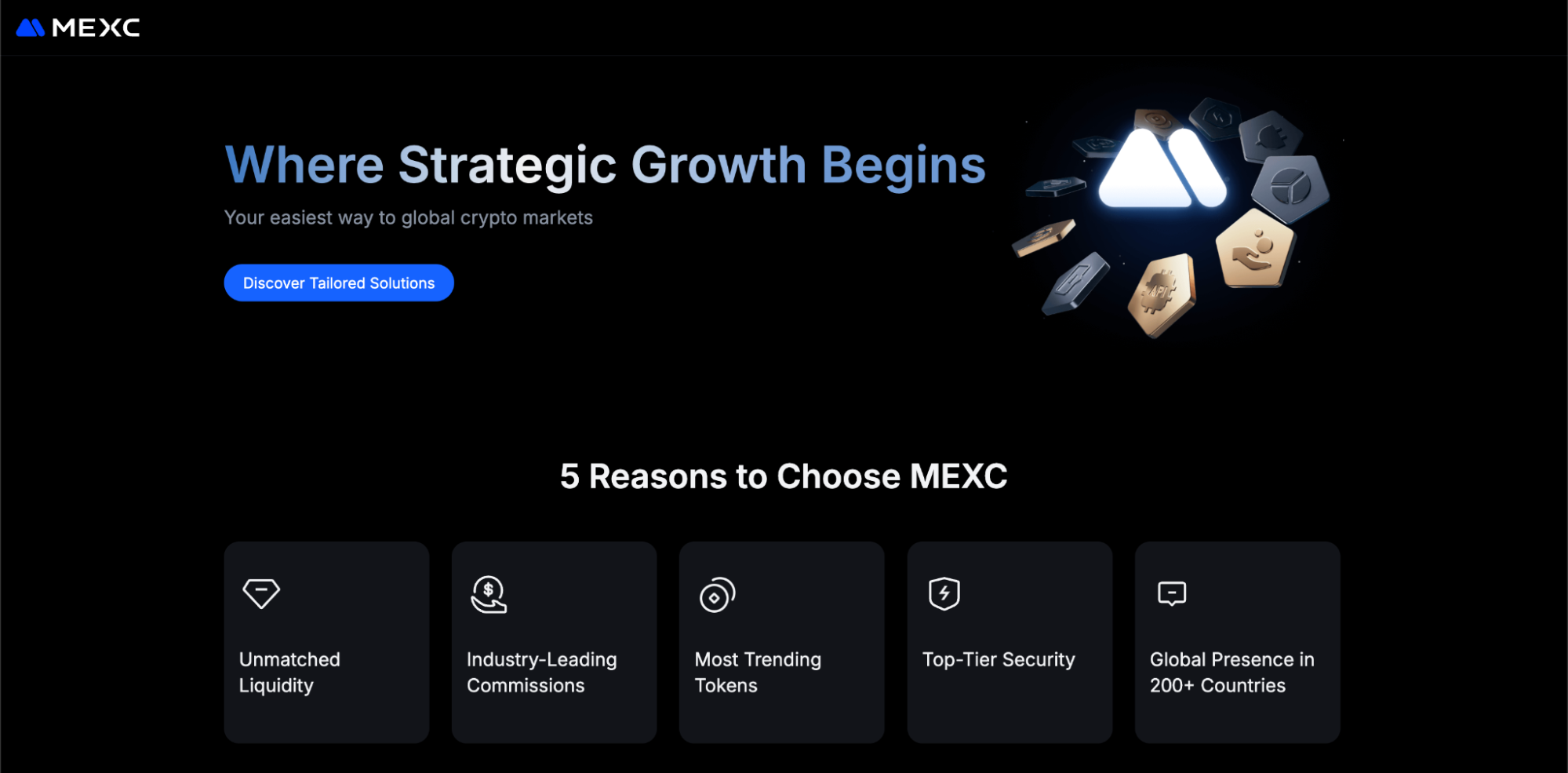 First and foremost, MEXC is built for market makers, high-frequency traders, and funds who prioritize low fees and access to the widest selection of cryptocurrencies. For instance, maker fees range from -0.0025% for market maker level T1 to -0.0075% for T3, which effectively means that you’re getting paid to provide liquidity. This reduces costs for institutions running high-volume or API-driven strategies, as you don’t have to constantly calculate whether fees would erode margins.

That said, MEXC is more trading-focused than compliance-focused, and this is where the exchange becomes limiting. It doesn’t offer the same level of regulatory clarity or custody guarantees as competitors like Coinbase or Kraken. This limits institutions that have to answer to compliance teams, auditors, or investment committees. In many cases, this alone is enough to rule out MEXC, regardless of how attractive the fee structure appears on paper.
MEXC institutional platform at a glance:
| Maker fee | -0.0025% for market maker level T1, -0.0050% for level T2, and -0.0075% for T3. |


KuCoin has built a reputation as an exchange that strongly appeals to active traders, and it was clear from our experience on the platform that they’ve been making deliberate moves to extend that appeal to institutional users as well.
This is evident in KuCoin’s approach to fees and incentives. By offering tiered discounts and benefits tied to volume and participation, the platform rewards institutions that trade frequently and deploy capital across multiple strategies. 
KuCoin also offers lending and financing options, with VIP users able to borrow up to $20 million at 5x leverage. When combined with its extensive API coverage of over 1,000 cryptocurrencies and support for large OTC transactions, KuCoin is a practical option for institutional investors.
Kucoin institutional platform at a glance:
| VIP minimum amount | ≥ 1,000,000 USD 30-day spot trading volume |
| Maker fee | -0.005% for ≥950M to 0.095% for ≥1M based on a 30-day spot volume (20% off fees when paying with KCS) |
| Taker fee | 0.025% for ≥950M to 0.1% for ≥1M based on a 30-day spot volume (20% off fees when paying with KCS) |
| Loans | Up to 20 million USD at 5x borrowing leverage |

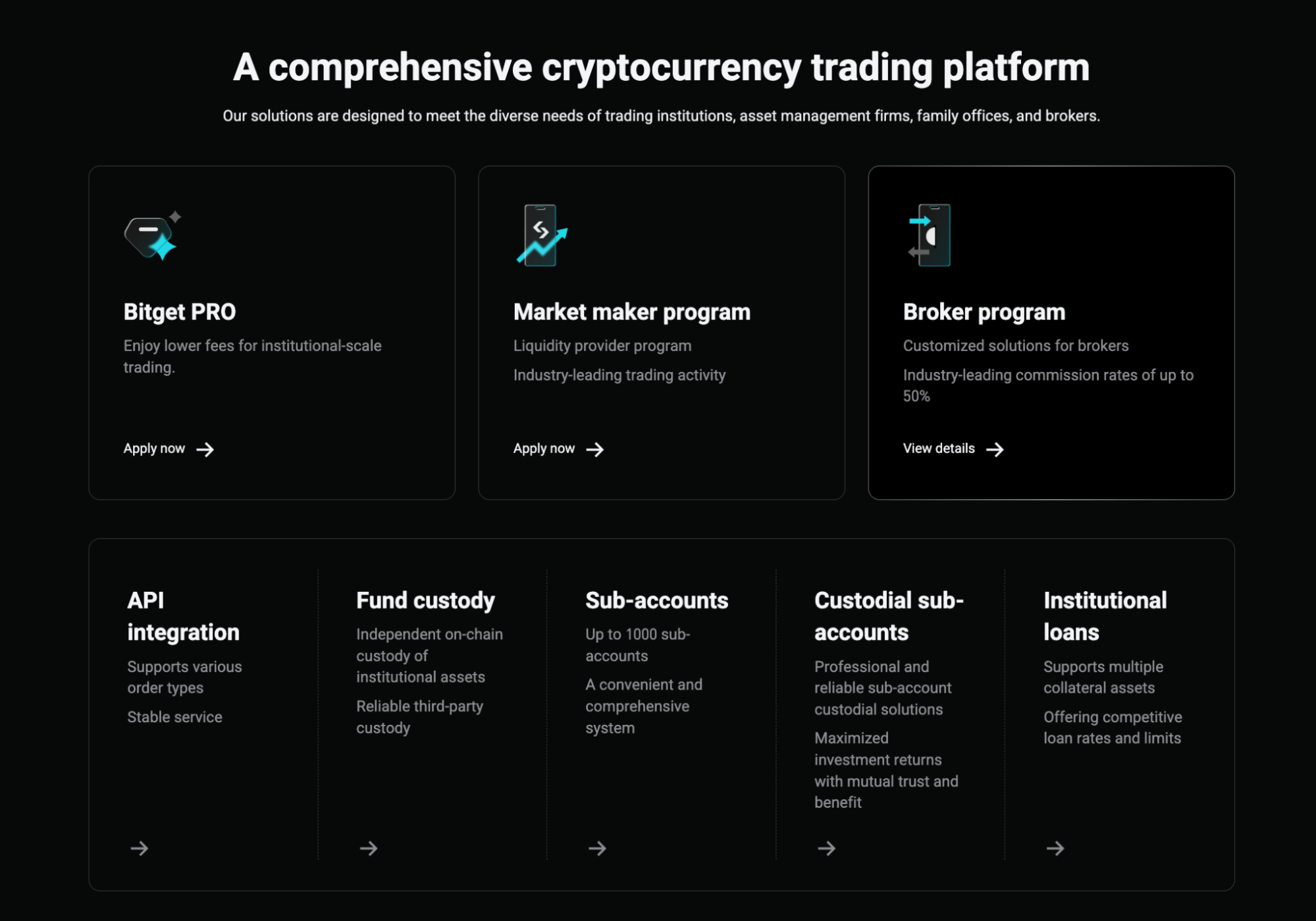
Bitget’s slogan is “a one-stop cryptocurrency investment and trading solution,” and it lives up to that name. What stood out immediately was the depth of its institutional infrastructure, with access to custody options from trusted providers such as Copper ClearLoop, Cobo SuperLoop, Cactus Custody, and Fireblocks.
On the operations side, Bitget is built for complex trading, with the ability to create up to 1,000 sub-accounts and a single-dashboard platform for managing them. This makes trading at scale less painful than platforms that scatter these features across separate interfaces.
Bitget also provides dedicated account managers, market-maker and broker programs, and institutional lending options, making it easier to run high-volume or multi-strategy setups.
Another consensus win across our team during Bitget’s review is its high-performance API integration. It supports spot, futures, and copy trading and consistently performs fast and reliably in testing. Bitget’s API also includes SDKs for five programming languages, making integration straightforward, and it’s free to use.
Bitget institutional platform at a glance:
| Maker fee | 0.025% for ≥50M to 0.01% for ≥1B based on a 30-day spot volume (BGB fee discount of 20% applies) |
| Taker fee | 0.04% for ≥50M to 0.02% for ≥1B based on a 30-day spot volume (BGB fee discount of 20% applies) |
| Sub accounts | Up to 1000 sub-accounts |
| PRO minimum amount | ≥ 50,000,000 USD 30-day spot trading volume |


OKX institutional is clearly built for serious, high-volume crypto traders in mind, and it shows. As of the writing of this article, its 24-hour trading volume is over US$ 30 billion.

As we explained earlier in this article, institutional investors look for reliable custody and liquidity, stable APIs, and regulatory compliance when choosing a crypto exchange. Here are some of the issues that can arise when a crypto exchange falls short in any of these areas.
If you manage client or company funds as an institutional investor, your main goals are to keep the capital safe and grow it steadily over time. As such, to provide a reliable list of institutional crypto trading platforms, we tested, evaluated, and reviewed each exchange using a clear and consistent framework.
Our criteria included security, regulatory compliance, asset coverage, liquidity and execution quality, advanced trading tools and APIs, fees, availability of dedicated account managers, and data reporting.
After reviewing these crypto exchanges, it’s evident that the “best” ultimately depends on your use case and risk tolerance. While some crypto institutions, such as Coinbase, prioritize compliance, others are built for speed, advanced trading, and liquidity.
With that context in mind, here’s how these 8 crypto exchanges for institutional investors rank across everyday use cases.


 2M+ Monthly Readers
 50k+ Articles