CoinGape has been covering cryptocurrency and blockchain markets since 2017. Our editorial team evaluates projects and platforms using structured review frameworks focused on transparency, utility, and risk assessment. You can explore our review methodologies to see how we assess and rate different categories. We maintain clear editorial standards and disclose advertising or affiliate relationships where applicable.
Technical patterns on the chart have often aided traders, especially in volatile markets such as cryptocurrencies. These patterns or signs act as a guiding light for short-term traders. One of them is the Doji candlestick or Doji star.
In the article below, we will explore the aspects of Doji candlesticks, types, and trading suggestions lining with the pattern. Let’s begin.
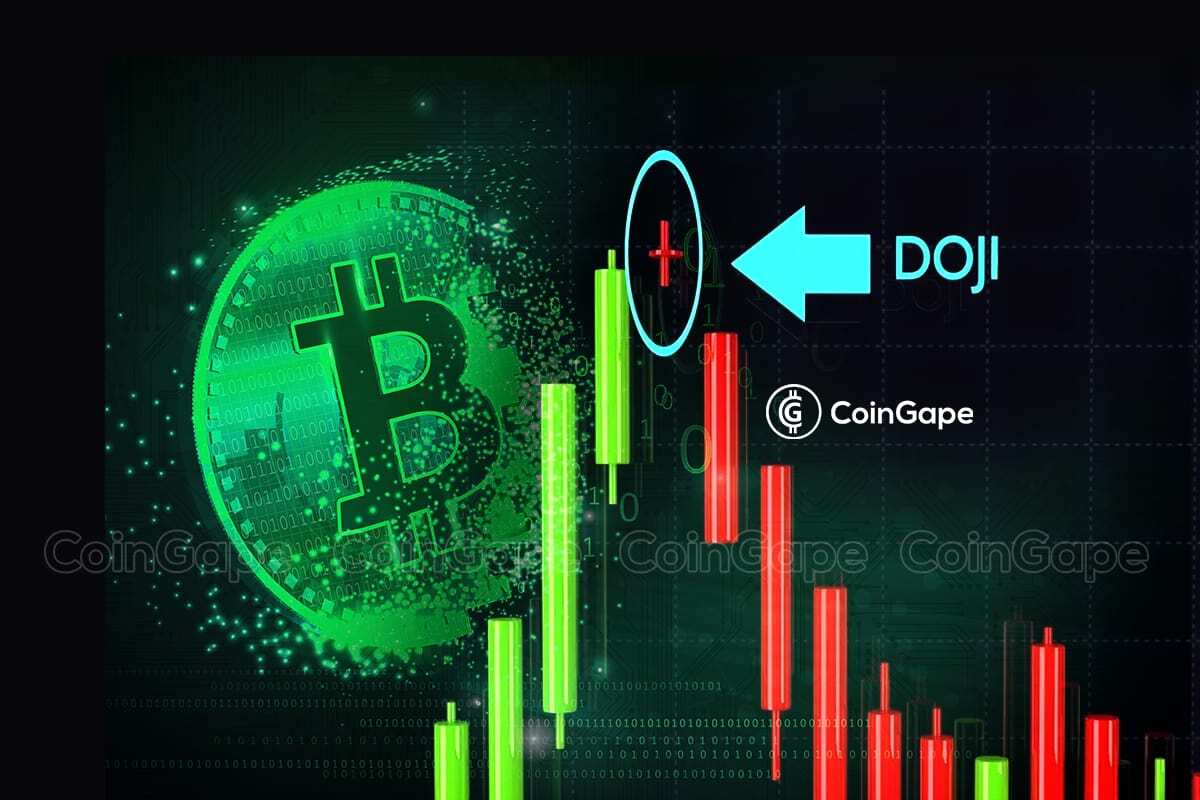
The Doji candlestick is also known as the Doji star. The pattern’s appearance indicates that the traders are indecisive about the coin. The doji candlestick is confirmed when the opening and closing prices of the token are almost the same.
A trading session is known as a “doji” when a security’s open and close are almost equal.
There are three main categories of doji formations: long-legged, dragonfly, and gravestone.
Typically, a Doji signifies that the buyers and sellers of an asset balance one another out. It is a sign that the sellers have rejected all attempts of buyers to bring down the price and vice versa. A doji candlestick, though uncommon, typically indicates a market reversal. Moreover, it can also indicate uncertainty about future prices. Candlestick charts offer an overview of market movements. These chart patterns also act as indicators for market activities and sometimes reactions.
In the end, both sides drive the cost to a pivot point. So, for instance, even though the price of Cardano (ADA) fluctuated between $0.384 and $0.256 during a given day, when it tickers down $0.33, it starts and closes at $0.30 instead.
Doji candlesticks might have the shape of a dragonfly, a gravestone, or a neutral. Analysts and investors attempt to predict price behavior based on these shapes.
As mentioned above, Doji candlestick varies based on the shadow’s length or position. Here are the most common variations:
Doji candlesticks have aided traders in predicting market fluctuations. It is important to remember that the Doji pattern does not always indicate a trend reversal. Instead, it reveals traders’ uncertainty about potential developments.
For instance, a Doji candlestick that appears during an upswing may be a sign of bulls’ exhaustion, which is when more buyers start to lean toward the sellers, and the trend begins to reverse.
Therefore, using more technical indicators to verify the Doji candlestick indication is preferable. The RSI or others, for example, can offer extra significance to what the Doji pattern says.
It is preferable for seasoned traders who can quickly recognize and correctly analyze the offered signals to develop a trading strategy based on Doji candle patterns. The Doji candlestick pattern and other indicators might provide the most significant buy or sell indications in technical analysis.
Being said that, it is a valuable market indicator to consider when determining the level of uncertainty among buyers and sellers.


 2M+ Monthly Readers
 50k+ Articles


 Claim Bonus