

 Buy $GGs
U.S. Federal Reserve to Inject $55B in Liquidity, Boosting Crypto Market Optimism




Highlights
- The U.S. Federal Reserve will buy up to $55 billion worth of treasury bills starting January 20.
- This follows Fed's completion of its $40 billion reserve management purchases.
- This move marks a positive for the crypto market as Bitcoin eyes rally to $100,000.
The U.S. Federal Reserve is set to make another round of Treasury bill purchases as it expands its balance sheet again. This has sparked optimism about a crypto market rally, as this move could inject more liquidity into the economy.
Federal Reserve To Buy $55 Billion Worth Of Treasury Bills
The New York Fed will begin buying Treasury bills next week, January 20, and will purchase up to $55 billion in these treasuries between then and February 10. This move comes as part of the Fed’s plans to expand its balance sheet through reserve management purchases.
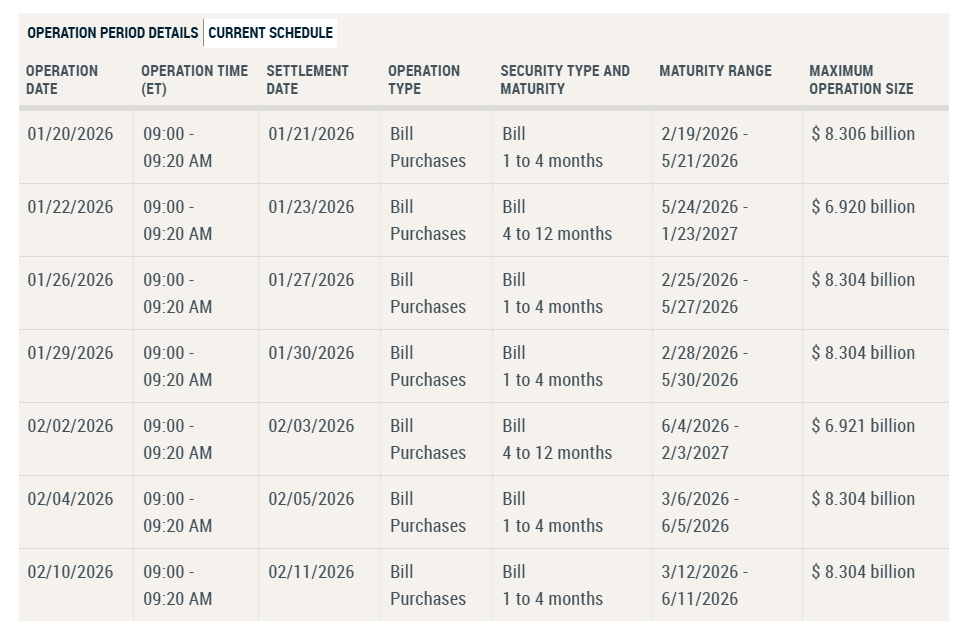
As CoinGape reported, the Federal Reserve ended quantitative tightening (QT) at the December FOMC meeting and committed to purchasing treasury bills. The Fed notably just completed $40 billion in reserve management purchases, which it began in December after the meeting.
The upcoming $55 billion in treasury bill purchases has sparked optimism about a potential crypto market rally. The purchases come at a time when the market is seeing renewed bullish momentum, with Bitcoin reaching a new yearly high above $97,000 earlier this week.
Crypto commentator Crypto Rover noted in an X post that the U.S. Federal Reserve’s move is bullish for the market in the long term. This could lead to higher crypto prices as dollar liquidity increases, as BitMEX co-founder Arthur Hayes has predicted.
Meanwhile, it is worth noting that the Fed’s purchases of the treasuries will come amid the upcoming FOMC meeting, where the committee is likely to keep interest rates steady. There is currently a 95.6% chance that the FOMC will hold rates steady and 4.4% chance they will lower rates by 25 basis points (bps), according to CME FedWatch data.
Why The Treasury Purchases Are Not Bullish In The Short Term
In an X post, macro commentator Milk Road Macro explained why the Federal Reserve’s treasury purchases are not bullish for the crypto market in the short term. Milk Road Macro noted that the Fed balance sheet is expanding but rising at an “extremely slow pace.”
The commentator further remarked that while each reserve management purchase is a liquidity-positive event, it is too small to move risk assets such as Bitcoin on its own. They predict that this balance sheet expansion is likely to remain gradual unless there is a “true shock” to the system.
Milk Road Macro also noted that the current type of balance sheet expansion is different, as the Federal Reserve is buying Treasury bills rather than coupons. Buying treasury coupons usually leads to faster expansion, which is more akin to quantitative easing and is more bullish for the crypto market.
Play 10,000+ Casino Games at BC Game with Ease
- Instant Deposits And Withdrawals
- Crypto Casino And Sports Betting
- Exclusive Bonuses And Rewards



Why Trust CoinGape
CoinGape has covered the cryptocurrency industry since 2017, aiming to provide informative insights Read more… to our readers. Our journal analysts bring years of experience in market analysis and blockchain technology to ensure factual accuracy and balanced reporting. By following our Editorial Policy, our writers verify every source, fact-check each story, rely on reputable sources, and attribute quotes and media correctly. We also follow a rigorous Review Methodology when evaluating exchanges and tools. From emerging blockchain projects and coin launches to industry events and technical developments, we cover all facets of the digital asset space with unwavering commitment to timely, relevant information.



Delivered every day.
- Insights that move markets
- 100,000 active subscribers
Related Articles





- Peter Schiff Predicts BTC to Fall, Gold to Rise as Markets Price in Prolonged Iran War
- Institutional Re-Accumulation Signs Emerge as Bitcoin ETFs See $1.1B Net Inflows Since Iran War Began: Glassnode
- From Mining Pool to Infrastructure Platform: Nine Years of EMCD
- U.S.-Iran War: U.S. Oil Prices Spike To One-Year High, Bitcoin and Gold Dip
- Crypto Traders Bet Against U.S.-Iran Ceasefire This Month as Iran Denies Peace Talks
- HOOD Stock Targets $100 as Robinhood Unveils Platinum Card and Advance Dividend Feature
- Bitcoin Price Prediction if Donald Trump Signs the CLARITY Act on April 3, 2026
- Pi Network Price As BTC Rallies Above $74K: Can PI Coin Extend Gains to $0.30?
- XRP Price As Bitcoin Reclaims $74K- Is $5 Next?
- Dogecoin Price Outlook as BTC Recovers Above $73,000
- XRP Price Prediction as Iran-U.S. Peace Talks Trigger a Crypto Rally