



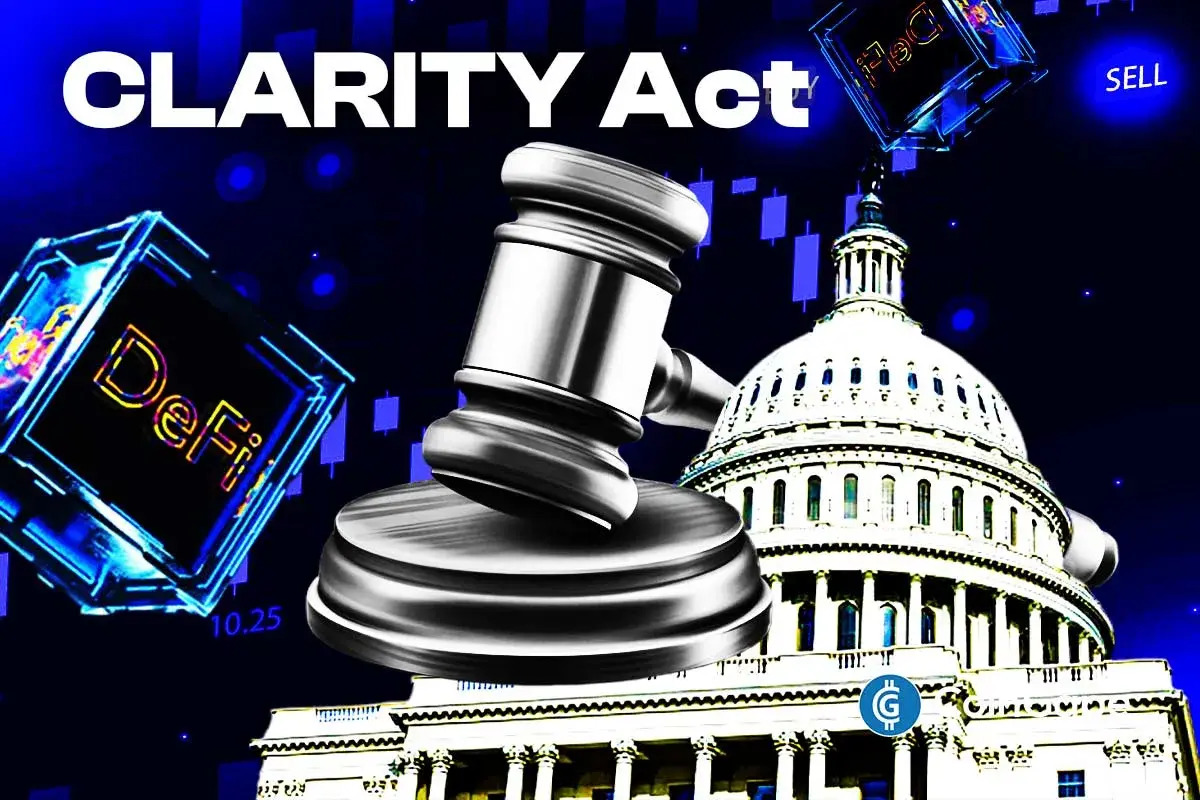
U.S House Introduces Bipartisan Crypto Bill To Protect Crypto Developers Amid DeFi Push Under CLARITY Act



Highlights
- House lawmakers introduce Crypto bill to clarify Section 1960 scope for developers.
- Measure limits liability to actors controlling funds, not open-source code writers.
- Crypto group Blockchain Association is set to meet with Congress members to discuss DeFi protections under the CLARITY Act.
Crypto bill discussions intensified on February 26, 2026, as Representatives Scott Fitzgerald, Ben Cline, and Zoe Lofgren introduced the Promoting Innovation in Blockchain Development Act of 2026. The bipartisan measure aims to protect software developers who write code but do not control customer funds from prosecution under criminal code Section 1960.
Crypto Bill Clarifies Section 1960 Scope
According to a DeFi Education Fund (DEF) blog post, the lawmakers claimed that this crypto bill clarifies that only those who control assets and transmit funds on behalf of users are subject to Section 1960. This aligns with the long-standing interpretation of the Treasury Department’s money transmission regulations.
The Crypto bill has been proposed as a solution that brings legal clarity for blockchain developers. This is due to the decentralized and open-source systems that do not easily align with intermediary rules. This follows calls for better protection for crypto software developers among industry leaders.
Journalist Eleanor Terrett wrote that this bill clearly distinguishes between those who control funds and those who write code. This distinction has been an essential part of decentralized finance advocacy and would provide a major boost for the DeFi industry.
It is worth noting that the Section 1960 legislation focuses on custodial money transmitters. There have been recent actions involving Tornado Cash and Samourai Wallet, in which developers faced prosecution. This has caused a great deal of debate between crypto developers and regulators regarding this legislation.
Meanwhile, as CoinGape reported, Democrats have convened a meeting to advance a Senate crypto bill. a16z, a venture capital firm, met with Senate Republicans regarding crypto and artificial intelligence legislation. Marc Andreessen and Chris Dixon urged lawmakers to advance the CLARITY Act. The White House urged a March 1 deadline for a Senate vote on market structure legislation.
Industry Leaders Press Lawmakers on DeFi and Tax Rules
In a recent X post, the Blockchain Association revealed that its members are going to Capitol Hill to discuss DeFi in the draft of the Senate Banking Committee. The discussions will center on Title III and the status of BRCA provisions. There are 21 leaders from 18 companies meeting with 24 Senate offices on the Banking and Agriculture Committees.
In the statements from the Blockchain Association, open-source developers are not considered financial intermediaries, provided they don’t custody or control customer assets. The Blockchain Association also claimed that policy decisions made during the negotiation of the CLARITY Act will determine the outcome for innovation.
CoinGape reported that the Blockchain Association released its framework for crypto tax rules earlier this week. The framework includes principles that are based on the following: administrability, economic ownership, and functional consistency in mining and staking.
Some recommendations include a de minimis exemption for small transactions. The framework also proposes treating stablecoins as cash for tax purposes.
Play 10,000+ Casino Games at BC Game with Ease
- Instant Deposits And Withdrawals
- Crypto Casino And Sports Betting
- Exclusive Bonuses And Rewards



Why Trust CoinGape
CoinGape has covered the cryptocurrency industry since 2017, aiming to provide informative insights Read more… to our readers. Our journal analysts bring years of experience in market analysis and blockchain technology to ensure factual accuracy and balanced reporting. By following our Editorial Policy, our writers verify every source, fact-check each story, rely on reputable sources, and attribute quotes and media correctly. We also follow a rigorous Review Methodology when evaluating exchanges and tools. From emerging blockchain projects and coin launches to industry events and technical developments, we cover all facets of the digital asset space with unwavering commitment to timely, relevant information.


Delivered every day.
- Insights that move markets
- 100,000 active subscribers




- MSTR, COIN, HOOD Stock Prices Crash As FED Rate Hike Odds Climb to 50% in 2026
- US Congress Schedules Tokenization Hearing Next Week as CLARITY Act Advances
- Breaking: CLARITY Act Advances as Senate and White House Reach Deal On Stablecoin Yields
- U.S.-Iran War: U.S. To Deploy More Troops to Middle East as Bitcoin Slips Below $70K
- Bank of America Warns of Fed Rate Hike Risk as Crypto Market Faces Pressure
- Why is Pi Network Price Up Today (March 21) Despite Market Wide Correction?
- Bittensor (TAO) Price Surges 20% After Nvidia CEO Comments
- Dogecoin, Shiba Inu, and Pepe Coin Price Prediction If BTC Holds $70k Level
- Cardano (ADA) Price Prediction Amid SEC/CFTC Policy Shift and ETF Update
- Crypto Stock to Watch As Bitcoin Price Crashed Below $70k; CRCL, COIN, MSTR, HOOD
- Why Is XRP Price Crashing Today (March 19th)