Buy

CoinGape has been covering cryptocurrency and blockchain markets since 2017. Our editorial team evaluates projects and platforms using structured review frameworks focused on transparency, utility, and risk assessment. You can explore our review methodologies to see how we assess and rate different categories. We maintain clear editorial standards and disclose advertising or affiliate relationships where applicable.
Agentic crypto wallets assist users in answering questions, explaining transactions, and flagging risks (AI-integrated), or in independently executing transactions and managing portfolios (AI-agentic).
Both categories exist for a reason. DeFi has become increasingly complex, and much of what crypto users do is repetitive and time-sensitive. AI-agentic crypto wallets promise to do the cognitive heavy lifting, but most are glorified chatbots that don’t deliver.
So we reviewed 19 wallets based on real AI capabilities, security, and usability to separate what actually works from what’s just marketing.
Quick Comparison Table
| Wallet Name | AI Features | Chains Supported | Custody Type | Best For | Security Model | CoinGape Rating |
|---|---|---|---|---|---|---|
 Coinbase WalletRead More | Send, trade, earn, x402 payments | Base, Ethereum, Arbitrum, Polygon, Solana | Custodial | Best for developers building financial agents | Programmable spending limits, enclave isolation, KYT compliance | 3.8 |
 MetaMaskRead More | Preauthorize specific actions, transaction batching, and gas abstraction | Arbitrum Nova, Arbitrum One, Base, Berachain, Binance Smart Chain, Ethereum, Gnosis Chain, Ink, Linea, Monad, Optimism, Polygon, Sei, Sonic, Unichain | Non-custodial | Best for programmable transaction automation | User-controlled keys and SRP, preauthorization permissions | 3.2 |
 MoonPay AgentsRead More | Trading, DCA, swaps, x402 payments, cross-chain execution, portfolio monitoring | Solana, Ethereum, Base, Polygon, Arbitrum, Optimism, BNB, Avalanche, TRON, Bitcoin | Non-custodial | Best for fiat-to-onchain-to-fiat agent infrastructure | Local key encryption via OS keychain | 4.1 |
 Crypto.comRead More | Execute trades, track portfolio, pull market data, create wallets, check balances, send tokens, interact with smart contracts | Cronos EVM and Cronos ZK EVM networks | Custodial | Best for non-technical/beginner users | User-defined limits, restricted actions | 3.6 |
 Trust WalletRead More | Execute trades, perform cross-chain swaps, and run recurring purchases | ETH-compatible chains, Solana, Bitcoin, Cosmos, TON, Aptos, Tron, NEAR, Sui, and 20 other chains | Hybrid – Custodial for Agent wallet mode and Self-custody for WalletConnect mode | Best for broad chain coverage | Token risk scoring, self-custody, WalletConnect approval layer | 4.1 |
 ASI WalletRead More | Hold assets, stake tokens, participate in governance, send assets across chains | Fetch.ai and Cosmos | Non-custodial | Best for builders exploring a fully AI-native on-chain ecosystem | Local key encryption | 2.5 |
To find the best agentic and AI crypto wallets, we tested 19 wallets across capability, security, usability, ecosystem, and innovation. Then, we applied a 5-factor weighted model based on what actually makes a wallet genuinely agentic.
Innovation vs Hype (15%): We separated wallets genuinely pushing the boundaries of AI-agentic crypto wallets from those riding the popularity wave with wrapper features.
| Wallet Name | AI Capability (_/10) | Security (_/10) | UX (_/10) | Ecosystem (_/10) | Innovation vs Hype (_/10) | Overall Score |
| Coinbase Wallet | 8 | 9 | 5 | 6 | 8 | 7.5 |
| MetaMask Wallet | 4 | 8 | 7 | 9 | 5 | 6.5 |
| MoonPay Agents | 9 | 8 | 6 | 9 | 8 | 8 |
| Crypto.com | 7 | 8 | 8 | 5 | 7 | 7 |
| Trust Wallet | 8 | 9 | 6 | 9 | 9 | 8.5 |
| ASI Wallet | 4 | 7 | 5 | 4 | 5 | 5 |
Each factor above is scored out of 10 and combined using a weighted model, with AI capability and security contributing the most to the final score.
True AI-agentic wallets operate across three distinct categories:
However, most wallets today are not fully agentic and nowhere near the third category. Instead, they layer AI UX on top of traditional wallet infrastructure without meaningfully changing what happens underneath. This is because the foundations that would make true AI-agentic wallets possible, such as reliable AI reasoning, secure key delegation, and on-chain agent standards, are still being built.
From the 19 wallets we tested, only 6 consistently met our standards across AI capability, security, usability, and ecosystem.
Most wallets that appear on popular lists either no longer function, have quietly shut down, or have no meaningful AI features beyond a chat interface.
Best for developers building financial agents

Coinbase’s agentic wallets can execute transactions using predefined skills (send, trade, earn), operate continuously with gasless transactions on Base, and make payments via the x402 protocol without manual approval. The security architecture includes programmable spending limits, enclave isolation for private keys, and built-in KYT compliance.
That said, setting up an agentic wallet requires CLI familiarity, and the agents are only as autonomous as the permissions a developer defines upfront.
Key strengths:
Weaknesses:
Verdict: Coinbase’s agentic wallet builds upon AgentKit by giving any agent a wallet. It’s the most credible AI-agentic infrastructure available today, but its interface isn’t consumer- or beginner-friendly, as it’s tailored for developers.
Best for programmable transaction automation

Through its delegation framework and ERC-4337 smart contracts, MetaMask lets users preauthorize specific actions, batch transactions, and pay gas fees in any token without repeated manual approvals. Its EIP-7702 allows existing accounts to inherit smart account functionality without migrating funds, while ERC-7715 enables subscription-style permissions, where you approve once, and the smart wallet executes many times.
Key strengths:
Weaknesses:
Verdict: In practice, MetaMask offers an AI-integrated smart crypto wallet and falls under category 2 (automation), but it’s far from AI-agentic. There is no natural language interface, no autonomous decision-making, and no intent-based execution.
Best for fiat-to-onchain-to-fiat agent infrastructure
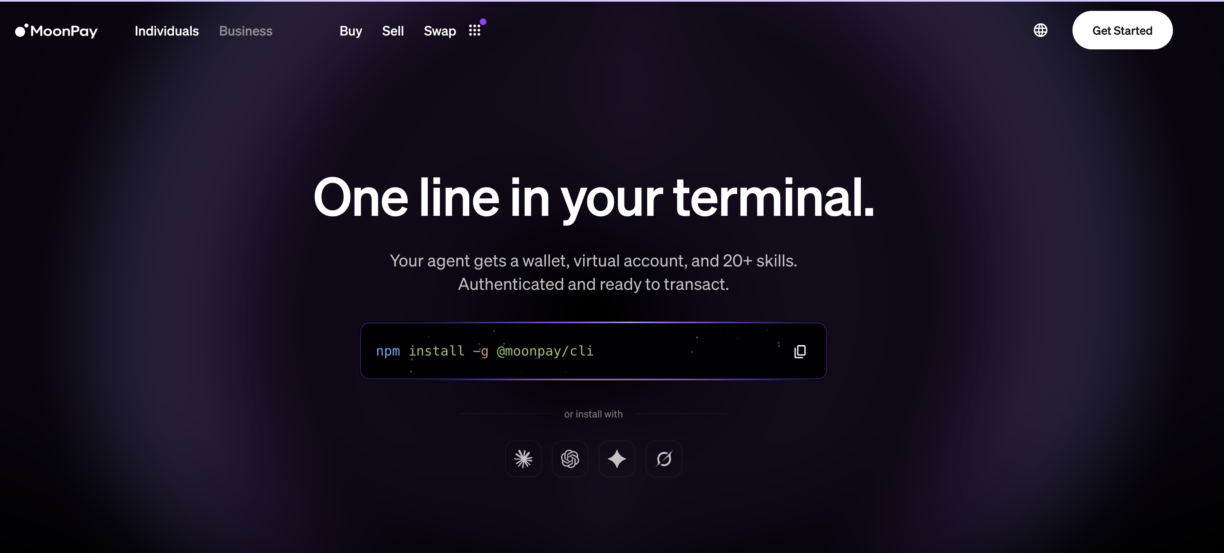
MoonPay gives AI agents access to 92 tools across 20+ skills and 10 chains via a command-line interface (CLI), local MCP server, or web chat. The agents can manage non-custodial wallets, execute cross-chain swaps, analyze tokens and price data, run DCA strategies, set limit orders and stop losses, and monitor portfolios autonomously on your behalf.
In practice, an agent can start with fiat, execute a full on-chain strategy, and convert back to fiat. An additional benefit of Moonpay is that its non-custodial architecture keeps keys encrypted locally on the user’s device via OS keychain encryption, preventing them from being exposed to the agent.
Key strengths:
Weaknesses:
Verdict: Moonpay’s chain coverage is broad, and the toolkit is the most complete on this list. Funding covers US, EU, and GBP virtual accounts, Apple Pay, Venmo, and PayPal, with direct fiat offramp from the terminal.
Best for non-technical/beginner users

Crypto.com’s agentic wallet operates at two levels. At the developer level, the AI Agent SDK lets builders create natural-language interfaces for token transfers, smart contract queries, DeFi protocols, and portfolio management on the Cronos EVM and the Cronos zkEVM.
At the consumer level, OpenClaw is integrated directly into the Crypto.com App via the Agent Key feature, giving users a personal AI trading agent. Users set a weekly trading limit and define exactly what the agent can and cannot do. High-risk actions, such as withdrawing funds, are strictly off-limits.
Key strengths:
Weaknesses:
Verdict: Crypto.com is one of the few platforms on this list with a consumer-facing AI trading agent, not just developer infrastructure. However, the limitations of the Cronos ecosystem are hard to ignore.
Best for broad chain coverage

Trust Wallet’s Agent Kit (TWAK) lets AI agents execute real transactions (swaps, transfers, DCA automations, limit orders, token risk scoring, etc) across more than 25 blockchains.
TWAK ships with two distinct modes: Agent wallet mode, which gives an AI its own dedicated wallet to operate autonomously within developer-defined rules, and WalletConnect mode, which connects an AI agent to a user’s existing Trust Wallet, proposing transactions for the user to review and approve before anything moves. The Agent Kit integrates with the Model Context Protocol (MCP) and is available via a command line interface (CLI).
Key strengths:
Weaknesses:
Verdict: TWAK delivers what most AI wallets only promise in marketing: real execution across real chains, with self-custody intact.
Best for builders exploring a fully AI-native on-chain ecosystem

ASI-1 Mini is the Artificial Superintelligence Alliance’s first Web3-native large language model. With its “Mixture of Agents” approach (MoA) and four dynamic reasoning modes, ASI-1 Mini is ideal for applications that require autonomous agents to make decisions or collaborate on complex tasks, such as AI-driven smart contract automation.
It also features a three-layered architecture that combines foundational intelligence, domain-specific models, and autonomous agents on Agentverse. However, many of these features remain a roadmap.
Key strengths:
Weaknesses:
Verdict: Agentic tool-calling, expanded multi-modal capabilities, and deeper Web3 integrations are listed as upcoming features, not live ones. What exists today is a non-custodial wallet with staking, governance, and IBC transfers.
After feature testing 19 wallets and running agents through real transactions, the right AI wallet comes down to one question: What do you actually need it to do?
The same capabilities that make AI wallets appealing also introduce risks not found in traditional wallets.
AI-integrated and agentic crypto wallets are real, but the foundations that would enable true intent-based execution are still being built. The real value right now is smarter UX and reliable automation, meaning wallets that help you understand what you are signing, flag risks before you approve, and execute predefined strategies without manual input.
If you are looking for the best AI crypto wallet, here is a simple way to decide:
Best for fiat-to-onchain execution: MoonPay Agents.
It depends on the wallet. Trust Wallet’s WalletConnect mode and MetaMask’s smart account feature let you connect an AI agent directly to your existing Trust Wallet without migrating funds or changing your address. Whereas, Coinbase and MoonPay Agents require you to set up a dedicated agent wallet.
It depends on the wallet and your technical know-how. Trust Wallet claims under 15 minutes from signup to a working agent via CLI. Coinbase Agentic Wallets can be set up in under two minutes using the npx awal command, assuming you already have Node.js installed. Likewise, you can launch a MoonPay Agent in under 60 seconds.
Standard private key storage keeps your keys encrypted on your device or in a wallet provider’s database. On the other hand, enclave isolation stores private keys within a Trusted Execution Environment (TEE).
Algorithmic trading and automated financial advice are legal in most jurisdictions, but you must comply with various regulations to ensure fairness and prevent market manipulation. In the U.S., the SEC and CFTC oversee algorithmic trading, while in the EU, MiFID II provides risk-management guidelines.











 2M+ Monthly Readers
 50k+ Articles