Buy

Tokenized real-world assets are now a $370B+ on-chain market including stablecoins, roughly $36B excluding them, according to CoinGape’s live RWA screener (July 2026). Boston Consulting Group’s much-quoted projection puts asset tokenization at $16 trillion by 2030. Whatever the eventual number, the businesses positioned to earn from it are the ones running the platforms, and most of them will not build that software from scratch.
Tokeny (White-Label Score 4.5/5) is the best white label RWA tokenization platform for regulated issuers in 2026: its ERC-3643 standard and T-REX platform back $32 billion in tokenized assets across 120+ clients. Brickken (4.2) has the strongest verified customer reviews in the category (4.9/5 on G2), DigiShares (4.1) and Blocksquare (4.0) lead for real estate, and Antier or Blockchain App Factory fit teams that need a custom build instead of white-label software. Costs run from €299 for a self-serve token deployment to six figures for a full custom platform; the complete breakdown is below (scores and figures as of July 2026).
Looking to invest in tokenized assets, or comparing issuance platforms as an investor? That decision lives in our guide to the best RWA tokenization platforms. This page is for businesses launching a tokenization platform of their own.
| Platform | Compliance Support | Supported Blockchains | Token Standard | Custody Integration | Best For | Rating |
|---|---|---|---|---|---|---|
 1. SecuritizeRead More | SEC/FINRA license | ETH, Avalanche, POL | DS-protocol (ERC-20 based) | Fireblock, Coinbase, Anchorage | Regulated fund issuers | 4.8 |
 2. TokenyRead More | MiCA-compliant | ETH, POL, EVM-compatible | ERC-3643 (TREX Protocol), ERC-20 (security) | Fireblock, Taurus, Hex Trust | Banks launching tokenized products | 4.7 |
 3. PolymathRead More | Built-in identity verification | Polymesh, ETH-compatible | ERC-1400 | BitGo, GK8 | Fintech start-ups | 4.6 |
 4. Antiers SolutionRead More | Adaptable to Mica, SEC frameworks | Multi-layer 2, ETH, Base, ZK chains | ERC-20 and ERC-3643 | Skoda, CoinTrade | Property tokenization projects | 4.4 |
 5. Blockchain App FactoryRead More | Global KYC/AML protocols | ETH ecosystem | ERC-20, BEP-20 | Polygon, Shell | Startup property platforms | 4.4 |
 6. DigiSharesRead More | Embedded regulatory rules and local law alignment | ETH, POL, and others | ERC-1404 | ZigChain, Injective | Issuers and investment marketplaces | 4.3 |
 7. BlocksquareRead More | EU-MiCA alignment | ETH | ERC-20 | OceanPoint | EU-focused investors and projects | 4.3 |
 8. Brickken WalletRead More | Integrated KYC/KYB | ETH, BSC, POL | ERC-20 | Credefi | Financial institutions and asset managers | 4.2 |
Below is a well-researched review of the top providers of white-label RWA tokenization platforms. We analyzed over 15 platforms and selected the top 8 for detailed review using the CoinGape review methodology.

White-label tokenization platform
Tokeny wrote the standard the rest of the market implements. Its ERC-3643 protocol (published open-source in 2018) is the permissioned-token standard for compliant tokenization, and its T-REX platform now sits behind $32 billion in tokenized assets for more than 120 clients (company figures, July 2026). Transfers on ERC-3643 tokens check an on-chain identity registry before they settle, which is what lets a security token move wallet-to-wallet without breaking eligibility rules. Since Apex Group took a majority stake in 2025, Tokeny plugs into a fund-services group with 13,000 staff across 52 countries, which matters if you want administration and custody arranged alongside the software.
The white-label offer is genuine: your brand, no-code configuration, API access to the full issuance and lifecycle stack. Pricing is enterprise-style and unpublished, so budget for a sales process rather than a checkout page.

| Factors | Details |
|---|---|
| Type | White-label tokenization platform |
| Token standards | ERC-3643 (T-REX), ONCHAINID identity registry |
| Blockchain networks | Any EVM chain, public or private |
| Compliance & KYC | Automated eligibility checks via on-chain identity; 180+ jurisdictions supported |
| Custody integrations | Fireblocks, Taurus; Apex Group fund services |
| White-label depth | Full platform under your brand; no-code configuration + APIs |
| Pricing | On request (enterprise contracts) |
| Track record (Jul 2026) | $32B tokenized, 120+ clients since 2017 |

Enterprise platform licensing
Securitize is on this list for one reason: it licenses the same infrastructure that runs BlackRock’s BUIDL, the largest tokenized fund at $2.01B (CoinGape screener, July 2026). That stack includes an SEC-registered transfer agent and a broker-dealer subsidiary, so an enterprise building on Securitize inherits registered rails rather than assembling them. For banks and asset managers that need US regulatory substance more than they need speed, that trade is usually worth it.
Be clear about what this is not. Securitize is not a self-serve product you rebrand in a weekend; engagements are institutional, scoped, and priced accordingly. Its single G2 review (3.5) says less about quality than about where its clients live, which is not on software review sites.
| Factors | Details |
|---|---|
| Type | Enterprise platform licensing |
| Token standards | DS Protocol (ERC-20 based, transfer-restricted) |
| Blockchain networks | Ethereum, Solana, Avalanche, Polygon and more |
| Compliance & KYC | SEC-registered transfer agent; broker-dealer subsidiary; investor onboarding built in |
| Custody integrations | Fireblocks, Coinbase, Anchorage |
| White-label depth | Institution-branded deployments of the issuance stack; not self-serve |
| Pricing | On request (institutional engagements) |
| Track record (Jul 2026) | Operates BlackRock’s BUIDL, $2.01B (CoinGape screener) |
Enterprise tokenization platform
Kaleido comes at tokenization from enterprise infrastructure rather than crypto issuance, and its receipts are unusual for this category: participation in Project Agorá with the BIS and 40+ financial institutions, a SWIFT CBDC sandbox, and pilots with the ECB and Deutsche Börse. The platform covers tokenized deposits, funds, digital securities, bonds and stablecoins, with custody built in, and it carries SOC 2 Type 2 plus ISO 27001/27017/27018 certifications (verified July 2026).
It also has the strongest verified review base of any provider here: 4.8/5 from 24 G2 reviews. There is a free tier to prototype on, which no other enterprise vendor on this list offers; production pricing is quoted.
| Factors | Details |
|---|---|
| Type | Enterprise tokenization platform |
| Token standards | Multiple; tokenized deposits, funds, digital securities, bonds, stablecoins |
| Blockchain networks | Multiple public and private chains |
| Compliance & KYC | SOC 2 Type 2; ISO 27001/27017/27018 |
| Custody integrations | Institutional custody built into the platform |
| White-label depth | Modular platform + APIs; branded deployments |
| Pricing | Free tier for prototypes; production on quote |
| Track record (Jul 2026) | 1,000+ projects; BIS Project Agorá, SWIFT CBDC sandbox, ECB pilot |

White-label SaaS
Brickken is what most people mean by white-label tokenization: software you rebrand and run. The pitch on its own site is literally “tokenization infrastructure under your brand,” with issuance, multi-asset management, and a KYC/KYB rules engine included. Traction is verifiable and mid-market shaped: $660M+ tokenized for 150+ clients across 40+ countries (company figures, July 2026), on Ethereum, BNB Chain, Base and Polygon. It is also a member of the EU Blockchain Sandbox and advertises DORA-ready infrastructure, a detail European issuers will care about before American ones do.
Its 4.9/5 from 14 G2 reviews is the best score in G2’s asset-tokenization category. Fourteen reviews is not five hundred, but in a category where most vendors have zero, verified customer evidence is a real differentiator.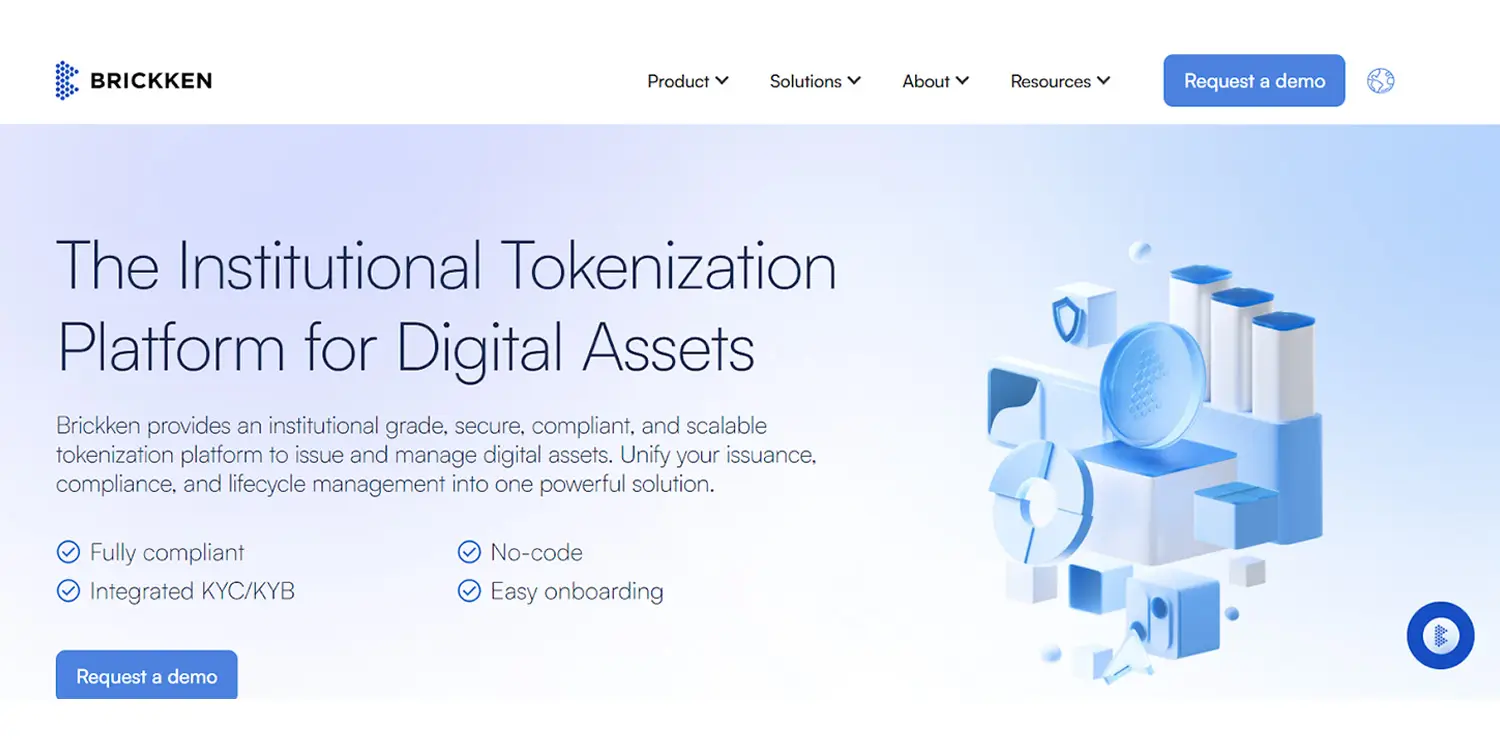
| Factors | Details |
|---|---|
| Type | White-label SaaS |
| Token standards | Multi-asset token suite (equity, debt, funds, real estate) |
| Blockchain networks | Ethereum, BNB Chain, Base, Polygon |
| Compliance & KYC | KYC/KYB rules engine; ISO 27001/27701/27018; DORA-ready; EU Blockchain Sandbox member |
| Custody integrations | Wallet-based; custody partners not published |
| White-label depth | Full issuance stack under your brand, self-serve |
| Pricing | On quote (plans page listed, figures unpublished) |
| Track record (Jul 2026) | $660M+ tokenized, 150+ clients, 40+ countries |

White-label SaaS (real estate lead)
DigiShares publishes the sentence every buyer wants to read: pricing is “predictable and competitive flat fees for onboarding and monthly payments,” with no transaction or success fees (stated on its site, July 2026). That transparency, rare in this market, earns it the top real-estate slot. The platform is deployed in 40+ countries, leans on a network of 80+ legal partners for offering structure, and ships with KYC integrations (SumSub, BlockPass), e-signing, cap-table management and distributions. Chain support is broad for the segment: Ethereum, Polygon, BNB Chain, Fantom and Polymesh.
The focus is genuinely real estate and funds. If you are tokenizing a commodity flow or a bond program, the fit is weaker and Tokeny or Bitbond will serve you better.
| Factors | Details |
|---|---|
| Type | White-label SaaS (real estate lead) |
| Token standards | Security-token modules; Polymesh option for permissioned deployments |
| Blockchain networks | Ethereum, Polygon, BNB Chain, Fantom, Polymesh |
| Compliance & KYC | Integrated KYC (SumSub, BlockPass); e-signing; 80+ legal partners |
| Custody integrations | 90+ wallets via WalletConnect; custodial options per deployment |
| White-label depth | Full back office: issuance, cap table, distributions, marketplace module |
| Pricing | Flat setup + monthly; no transaction or success fees (published model) |
| Track record (Jul 2026) | Deployed in 40+ countries |
Licensed tokenization SaaS
InvestaX’s differentiator is a licence stack, not a feature list. The Singapore operator holds a MAS Capital Markets Services licence (CMS100635), a Recognized Market Operator licence, and exempt financial adviser status (verified July 2026). For an institution that wants to issue and trade tokenized securities in APAC under a regulated umbrella rather than assemble its own licensing, that combination is close to unique among the vendors here. The deal sheet lists 20+ completed and live issuances, including the $100M Spice VC fund tokenization.
The trade-off is the mirror image of its strength: this is a licensed-market model, not a cheap SaaS subscription, and it makes most sense for issuers who need Singapore’s regulatory perimeter specifically.
| Factors | Details |
|---|---|
| Type | Licensed tokenization SaaS |
| Token standards | Platform-managed tokenized securities |
| Blockchain networks | Multiple |
| Compliance & KYC | MAS Capital Markets Services licence (CMS100635), Recognized Market Operator, exempt financial adviser |
| Custody integrations | Regulated market infrastructure under MAS perimeter |
| White-label depth | Institution-branded issuance and trading under InvestaX licences |
| Pricing | On request |
| Track record (Jul 2026) | 20+ completed/live deals, incl. $100M Spice VC fund |

Real-estate tokenization infrastructure
Blocksquare sells the plumbing for branded property marketplaces: its protocol divides each property into 100,000 tokens on Ethereum, and partners launch their own marketplaces on top through its Launchpad product. The company announced passing $200M in tokenized real estate in 2026, and it has done notable legal groundwork, including a notarized EU framework connecting tokens to land-registry claims (company announcements, 2026; its site resists automated verification, so treat exact figures as company-reported).
Choose Blocksquare when the product you want to run is a real-estate marketplace under your brand and you value protocol-level standardization over a turnkey back office. Choose DigiShares when you want the back office too.

| Factors | Details |
|---|---|
| Type | Real-estate tokenization infrastructure |
| Token standards | Property tokens; 100,000 tokens per property protocol |
| Blockchain networks | Ethereum (+ IPFS for documents) |
| Compliance & KYC | Notarized EU tokenization framework linking tokens to land-registry claims (company-announced) |
| Custody integrations | Non-custodial protocol |
| White-label depth | Launchpad for fully branded property marketplaces |
| Pricing | Partner licensing model |
| Track record (Jul 2026) | $200M+ tokenized real estate (company-announced) |
Best for EU-focused entrepreneurs launching real estate tokenization marketplaces
Blocksquare was launched in Europe and provides white label platform for tokenized real-estate investing. Blocksquare allows businesses to launch branded investment portals in weeks, without needing to write code. Built on Ethereum, Blocksquare focuses on property issuance, investor onboarding, peer-to-peer trading, and revenue distribution. Overall, Blocksquare works best for investment clubs, regional portals, and property platforms that want fast deployment with built-in blockchain transparency.
White Label Tokenization Platform Capabilities
| Factors | Details |
| Token Issuance Infrastructure | Property token listing |
| Marketplace Support | P2P secondary trading |
| KYC/AML Regulation | ZignSec |
| Transfer Restrictions | Platform-level control |
| Jurisdictional Compliance Support | EU-focused alignment |
| Securities-Compliant Token Standard | ERC20 |
| Custody Integrations | Self-custody wallets |
| Smart Contract Audits | Hacken |
| Key Security Infrastructure | IPFS |
| White Label Branding | Full branding |
| API Integration | Yes |

Best for property and asset tokenization projects needing flexible white-label infrastructure
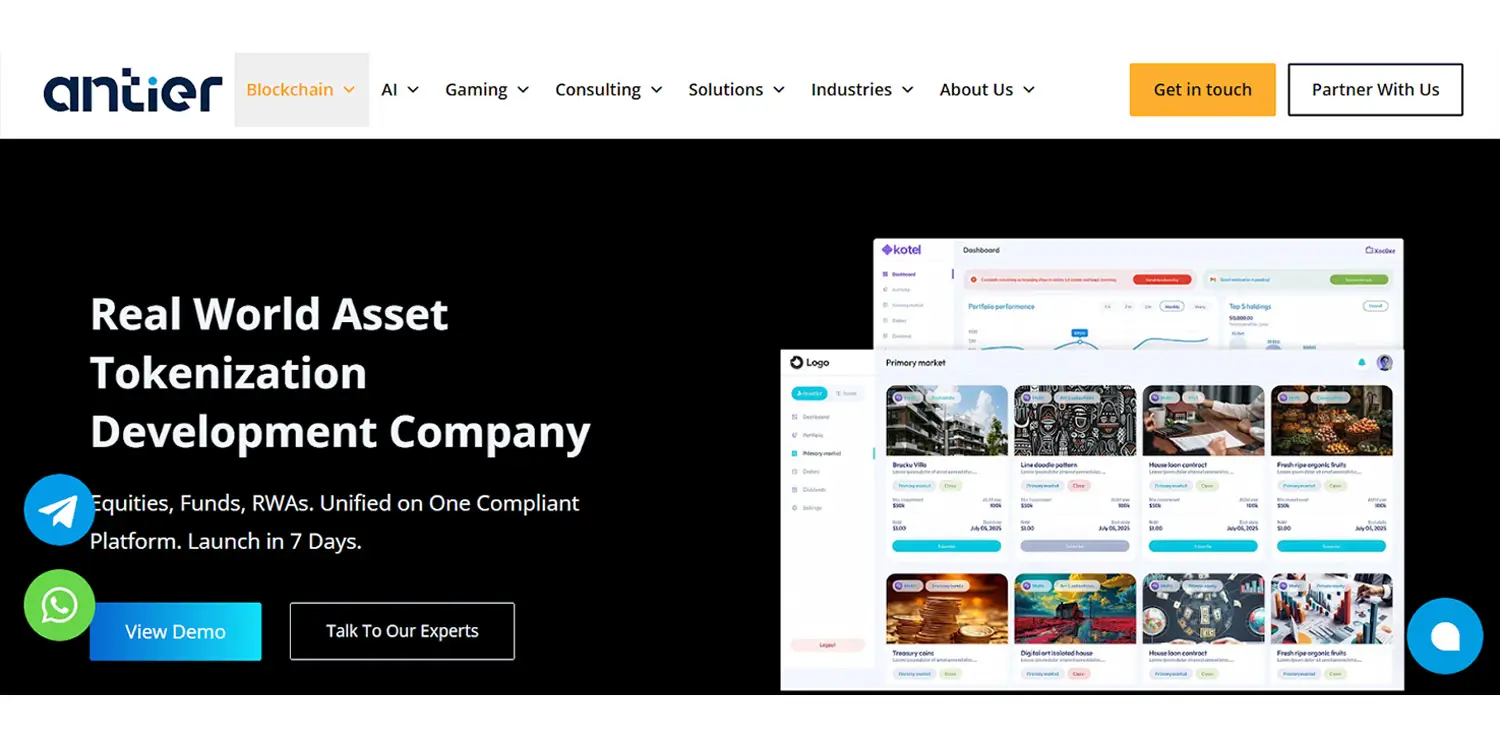
Antier Solution has a global presence that spans the US, UK, UAE, and Australia. Currently, more than 400+ projects use Antier as of 2026. A good reason for this is its white-label tokenization platform tool. With Antier, these projects get fully customizable tokenization platforms for real-world assets like real estate and funds.
Antier’s strength is in offering fast deployment, multichain support, and a compliance framework that issuers can adapt to fit with MiCA and SEC-style regulations. Overall, Antier is mostly used by startups and mid-sized firms launching branding RWA platforms without needing to start from scratch.
 White Label Tokenization Platform Capabilities
| Factors | Details |
| Token Issuance Infrastructure | Fractional asset issuance |
| Marketplace Support | Secondary market integration |
| KYC/AML Regulation | Automated global screening |
| Transfer Restrictions | Jurisdiction-specific controls |
| Jurisdictional Compliance Support | MiCA, SEC, VARA |
| Securities-Compliant Token Standard | ERC-20, ERC-3643, ERC-1400 |
| Custody Integrations | Third-party |
| Smart Contract Audits | Enterprise-grade verification |
| Key Security Infrastructure | MPC wallets, HSM integration |
| White Label Branding | Fully customizable UI/UX |
| API Integration | Multi-chain wallets API |

Best for businesses launching branded real estate tokenization platforms with global reach
Blockchain App Factor has been around for 12+ years, and currently offers one of the oldest white-label services. Their longevity shows trust and real usage. Their white-label services allow anyone to launch real estate tokenization services with quick market entry, automated compliance, and carry out safe cross-border transactions using blockchain.
Blockchain App Factory also handles everything from token issuance to asset management. Investors who choose this platform will also get access to compliance and reporting tools, a customizable investor dashboard, and a developer control panel. 
White Label Tokenization Platform Capabilities
| Factors | Details |
| Token Issuance Infrastructure | Fractional property tokenization |
| Marketplace Support | P2P trading infrastructure |
| KYC/AML Regulation | Built-in onboarding and compliance |
| Transfer Restrictions | Compliance automation |
| Jurisdictional Compliance Support | Global regulatory tools |
| Securities-Compliant Token Standard | ERC-20 |
| Custody Integrations | Multi-chain wallet APIs |
| Smart Contract Audits | Integrated smart governance |
| Key Security Infrastructure | Blockchain immutability and controls |
| White Label Branding | Full UI/UX customization |
| API Integration | Yes |
White-label RWA tokenization platform development companies build ready-made blockchain solutions. Businesses can use these solutions to tokenize real-world assets like funds, commodities, and real estate. The best part is that they do not need any deep experience in blockchain.
What this means is that organizations no longer need to build complex blockchain systems. They can simply license white-label platforms and brand them as their own. This approach makes it easy for fintech startups, asset managers, banks, and enterprises to enter the market faster with tokenized products that comply with local laws. These platforms handle both the backend infrastructure and customer-focused features. They also integrate key aspects like regulations and security into the product.
White-label tokenization platforms have several core technical components that help them operate effectively:
1. Token Issuance Engine: The system that mints and defines digital tokens representing real-world assets. This includes funds. Some of the common standards include:
2. Compliance and Transfer Restriction Engine: This system automates the enforcement of regulatory rules. This means only eligible investors can hold or trade tokens based on their regions, investor type, or legal requirements.
3. Investor Onboarding and Identity Verification (KYC/AML): It integrates with identity providers to confirm investor identities, check sanction lists, and manage anti-money laundering checks before onboarding or token activity.
4. Asset Lifecycle Management Tools: These are dashboards and systems that handle token issuance, distributions (such as dividends), corporate actions, buybacks, and other investor events throughout the token’s life.
5. Wallet and Custody Integrations: These are connections to secure wallets or institutional custodian services that store private keys and manage token holdings.
There’s a serious demand for white-label tokenization platforms in 2026. That’s because they play a huge role in helping companies enter the RWA tokenization market and launch tokens more easily. They offer these services at a reduced cost compared to building the whole setup.
Here are some reasons white-label tokenization platforms are important in 2026:
1. Institutional demand for tokenized RWAs – More banks, asset managers, and funds are entering the RWA market, especially in real estate, funds, and bonds. Some reports predict that this inflow of financial institutions could push the RWA tokenization to trillions by 2030. White-label platforms are a key part of making this happen.
These financial institutions do not need to have a dedicated team or infrastructure to tokenize assets. They just tap into a ready-made solution.
2. Faster deployment than custom setups – While label solutions allow businesses to launch their tokenization platforms in weeks rather than months or years. Plus, it’s also cheaper and requires little maintenance.
3. Built-in compliance for reduced regulatory risk – White-label solutions come ready with compliance tools and transfer retention engines. All of these are designed for regulated securities, reducing the risk of breaking the rules.
| Factors | White label | Custom |
| Cost | Lower | Higher |
| Compliance readiness | Faster | Slower |
| Flexibility | Moderate | High |
| Time to launch | Weeks | 6-18 months |
| Security | Pre-audited infrastructure | Depends on the team and budget |
| Technical complexity | Handled by the provider | Managed fully in-house |
From this table, we can see that white-label solutions are cheaper and faster to launch. However, custom-built platforms leave room for more flexibility.
Note: CoinGape scores tokenization companies through two lenses. Our RWA tokenization platforms guide scores platforms for investors and issuers choosing where to tokenize or invest. The White-Label Score below rates vendors for businesses licensing or commissioning their own platform — so the same company can score differently in each guide.
Evaluation Framework and Weighting
| Factor | Weight | What we measure |
| Compliance capability | 20% | Built-in KYC/AML, permissioned token standards (ERC-3643, DS-protocol), transfer-agent/licensing support, jurisdictions covered |
| Technology & token standards | 15% | Chains supported, standards, APIs, audit history, uptime record |
| Deployment speed & customization | 15% | Time-to-launch, branding depth, modularity, integrations |
| Track record & clients | 15% | Named clients, live issuances, years operating, funds raised on-platform |
| External reviews | 15% | G2 ratings and review counts (G2 runs a dedicated asset-tokenization category), Trustpilot, and Clutch for development agencies |
| Asset-class coverage | 10% | Real estate, funds, private credit, equities, commodities |
| Pricing transparency | 10% | Published pricing or clear quote process vs opaque enterprise sales |
| Evaluation Factor | What We Assessed | Weight |
| Compliance and Regulatory Infrastructure | We looked at the quality of built-in KYC/AML, transfer restrictions, jurisdictional controls, securities-law readiness (EU, US, global). | 30% |
| Blockchain and Token Standard Support | We prioritized platforms that offer support for regulated standards like ERC-1400 and ERC-3643. We also looked at multi-chain readiness and upgrade flexibility. | 20%% |
| Security Architecture and Smart Contracts Standards | We reviewed factors like contract audits, key management, custody integrations, identity controls, and infrastructure security. | 20% |
| Institutional Adoption and Client Base | Here, we checked if the platform has verified enterprise clients and regulated issuers. We also checked for the quality of partnerships and real-world tokenized assets. | 15% |
| Deployment Speed, Scalability, and Customization | We looked at the time-to-launch, white-label depth, API access, and scalability for growth | 15% |
It’s important to pay attention to what matters when choosing a white-label solution for RWA tokenization. Look out for compliance, security, and overall reliability. RWA requires trust, as mistakes here could be costly. So, ensure the platform is truly compliant with the regulations in jurisdictions of interest.
With a good white-label tokenization platform, you eliminate the need for long development cycles and save costs. Check for built-in compliance, security, and investor management tools. This makes it easier to launch, scale, and stay compliant in a fast-paced market.
For financial institutions, white-label platforms make it easy to onboard. They also lower entry barriers for startups and fintechs.
A white-label RWA tokenization platform is a ready-made software that allows businesses to tokenize real-world assets like real estate, funds, or bonds under their own brand.
Costs vary by provider and features. Most white-label solutions are cheaper than custom-built platforms.
Yes, in most regions, tokenized RWAs fall under the same bracket as traditional securities or financial products. Regulators like the SEC in the US oversee tokenized RWAs.
Look for built-in compliance, support for security token standards, KYC/AML integrations, custody options, transfer restrictions, audit-ready smart contracts, and API support.
Most white-label platforms can be launched in weeks, not months or years. Some providers enable deployment in as fast as two weeks, depending on compliance setup and customization.
Ethereum is the most common blockchain. Polygon, Avalanche, Polymesh, and other EVM-compatible chains are widely used for regulated assets tokenization.
They are used by fintech startups, asset managers, real estate firms, banks, private equity funds, crowdfunding platforms, and enterprises looking to issue or manage digital assets compliantly.











 2M+ Monthly Readers
 50k+ Articles