Buy

Choosing the right crypto lending platform isn’t always straightforward. The wrong choice can lead to high fees or liquidation.
In this guide, we review the best protocols based on their security, loan-to-value ratio, APRs, and supported assets. We also explain how they work and the risks to consider.
Based on our evaluation framework, the following platforms performed consistently well across both centralized and decentralized lending models.
| Platform | Type | Best For | Supported Assets | Supported Chains | Max LTV | KYC | APR/Interest Rate | Minimum Loan | Maximum Loan | Rating |
|---|---|---|---|---|---|---|---|---|---|---|
 BinanceRead More | CeFi | Flexible crypto-backed loans with many collateral options | BTC, ETH, stablecoins, and other cryptocurrencies | BNB Chain | 91% | Yes | 0.52% – 6.74% (varies by asset) | $1 | $10,000,000 | 4.8 |
 NexoRead More | CeFi | Multi-asset collateral loans with large borrowing limits | 100+ digital assets, including BTC, ETH, BNB, stablecoins | Bitcoin, Base, Ethereum, Polygon, BNB Chain, Arbitrum, Solana, Avalanche, Litecoin, Bitcoin Cash, Ripple, Stellar, Tron, Cardano, Polkadot, NEAR Protocol, Cosmos, Dogecoin, Optimism, Hedera, Algorand, Celestia, The Open Network, Plasma network | 90% | Yes | 9.9% – 17.9% annual interest rate | $50 in stablecoins or $500 via bank transfer | $2,000,000 per day | 4.5 |
 LednRead More | CeFi | Simple Bitcoin-backed loans | BTC | Bitcoin | 50% | Yes | 11.9% – 12.4% APR | $500 | $5,000,000 | 4.0 |
 XapoRead More | CeFi | Fast BTC-backed loans with flexible repayment | BTC | Bitcoin | 40% | Yes | 10.5% annual interest rate | $1,000 | $5,000,000 | 3.9 |
 UnchainedRead More | CeFi | High-net-worth Bitcoin borrowers | BTC | Bitcoin | 50% | Yes | 14.18% APR | $150,000 | $100,000,000 | 4.3 |
 Coinbase (via Morpho)Read More | Hybrid | Large USDC loans backed by BTC or ETH | BTC, ETH | Base | 86% | Yes | Starts at 5% | No minimum | $5,000,000 USDC (against Bitcoin) or $1,000,000 USDC (against Ethereum) | 4.4 |
 7. Aave Read More | DeFi | Decentralised lending on Ethereum | Wide range of crypto assets | Ethereum, Polygon, Avalanche, BNB Chain, Fantom, Harmony, Base, Arbitrum, Optimism, Gnosis, Scroll, Metis, and zkSync Era | 82% | No | Average 7.73% annual interest rate | No minimum | Depends on collateral & available liquidity | 4.8 |
 8. Compound Read More | DeFi | DeFi users who want simplicity and low interest rates | ETH, WBTC, USDC, and others | Ethereum Mainnet and Ethereum Goerli Testnet | 75% | No | Varies by asset; average 4.72% APR | None stated | None stated | 4.4 |
 9. Alchemix Read More | DeFi | Self-repaying loans | AI Assets, Synthetic tokens | Ethereum, OP Mainnet, Arbitrum One, Linea Mainnet, Metis, and Base | 50% | No | Up to ~3.86% APR | None stated | None stated | 3.8 |
 11. Liquity Read More | DeFi | High-LTV ETH-backed loans | wETH, wstETH, rETH, LUSD, BOLD. | ETH Mainnet | 91% | No | Users set rate | No minimum loan on Starknet, $2,000 on mainnet | None stated | 4.2 |
To find the best crypto lending platforms, we tested and reviewed 25 lending protocols across centralized and decentralized finance using CoinGape’s methodology. This review became even more important after the recent hack and shutdown of the crypto lending protocol, ZeroLend.
Then, we applied a consistent evaluation framework and assigned each metric a percentage weight based on its importance. Security and risk management received the highest weighting because they directly affect the protection of user assets.
| Evaluation criteria | What we looked at | Weight (%) |
| Security & risk management | Smart contract audits, proof-of-reserves, insurance coverage, custody model, and platform track record. | 25 |
| Platform transparency | Public reporting, proof of reserves, and rehypothecation. | 18 |
| Liquidity & loan availability | Pool size, borrowing limits, and loan funding speed. | 15 |
| Loan-to-Value (LTV) ratio | Maximum borrowing limits and how aggressive liquidation thresholds are. | 12 |
| APR & borrowing costs | Interest rates, additional fees, rate transparency, and whether the APR is fixed or variable. | 10 |
| Supported assets | Number of cryptocurrencies supported as collateral and loanable assets. | 10 |
| User experience | Ease of borrowing, interface design, KYC requirements, and onboarding process. | 10 |
Crypto lending platforms allow you to borrow stablecoin or other digital assets using your available cryptocurrency as collateral. On the flip side, you can earn interest by lending your digital assets to others.
In simple terms, suppose you have $10,000 worth of Bitcoin but need $3,000 in cash. Instead of selling your Bitcoin, a crypto lending platform allows you to deposit your Bitcoin as collateral and borrow stablecoins or cash against it. Your Bitcoin remains locked as collateral for the loan, and once you repay the loan amount (plus interest), you get your crypto back.
Likewise, someone else on the platform deposits stablecoins to earn interest. The interest you pay as a borrower becomes part of their return as a lender.
CeFi and DeFi lending platforms are similar in that they allow users to borrow or lend crypto assets to earn yield. However, they differ in terms of custody, risk management, and liquidation.
| Features | CeFi | DeFi |
| Custody model | The platform holds and manages your crypto assets on your behalf. | You are your own bank (non-custodial). You control your funds through your wallet, and assets are locked in smart contracts. |
| Liquidation mechanisms | Liquidations are handled by the platform’s internal risk systems or risk management team. | Liquidations are fully automated through smart contracts. |
| Security model | Security depends on the company’s infrastructure, custody partners, and internal risk management processes. | Security is dependent on the smart contract code. |
| Regulation and accessibility | CeFi platforms are compliant with financial regulators, meaning users must create an account and complete KYC (identity verification) before lending. | Anyone with a compatible crypto wallet can access a DeFi lending platform without creating an account or submitting personal information. |
| Interest rate determination | Interest rates are set by the platform based on institutional demand and market conditions. | Interest rates are algorithmically determined by supply and demand within liquidity pools. |
From the 25 lending protocols we reviewed, 10 platforms consistently met our standards. These platforms stood out across both centralized and decentralized finance for their track record, supported assets, borrowing terms, and overall reliability.
Best for flexible crypto-backed loans with many collateral options
Binance loans lets users borrow crypto by pledging assets such as BTC, ETH, stablecoins, and a wide range of other cryptocurrencies as collateral. You can choose between flexible loans with open-ended repayment or fixed-rate loans where you set the loan amount and interest rate. Binance automatically monitors collateral levels and triggers liquidation if the loan-to-value ratio reaches around 91%.

| Parameters | Details |
| Platform type | CeFi |
| Interest rates | Variable (0.52% for BTC, 2.56% for ETH, 3.13% for USDT, 6.74% for SOL, etc). |
| Initial LTV | 78% |
| Margin Call LTV | 85% |
| Liquidation LTV | 91% |
Best for multi-asset collateral loans with large borrowing limits
Nexo supports 100+ digital assets, including BTC, ETH, BNB, and stablecoins, and loan amounts range from $50 to $2 million. You can withdraw funds in stablecoins or receive the fiat equivalent in USD, EUR, GBP, or ARS via bank transfer. The interest rates depend on your Loyalty tier, which is determined by how much NEXO token you hold relative to the rest of your portfolio.

| Parameters | Details |
| Platform Type | CeFi |
| Interest rates | No NEXO tokens – 17.9% | At least 1% NEXO tokens – 15.9% | At least 5% NEXO tokens – 11.9% or 12.9% | At least 10% NEXO tokens – 9.9% |
| Liquidation LTV | Varies by collateral asset. | BTC – 50% | ETH – 50% | BNB – 30% | NEXO – 15% | USDT/USDC – 90% |

Robust Crypto Lending Platform
Binance is a CeFi crypto loan provider that combines crypto loans with its exchange, so you can borrow and trade in one place. Founded in 2017 by Changpeng Zhao (CZ) under parent company Binance Holdings Ltd, it supports loans with more than 50 different cryptocurrencies, including BTC, ETH, and USDT.
The platform focuses heavily on security, with several core policies built around customer protection. Following a strict no-rehypothecation policy it ensures users maintain full ownership of their collateralized crypto assets. Anchorage Digital holds custody of the assets for added security. The APR starts at 8.49%.
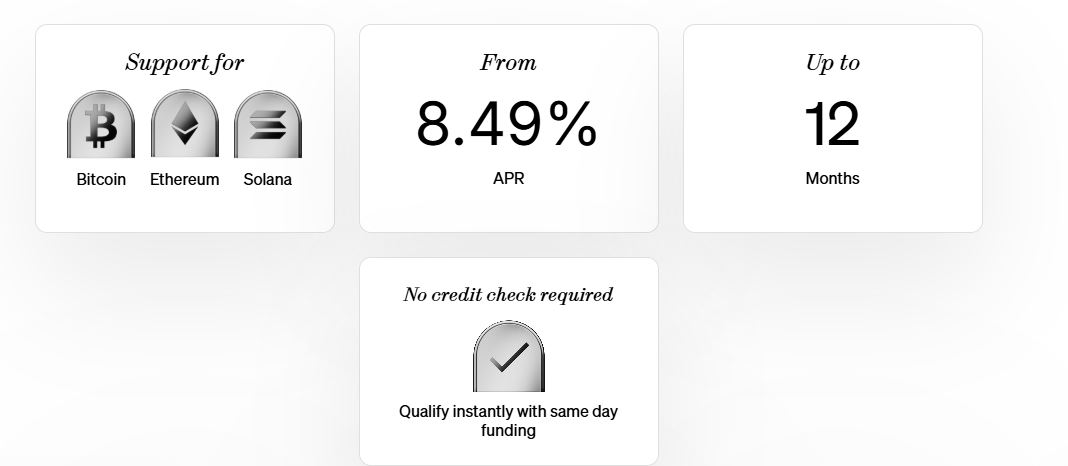
| Parameters | Details |
| Platform Type | CeFi |
| Loan size | Minimum is $500 |
| Interest rates | 8.49% APR |
| Loan duration | 12 months |
| Liquidation LTV | 60% |
Best for simple Bitcoin-backed loans
Ledn offers bitcoin-backed loans that let users borrow cash or stablecoins without selling their BTC. The loans are typically issued at 50% loan-to-value (LTV), starting at $500, with a minimum collateral requirement of $1,000 in BTC. You can receive funds in USD, USDC, or local currency, depending on your jurisdiction. As a plus side, approval does not require a traditional credit check, and loans are usually funded within 24 hours.

| Parameters | Details |
| Platform type | CeFi |
| Loan size | Minimum is $500 |
| Interest rates | 10.4% annual interest (11.9%–12.4% APR) + ~2% admin fee (varies by jurisdiction) |
| Liquidation LTV | 50% |
Best for fast BTC-backed loans with flexible repayment
Like Ledn and Unchained, Xapo offers bitcoin-backed loans, allowing borrowers to access up to 40% of the value of their Bitcoin, with loan sizes up to $1,000,000. You can choose loan terms of 30, 90, 180, or 365 days, and funds are typically deposited into your USD account within a minute of approval. Borrowers can make repayments at any time, provided the loan is fully repaid by the end of the selected.
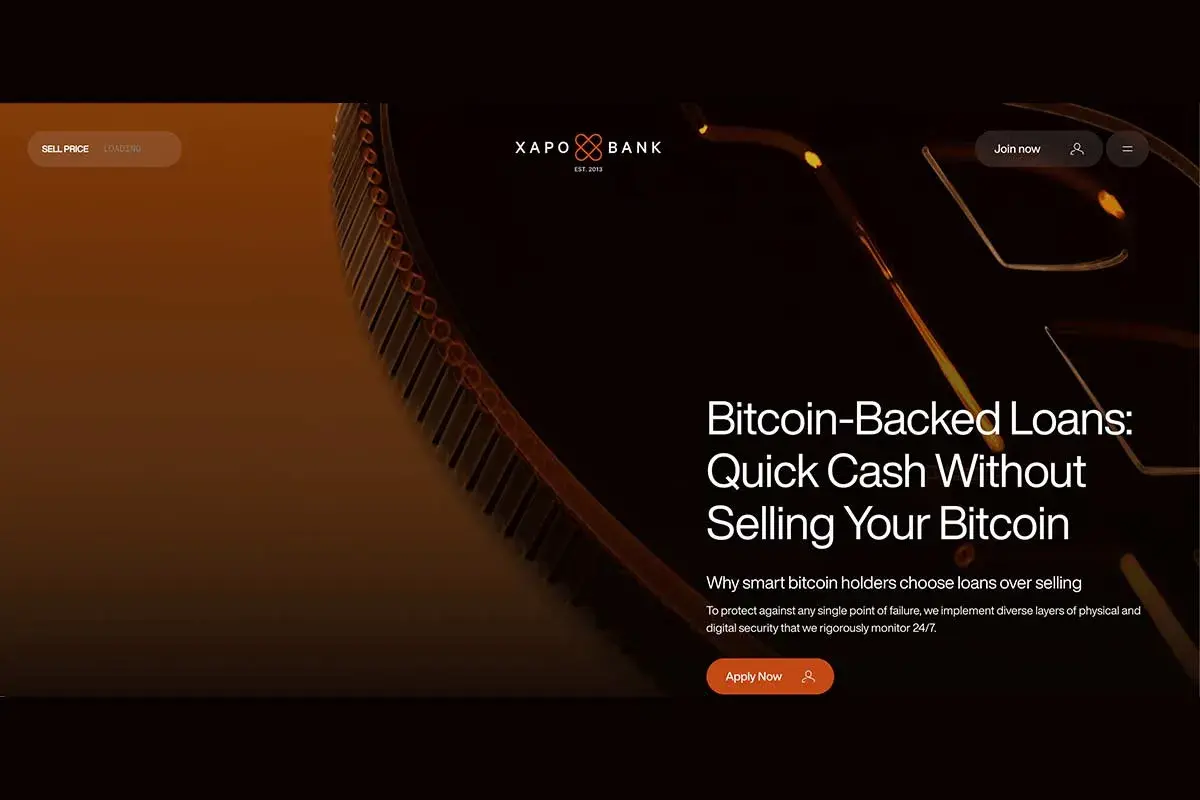
| Parameters | Details |
| Platform type | CeFi |
| Loan size | From $1,000 up to $1,000,000 |
| Interest rates | Subject to change, but currently 10.50% annual interest rate |
| Loan duration | 30, 90, 180, or 365 days |
| Liquidation LTV | 40% |
Unchained offers bitcoin-backed loans to long-term BTC holders who want liquidity without selling their assets. The platform’s lending model uses collaborative custody, where collateral is held in a multisignature wallet. You, Unchained, and Fortis (a key agent) each control ⅓ of the BTC keys, making it difficult for hackers to steal your crypto. The loans start at $150,000, have a 12-month term, and are processed within 1 to 2 business days after KYC verification.

| Parameters | Details |
| Platform type | CeFi |
| Loan size | Minimum is $150,000 |
| Interest rates | 12% interest rate (14.18% APR) |
| Loan duration | 12 months |
| Liquidation LTV | 50% |
| Custody model | Multisign custody (borrower + Unchained + Fortis) |
Best for large USDC loans backed by BTC or ETH
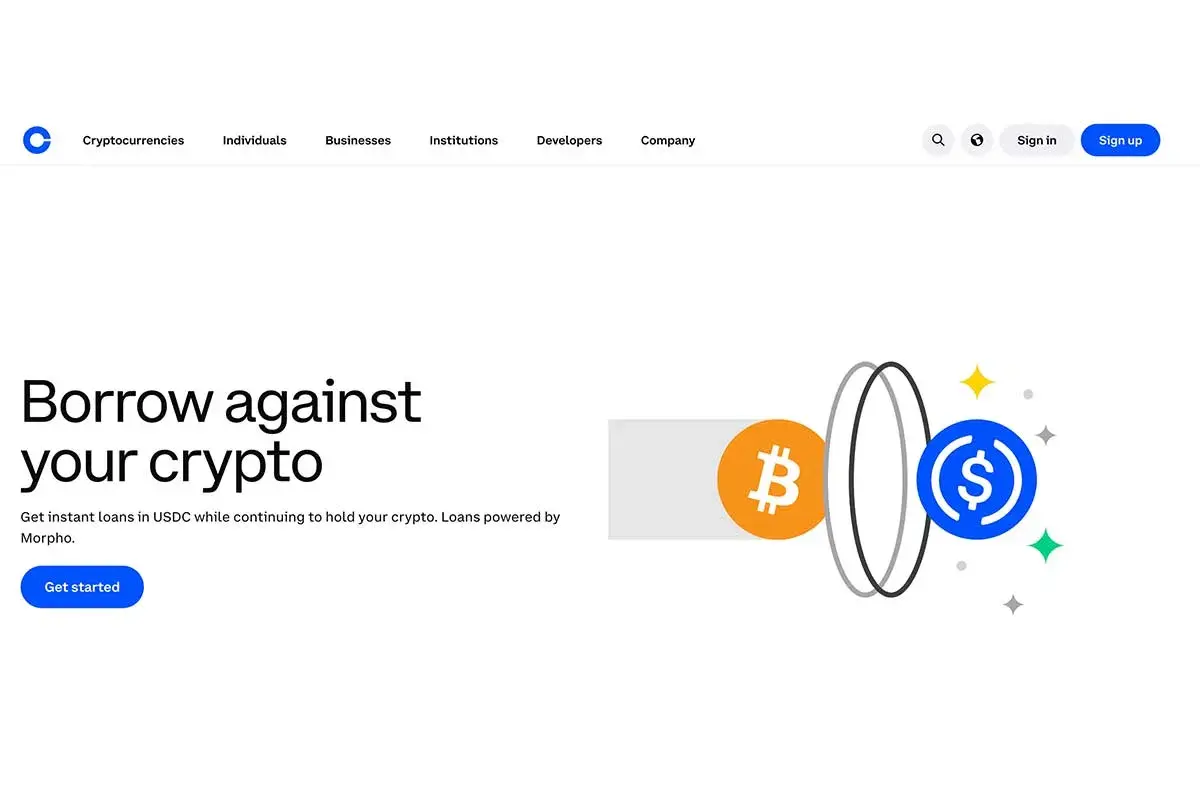
Coinbase lets users borrow USDC using the Morpho on-chain lending protocol behind the scenes. You can access up to 5,000,000 USDC against Bitcoin and 1,000,000 USDC against Ethereum, depending on how much collateral is provided. When a loan is issued, the pledged crypto is moved from your Coinbase account to on-chain Morpho smart contracts. There are no repayment schedules or deadlines, but borrowers must keep their loan-to-value ratio below 86% to avoid automatic liquidation.
| Parameters | Details |
| Platform type | Hybrid |
| Interest rates | Starts at 5% per annum |
| Liquidation LTV | 86% |
Aave is one of the largest decentralized lending protocols, supporting 13 different blockchains and a wide range of crypto assets. The protocol is known for introducing advanced features, such as flash loans, which allow users to borrow and repay funds within a single transaction. Interest rates adjust dynamically in response to supply and demand.
Compound Finance is one of the earliest lending and borrowing protocols in DeFi. It allows users to deposit crypto into liquidity pools to earn interest, while borrowers take out overcollateralized loans. Interest rates automatically adjust based on market demand, rising when borrowing activity increases and falling when liquidity is abundant. The protocol supports major assets such as ETH, WBTC, USDC, and several other widely used cryptocurrencies.
Alchemix takes a different approach by offering self-repaying loans. When users deposit collateral, the protocol allocates those funds to yield-generating strategies, and the interest earned gradually repays the loan. Borrowers can access up to 50% of their collateral value, while still earning yield on the full deposit. Depending on the asset pair, borrowing rates can reach around 3.86% APR.
Liquity is a decentralized borrowing protocol that allows users to borrow stablecoins against their ETH collateral. Unlike many DeFi lending platforms, Liquity lets borrowers set their own interest rates rather than relying on DAO decisions or utilization-based rate models. The protocol supports loans with an LTV ratio of up to 91%, making it one of the highest-leverage borrowing options in decentralized finance.
Check out our full DeFi lending platforms guide.
Crypto loans provide quick access to liquidity without selling your assets, but they also come with several risks that borrowers should understand.
Use these parameters to compare different lending platforms before choosing one that best fits your borrowing needs.
The “best” crypto lending platform depends on the assets you hold, the level of custody you are comfortable with, and how much flexibility you need in terms of borrowing limits, repayment schedules, and collateral requirements. Centralized platforms typically provide easier onboarding, customer support, and fiat withdrawals, while decentralized protocols offer non-custodial borrowing and greater transparency via smart contracts.
With that context in mind, here’s how the 10 crypto lending platforms rank across common use cases in 2026:
Crypto lending platforms connect borrowers and lenders. They allow you to borrow fiat or stablecoins by pledging cryptocurrency as collateral, or earn interest by lending your digital assets.
Crypto lending can be safe, but it depends on the platform and how risks are managed. Centralized lenders carry platform risks, while DeFi protocols introduce smart contract risks. You can mitigate these risks by selecting regulated platforms, maintaining conservative LTV ratios, and conducting due diligence.
If the value of your collateral drops, your loan-to-value (LTV) ratio rises. Once it reaches the platform’s liquidation threshold, the platform can automatically sell part or all of your crypto to repay the loan.
Crypto loans are generally not taxable because borrowing against an asset does not count as selling it. However, taxes may apply if your collateral is liquidated or if you earn interest from lending.
You can deposit your BTC on platforms like Unchained. They typically offer around 50% LTV, no credit checks, and funding within 24 hours.
Some trusted ones include:
Aave allows around 82% for ETH
Pretty much all of them! Platforms like Binance, Aave, and others give instant approval since loans are based on your collateral, not your credit history.
Keep your LTV under 50%, add more collateral if prices drop, set up price alerts, and consider platforms like Figure, which gives you more buffer with a 95% threshold.
Not if there’s no profit. If you repay the flash loan within the same transaction, it’s not taxable. However, profits from arbitrage or trades made with flash loans are considered capital gains.
Yes, when managed wisely. Crypto lending can be profitable, providing quick access to capital without selling crypto assets.
Like any lending, crypto loans involve risks. Caution is advised to avoid overextending your Loan-to-Value (LTV) ratio, and understanding loan terms is crucial. Choose reputable platforms that are effective in mitigating risks.
On platforms like Binance or Ledn, you repay with fiat or crypto, usually within a set term (7–180 days for Binance, 12 months for Ledn). Interest is added daily or monthly. On DeFi platforms like Aave or Compound, you repay by sending crypto back to the smart contract. Alchemix is unique, slowing repays itself using the yield from your collateral.
Yes, you can borrow money on Binance by using your crypto as collateral. The platform supports over 20 coins, including BTC, ETH, and USDT. For example, in June 2025, I tested a loan of $10,000 against 0.2 BTC at a 7.2% APR with a 2% origination fee. Binance loans usually run from 7 to 180 days and allow borrowing up to 65% of your collateral’s value.
Withdrawing a loan from Binance is simple:
Yes, most crypto loan platforms allow borrowing against crypto assets (e.g., BTC, ETH). CeFi platforms like Ledn (50% LTV) and Nexo (70% LTV) require KYC and collateral deposits. DeFi platforms like Aave (75% LTV) use smart contracts, no KYC. Collateral is locked until repayment or liquidation.
Yes. If you take a Binance loan in stablecoins like USDT, you can easily turn it into cash. First, convert the USDT to fiat money (like USD or EUR) using Binance’s Convert feature. You will be charged a small fee of about 0.1%. Then, withdraw the money to your bank account. Withdrawal fees vary by method.
Binance loans are considered quite safe since the exchange is regulated, and widely trusted. The CeFi platfor also has an insurance fund (SAFU) that once covered losses from a hack in 2019. However, your collateral is held by Binance, not you, which means it can be liquidated if prices drop. So while Binance loans are reliable for most users, they’re not risk-free. Borrow carefully.
CeFi Platforms like Binance, Crypto.com, Nexo, Save, and Unchained, Ledn) require KYC (ID verification) for compliance. However, no KYC is imposed on DeFi platforms like Maple, Compound, Alchemix and Aave. Check platform and regional regulations.










 2M+ Monthly Readers
 50k+ Articles