
 Claim Bonus
White House Proposes Stablecoin Rewards Compromise as CLARITY Act Odds Drop to 44%


Highlights
- White House backs CLARITY Act compromise banning stablecoin yields on idle holdings.
- White House-led session narrows debate to activity-based rewards, aiming for compromise by March 1.
- The odds of the CLARITY Act passing this year has dropped to 44% but since recovered to 52%.
The White House moved to break the stablecoin impasse last Friday at ETHDenver, proposing that holders cannot earn yields on idle coins under draft language tied to the CLARITY Act. Crypto Council Executive Director Patrick Witt outlined the compromise to industry and bank leaders after a closed-door session. The talks aim to resolve the rewards dispute by March 1 and restart Senate action.
CLARITY Act Talks Narrow Stablecoin Yield Provision
As per Crypto in America, the core compromise for the CLARITY Act is that firms would not offer yield on idle stablecoin balances. That objective, long pursued by crypto companies, is now effectively off the table. Instead, negotiators narrowed the debate to rewards tied to activity, such as transactions or network participation.
According to Witt, the gap between banks and crypto firms “shrunk considerably” after last week’s meeting. The White House digital assets adviser previously said that the recent closed-door meeting was a big step forward for stablecoin yield.
The draft addressed concerns raised in a recent banking framework on stablecoin yield limits. Notably, any restrictions would be narrowly scoped. A banking source said the proposed anti-evasion language would allow the SEC, Treasury, and CFTC to enforce the idle-yield ban. Civil penalties could reach $500,000 per violation, per day.
Witt said ethics concerns tied to President Donald Trump’s family crypto dealings remain under discussion. However, he described them as less central than the CLARITY Act rewards issue. Once negotiators finalize language, the Senate Banking Committee could reschedule its postponed January 15 markup. Chairman Tim Scott will decide the timing.
Industry and Bank Groups Face Off
The session included representatives from Coinbase, Ripple, and Andreessen Horowitz. Last week, Coinbase Chief Legal Officer Paul Grewal said discussions around the crypto bill remained constructive and cooperative. Despite this, Polymarket odds on Clarity Act odds of passing fell to as low as 44% but have since recovered to 52% as the March 1 deadline approaches with no meaningful movement on a compromise.
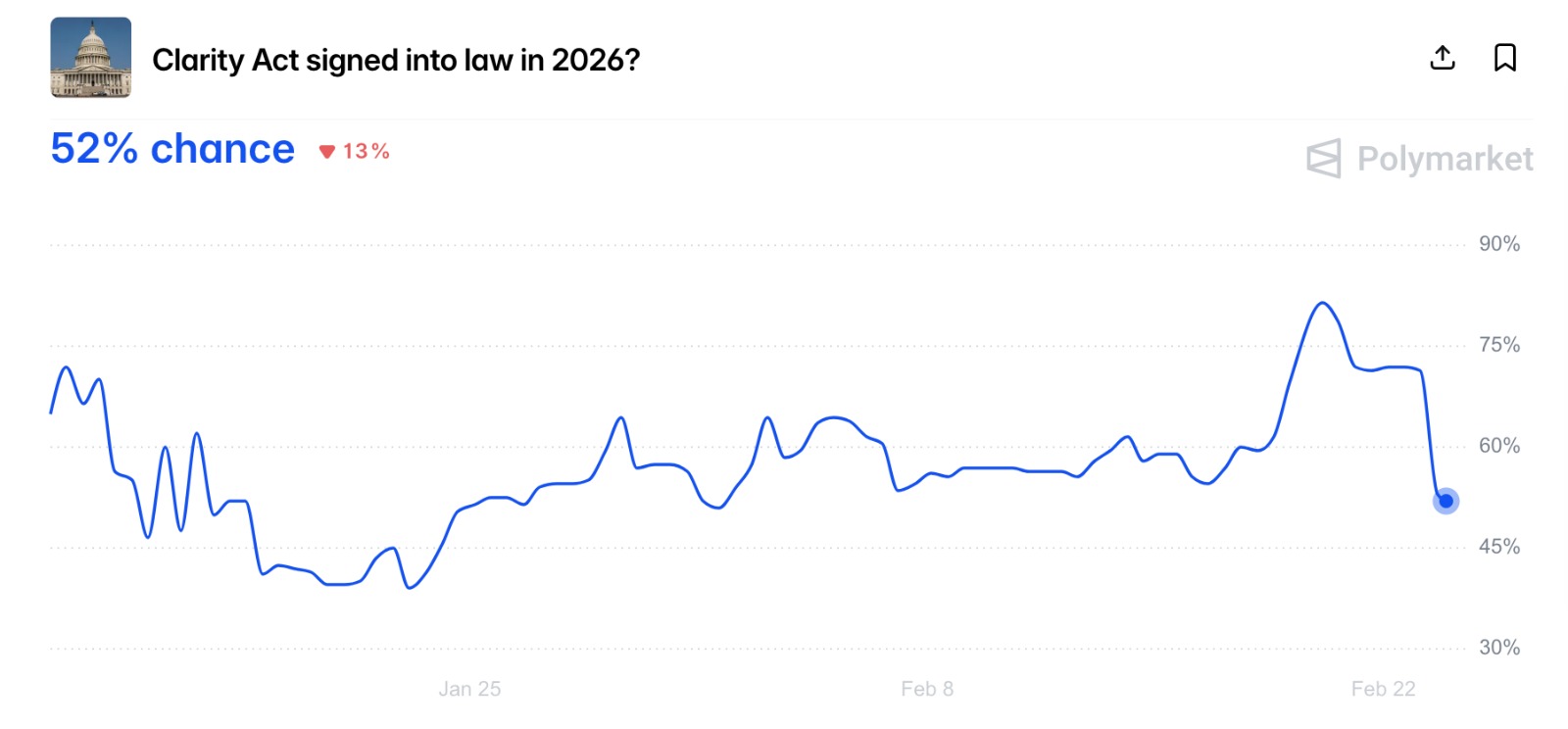 Source: Polymarket
Trade groups Blockchain Association and Crypto Council for Innovation also attended. Bank perspectives came from the American Bankers Association, Bank Policy Institute, and Independent Community Bankers of America.
As Coingape reported, the third White House meeting on the CLARITY Act was held on Thursday, with Ripple, Coinbase, and bank representatives attending. Now, banks argue that rewards could pull deposits from traditional institutions and raise systemic risk. Meanwhile, crypto firms warn that broad restrictions would curb innovation and favor incumbents. The White House inserted itself more directly than in prior meetings to bridge that divide.
Witt told Crypto In America, officials seek a resolution by March 1 for the CLARITY Act. He said good-faith engagement could unlock faster movement. Much reconciliation between stakeholders is already happening in parallel.

Why Trust CoinGape
CoinGape has covered the cryptocurrency industry since 2017, aiming to provide informative insights Read more… to our readers. Our journal analysts bring years of experience in market analysis and blockchain technology to ensure factual accuracy and balanced reporting. By following our Editorial Policy, our writers verify every source, fact-check each story, rely on reputable sources, and attribute quotes and media correctly. We also follow a rigorous Review Methodology when evaluating exchanges and tools. From emerging blockchain projects and coin launches to industry events and technical developments, we cover all facets of the digital asset space with unwavering commitment to timely, relevant information.



Delivered every day.
- Insights that move markets
- 100,000 active subscribers
Related Articles



- Michael Saylor Says Quantum Risk To Bitcoin Is a Decade Away, Describes it as ‘FUD’
- Trump’s Board Of Peace Eyes Dollar-Backed Stablecoin For Gaza Rebuild
- Trump’s World Liberty Financial Flags ‘Coordinated Attack’ as USD1 Stablecoin Briefly Depegs
- Trump Tariffs: U.S. Threatens Higher Tariffs After Supreme Court Ruling, BTC Price Falls
- Fed’s Chris Waller Says Support For March Rate Cut Will Depend On Jobs Report
- COIN Stock Risks Crashing to $100 as Odds of US Striking Iran Jump
- MSTR Stock Price Predictions As Michael Saylor’s Strategy Makes 100th BTC Purchase
- Top 3 Meme Coins Price Prediction As BTC Crashes Below $67k
- Top 4 Reasons Why Bitcoin Price Will Crash to $60k This Week
- COIN Stock Price Prediction: Will Coinbase Crash or Rally in Feb 2026?
- Shiba Inu Price Feb 2026: Will SHIB Rise Soon?