Buy

Leveraged prediction market platforms are venues or margin layers that allow traders to increase their exposure to real-world outcomes in markets such as sports, crypto, politics, economic data, and other major events.
The best leveraged prediction market platform for you depends on your trading goals. Some platforms focus on Polymarket leverage, others offer prediction market perps, Solana-native markets, or regulated event contracts. Overall, the custody model, liquidity, liquidation rules, risk controls, and regional restrictions matter more than leverage numbers.
| Platform | Rating | Platform Type | Best For | Max Leverage | Main Markets | Chain / Market Base | Custody Model | Fees | Audited? |
|---|---|---|---|---|---|---|---|---|---|
| ⭐4.3 | Margin layer for Polymarket | Leveraged Polymarket traders | Up to 5x | Politics, Sports, Crypto, Finance, AI, other | Polygon | Non-custodial (smart contracts) | Entry fee 7% + borrow APR 10-317% + 10% profit fee | Yes (Hashlock) | |
| ⭐4.2 | Native leveraged prediction market | Leveraged Solana event trading | Up to10x | Crypto, Politics, Sports, Tech, Economy, Culture | Solana | Non-custodial | 0% maker + dynamic taker fees | No | |
| ⭐4.2 | Margin layer for Polymarket | Leveraged Polymarket trading | Up to 10x | Elections, Sports, Economic data, and others | Polygon | Undisclosed (claims non-custodial) | 0.5%-1.5% open fee (market/limit) + 10% performance fee (profit only) | Yes (CDSecurity) | |
| ⭐4.1 | Margin/prime-brokerage layer for Polymarket | Leveraged Polymarket sports trading | Up to 10x | Crypto, Sports, Politics, Finance, Culture | Polygon | Non-custodial (TEE wallet) | $0.20 withdrawal fee | No | |
| ⭐3.9 | Native leveraged prediction market | Active event traders | Up to 5x (10x planned) | Sports (World Cup), Crypto, Finance, Politics, others | Base | Smart-contract custody | Dynamic fee + funding rate | No |
Levr Bet: Live, on-chain leveraged sports prediction exchange with confirmed 2x-5x leverage and real liquidation mechanics. Sports-only, not a general prediction market, and blocks 60+ countries, including the US, UK, and most of the EU.
Leveraged prediction market platforms are venues where traders can amplify their exposure to event outcomes beyond their initial capital. In a traditional prediction market, your maximum exposure is limited to the cost of the YES/NO shares you buy. Leveraged versions expand that exposure using margin, prediction market perps, or other structured payoff mechanisms.
Leverage increases both profit potential and risks. A standard prediction market position can only lose the amount invested. But a leveraged position can be liquidated before the event is resolved if margin requirements are no longer met or the price moves against the trader.
Also Read – List of Best Prediction Market Tools

Best for Leveraged Polymarket Traders
Predmart makes leveraged Polymarket trading easy. Instead of manually borrowing funds and placing multiple orders, you adjust a 1.5x-5x leverage slider, and the protocol automatically borrows funds, purchases Polymarket shares, and opens your positions in a single transaction. Predmart runs on Polygon and uses a non-custodial design.
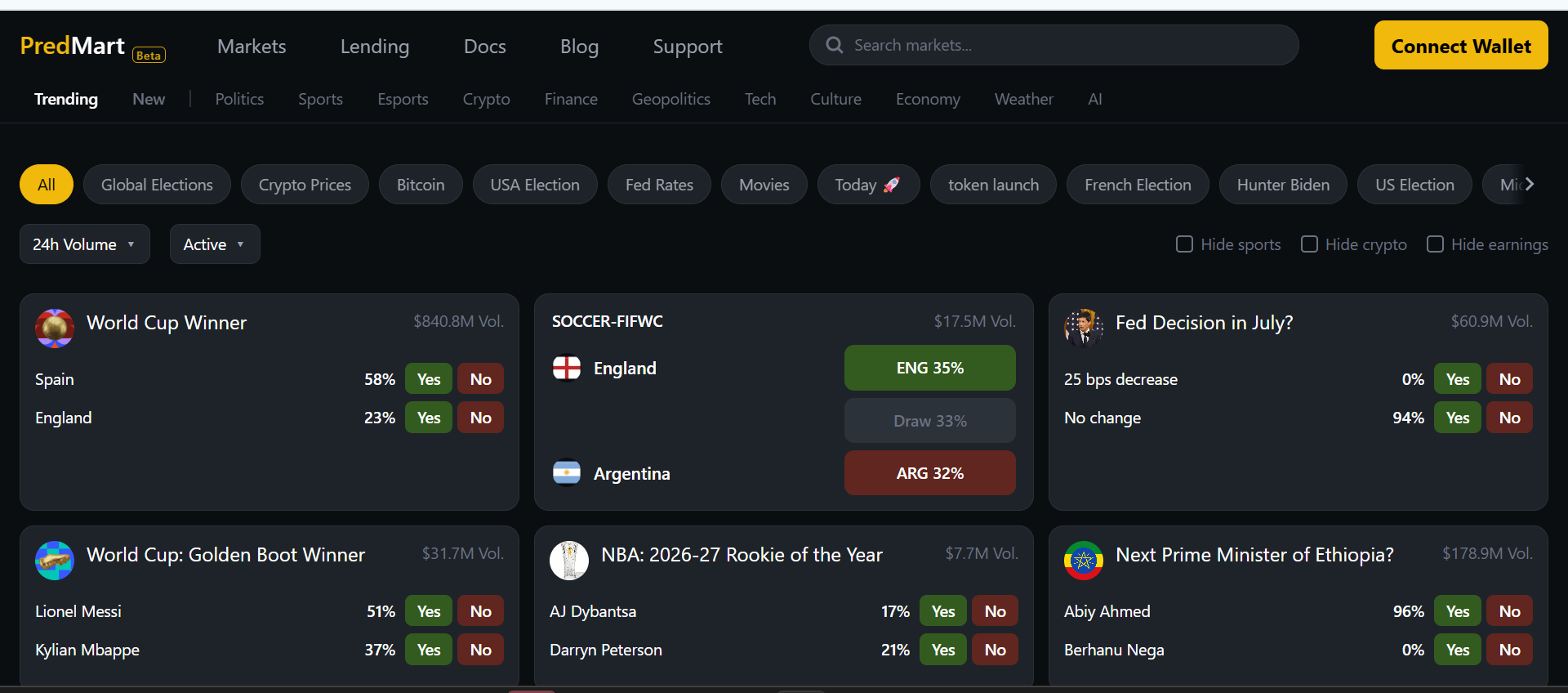 What to check before using it: Although Predmart supports up to 5x leverage on eligible Polymarket positions, it is still a beta product. The parameters change through a six-hour time lock.
Also, the positions are fully liquidated if margin requirements are breached. Predmart is unavailable in several jurisdictions, including the US, the UK, France, Ontario (Canada), Singapore, Australia, and Taiwan.
| Feature | Detail |
| Liquidation Mechanism | Full liquidation. 100% of collateral seized in a single transaction; no partial-liquidation option exists |
| Oracle / Resolution Source | Market outcomes inherit Polymarket’s own resolution (UMA-based, or similar); PredMart uses a centralized in-house signer for liquidation triggers. |
| Distinctive Feature | Uses a fully automated one-signature leverage execution via Gnosis Safe. |
Explore: Top Trade Opportunities with our Prediction Market Finder

Best for Solana-native Traders
Space has a non-custodial infrastructure (Terms of Service), meaning users maintain custody of their funds, while trades settle through Solana smart contracts. Unlike most platforms that fully liquidate positions, Space uses partial liquidation at 25% increments, reducing the chances of a full wipeout during sharp market moves. It also maintains an insurance fund targeting 2% of the platform TVL.

What to check before using it: Space does not clear the display funding or borrow rate for leveraged positions. So, it is not clear if holding a leveraged position carries an ongoing cost beyond the entry taker fee. Space also restricts users in France, the UK, Portugal, Australia, Hungary, and others. Ensure it supports your region before using it.
| Feature | Detail |
| Liquidation Mechanism | Partial liquidation in 25% increments, rechecked and repeated as needed. |
| Oracle / Resolution Source | Uses Pyth + Switchboard price median, with circuit breakers that pause trading on rapid price moves |
| Distinctive Feature | Space has a publicly on-chain insurance fund (target: 2% of platform TVL), funded by liquidation penalties and a share of platform fees. |

Best for Leveraged Polymarket Trading
By design, Ultramarkets is best for trading probability swings and not holding positions until an event resolves. It reduces gap risk by automatically closing all positions before market resolution instead of carrying leveraged exposure through binary outcomes.
Ultramarket has one of the most transparent documentation, including a published CDSecurity smart contract audit, and a transparent liquidation model.

What to check before using it: Ultramarkets is still in beta. So, features and some platform parameters may change as it develops. Although it advertises up to 10x leverage, the actual limit depends on liquidity and market volatility, with some traders capped at 2x and 5x. Positions are liquidated when position health falls to 45%, and users cannot add margin to avoid liquidation. They must either close the trade manually or allow it to be liquidated.
| Feature | Detail |
| Liquidation Mechanism | Two-tier: small positions liquidate directly on Polymarket’s orderbook; larger positions go through a Dutch auction (Phase 2) to avoid market impact |
| Oracle / Resolution Source | Fully inherited from Polymarket. Ultramarkets doesn’t operate its own markets or resolution process at all |
| Distinctive Feature | Structurally eliminates gap risk by force-closing every position before an event resolves, rather than managing risk through the resolution moment like other platforms. |

Best for Leveraged Polymarket Sports Trading
Amplifi supports deposits for as little as $ 2 and does not currently require KYC. Each trader receives a TEE-controlled smart contract wallet on Polygon that holds real Polymarket conditional tokens. With this, trades can execute on Polymarket’s order book while remaining eligible for Polymarket rewards.

What to check before using it: Amplifi supports up to 10x leverage. However, the maximum varies by market and entry price. Leverage falls as low as 1x for shares priced below $0.05, while live in-game sports markets have a 2-3x cap.
Amplifi is still in Beta, meaning the team could still make some changes, which is something to watch for. Amplifii charges a $0.20 USDC fee for withdrawal.
| Feature | Detail |
| Liquidation Mechanism | Dynamic, orderbook-depth-based trigger (not a static ratio). It deducts a penalty from the remaining equity after debt repayment, not from the full margin |
| Oracle / Resolution Source | Real-time monitoring via Polymarket’s own CLOB API; resolution itself is inherited from Polymarket |
| Distinctive Feature | Positions are held as real Polymarket conditional tokens in a TEE-controlled wallet, meaning leveraged positions remain eligible for Polymarket’s own rewards program. |
Also Read – List of Top Crypto Leverage Trading Platforms

Best for Native Leveraged Prediction Market
OmenX is one of the few platforms built specifically for leveraged event trading. OmenX stands out for combining a cross-margin central limit order book (CLOB) on Base with USDC settlement, allowing traders to manage multiple positions from a single margin account. OmenX has 52 active markets, with roughly 4000 to 7,000 daily traders.

What to check before using it: The terms of service state leverage up to 10x leverage but the live product caps at 5x. The best approach is to trade on 5x. Liquidation is automatic on margin breach, and resolution of disputes is settled internally.
| Feature | Detail |
| Liquidation Mechanism | Automatic on margin breach. |
| Oracle / Resolution Source | Internal system |
| Distinctive Feature | The “Hedge-to-Earn” incentive program targets existing Polymarket position holders to migrate exposure to OmenX |
Each platform in this guide was ranked using the CoinGape Leveraged Prediction Market Platform Score, which weighs seven factors. Overall, our ranking framework prioritizes risk controls over raw leverage. Here’s how we ranked the platforms:
A platform offering 10x leverage with weak liquidation controls scores lower than one offering 5x with transparent risk management.
Note: Leveraged prediction markets are a very new category. Platform status, leverage limits, fee structures, and regional restrictions can change quickly. Verify terms and conditions with each platform before trading.
A platform offering 10x is not automatically better than one capped at 2.5x or 5x. In prediction markets, prices can swing sharply as an event approaches resolution, and liquidity could dry up.
As a result, leveraged positions can be liquidated long before the outcome happens. This means a trader’s prediction could ultimately be correct, yet the position may already have been forced closed because of margin or collateral requirements.
Some recent research on leveraged event-linked markets also warns that higher leverage has serious risks. It could amplify market-price manipulation, informed trading advantages, and incentives to influence event outcomes. All of these show why risk controls matter more than headline leverage.
The costs attached to leveraged event trading are significantly higher than ordinary 1x YES/NO prediction trading. On most platforms, you may pay more than the entry price of a share.
You may pay platform fees on some platforms, borrow interest, gas, liquidation interest, and even withdrawal charges. Most of these fees do not show up until you’ve opened a position, which is why it is important to know the fees to compare.
Below is an example of the fees event traders pay. We used Predmart for this example
| Fee Type | Where does it appear? | Verified Fees |
| Trading fee | Charged when a leveraged position opens | Up to 7% entry fee, risk-based (scales with share price) |
| Operation fee | Charged on every relayed transaction | Flat USDC fee, admin-set (funds relayer gas) |
| Borrow rate / APR | Charged continuously on the borrowed portion while a position stays open | Borrow APR starts at 10% but is utilization-based, rising to 42% at the 80% kink, up to 317% at full utilization |
| Profit fee | Charged only on winning leveraged closes | 10% of profit (7% to lenders, 3% to protocol) |
| Slippage | Applies to forced sale/unwind of a failed or liquidated position | Not capped. PredMart’s Terms of Use confirm no slippage protection on these sales |
| Liquidation penalty | Charged on full liquidation, paid to the liquidator | 5% of the debt amount |











 2M+ Monthly Readers
 50k+ Articles