
Why Token Launches Are Still Broken: How the Token Forge Introduces Structure and Transparency to Fix That



While it has now become easier to launch a new token, most tokens don’t live too long. Price charts show clearly that traction goes away for most tokens as soon as they go live. But why is sustaining momentum for a token not as easy as launching one?
The answer can be summed up in a single word: quality. When token creation becomes easier, quality becomes a differentiator.
Haphazardly launched tokens often lack structure. Sometimes, their incentives don’t match what people are looking for. Since this misalignment happens often, failed launches have more to do with a broken launch structure and less to do with market dynamics.
To fix a broken launch structure means addressing the core problems directly, and with honesty.
But What Are the Core Problems With Traditional Token Launches
Lack of clear structure around launches is one recurring issue. Liquidity is often mismanaged, token distribution is disjointed, and team incentives are inconsistent. These problems look like:
- Liquidity getting removed without warning
- Only a few wallets getting most of the tokens
- No defined vesting for teams or those who invest early
- Presales only reward early buyers who are in it for short-term gains, not long-term growth.
Here is what a typical launch looks like: Funds are raised, liquidity is added, and trading goes on for two hours. All through that, people have no idea how tokens are being distributed or how long the liquidity will remain. Since uncertainty is high, people aren’t willing to participate in the project for the long term. The result: shorter-term behavior dominates.
Token Forge, however, changes the entire launch paradigm by doing one thing: setting predefined rules around liquidity, distribution, and access from the start. The result? Ambiguity goes down, the conditions running the tokenomics become clear, and the chances of tokenomic exploitation go down.
Making Token Launches More Structured
Token Forge moves away from the ad-hoc setup and introduces structured mechanisms. These mechanics improve transparency and align the product with what investors and founders want. As Token Forge offers clarity on what the project is and what economic structure operates underneath, the launch becomes easier to analyze and evaluate.
It does not leave key decisions to the team, but gives them a framework they cannot steer from. The framework includes structures for token creation, liquidity pairing, vesting, and multiple presale models, and the rules are clear and enforced.
It does not eliminate the risk, but it makes it transparent.
The system is already live on Base and projects have started to roll out. Initial launches include MYONE, KittyWifBow, and AiBotZilla. Some offer physical collectibles, others are offering crypto-branded perfumes. The innovative scale of these projects also penetrates entertainment, with some integrating music and revolving around a play-to-burn model.
Under the hood, Token Forge takes care of the transparency layer. Over the surface, it focuses on accessibility. Creating tokens requires no code, and you can explore them now directly on the platform: https://www.tokenforge-base.com/forge/explore
How the Token Forge Structures Launches
Look at a typical launch: liquidity is added manually, and makers can remove it any time. When it comes time to distribute the tokens, only a few early participants often get them. Token pricing hinges on immediate market behavior. The core rules of the presale vary wildly, with early participants dominating early access.
Token Forge removes this overtly flexible and mutable structure. It enforces rules that lock liquidity at launch. It creates vesting schedules that teams have to follow. The presales don’t follow the old, wild-west approach to pricing.
There are three structures to pricing. The fixed price structure keeps the price the same throughout the presale. Price Steps increase the asset’s price in configurable steps throughout the presale. With a bonding curve, users buying and selling during the presale shift the asset’s price.
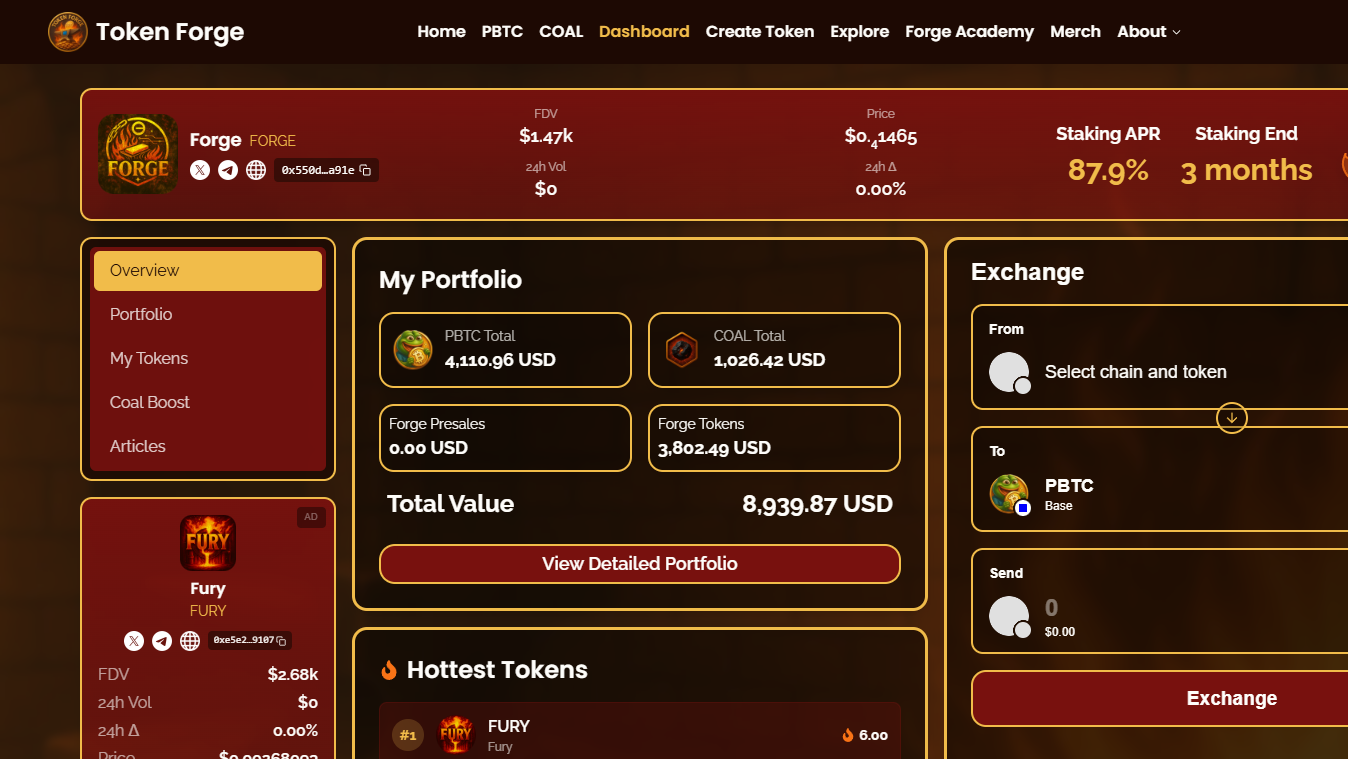
Token Forge also lets creators set whale limits in percentage, limiting how much of the total supply users are allowed to buy per wallet. While it does not limit participants’ ability to buy over the limit, it vests their tokens for a specific period of time to prevent dumping.
The result is a complete change in participant behavior. Rules make the launch predictable. Predictability reduces uncertainty. Reduced uncertainty makes the project easier to evaluate on its own merit.
The simplest way to describe what Token Forge does is this: it standardizes the processes that otherwise make the market volatile, the token’s future uncertain, and the underlying tokenomics opaque.
- Liquidity gets structure to remove rugpull risk
- Vesting mechanism gets enforced to remove any immediate sell pressure
- Presale models get clear participation rules to prevent whale dominance
- Pricing becomes predictable, making it easier for investors to evaluate the project
Why Did Token Forge Choose Base?
Base is a growing ecosystem, which makes it suitable for new project launches. Since it is developed by Coinbase, it has an exchange-backed ecosystem that automatically gains investors’ trust. Plus, the blockchain is highly accessible, which makes it easier for both builders and users to participate.
Aligning Incentives Beyond the Launch
Launches are not isolated events on Token Forge.The ecosystem has two tokens.
One is PBTC, which is a Base layer token that every token created on the platform is paired with. This means individual projects share liquidity, so the attention and traction that one project gets creates a benefit funnel for all projects on the platform.
The second one is COAL. It unlocks platform-specific features including early access to launches, discounted launch fees, and promotion through the Coal Boost system. COAL burns permanently when used, which means with every usage, its supply decreases. As supply pressure builds, the COAL price could go higher.
What Structured Launches Mean for Investors and Builders
With structured launches, investors find it easier to access new launches. They can identify projects that have long-term value. Since rules around liquidity, distribution, and vesting are clear from the start, investors find it easy to evaluate the project.
For builders, Token Forge offers accessibility. They don’t need to write a single line of code to create a project. Ideas become the sole drivers of a project since Token Forge already takes care of the launch framework.
Improving the Launches Through Control
Token launches are always going to be risky and there is no guarantee of success. But risks should always emerge from the visible layer: execution, not design.
That’s what Token Forge fixes. It improves what can be controlled: the token’s launch.
As it defines frameworks for liquidity, vesting, presales, and ecosystem alignment, much of the uncertainty that comes with new launches goes away.
It has become easier to create tokens, but that means strategies to find the right tokens need to change. Structured launches will become the key differentiators, establishing the barrier between projects that live long and launches that dissolve after initial profit distribution.
Check out the complete Token Forge ecosystem and see how it works in practice through this link: https://www.tokenforge-base.com/
Follow on X / Telegram for latest Updates : @tokenforge_base


- Europe’s Premier FX, Crypto & Fintech Event – Wiki Finance Expo Cyprus 2026 is Coming to Limassol This November!
- Global Conservation Capital Announces November 15 Presale Launch of Sloth Coin (SLOC), Connecting Rainforest Conservation With Environmental Credit Revenue
- ChangeNOW Announces NOW AI After Resolving Website Integration Vulnerability
- How AgentBNB Is Building an AI-Driven Ecosystem on BNB Chain as Its Presale Runs
- Sectora Foundation Announces Final Testing of Four Products and $SECT Token Availability on Uniswap
For PR & Sponsored Content Reach us :
 @Coingapeofficials