



USDai Crosses $20M in Yield Paid as GPU-Backed Loans Grow



Highlights
- USD.AI's USDai has paid out over $20M in cumulative yield to stakers.
- Staking USDai earns ~8% APY, projected to reach 11% as GPU loans grow.
- GPU-backed loans now make up nearly half of USDai's reserves.
USD.AI, the decentralized stablecoin protocol behind USDai, has paid out more than $20 million in cumulative yield to users amid growing demand for its GPU-backed lending model.


USDai Staking Yield Hits 8% APY
According to analytics firm Entropy Advisors, staking USDai currently returns about 8% APY, a figure the firm expects to climb toward 11% as more GPU-backed loans are deployed.
USDai is the synthetic dollar issued by USD.AI, a protocol that routes stablecoin deposits into loans secured by physical GPU hardware. Depositors mint USDai 1:1 from USDC or USDT, then stake it into sUSDai, the yield-bearing token that earns from both Treasury bills held in reserve and interest paid by AI infrastructure borrowers.
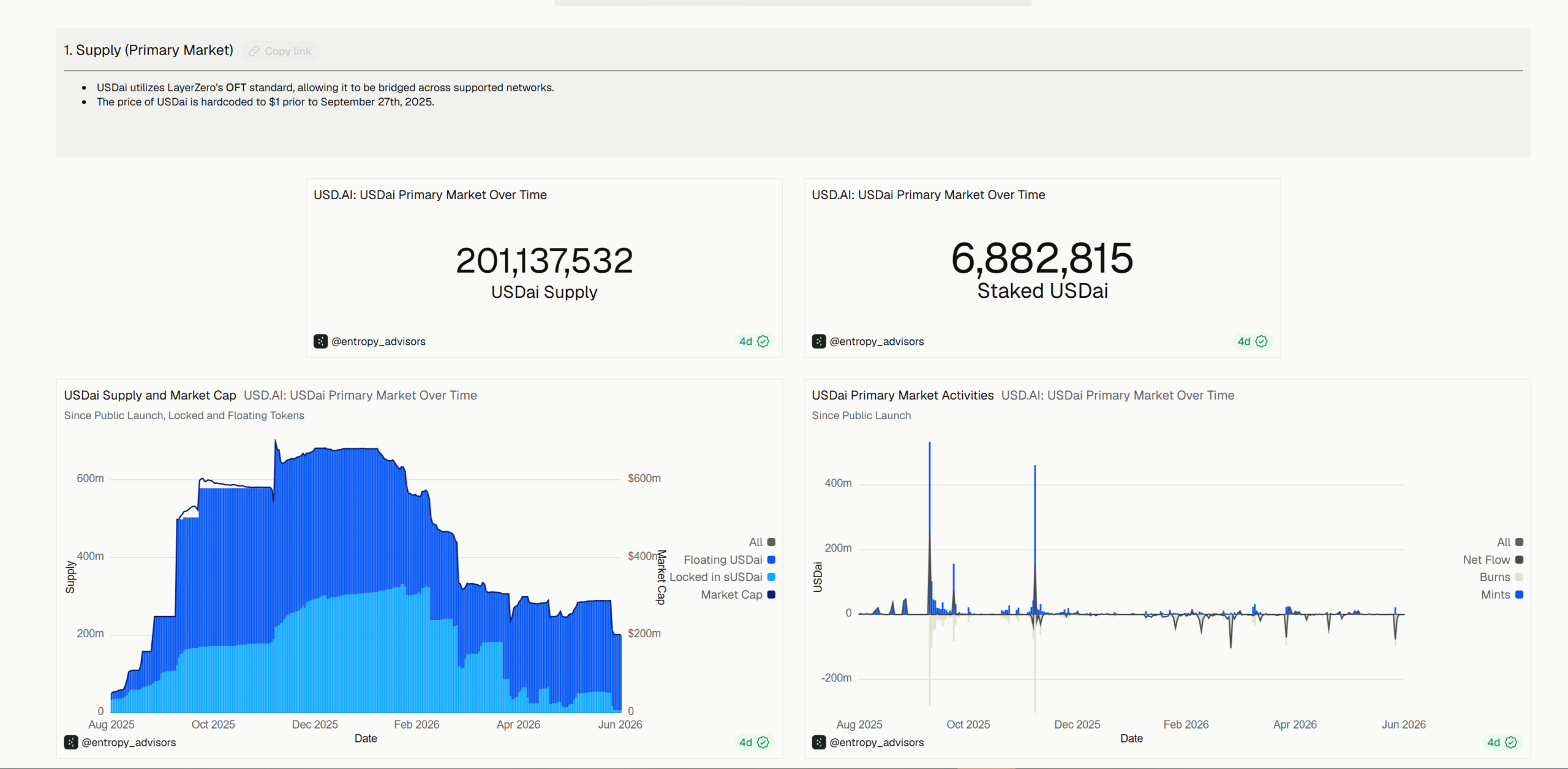
GPU loans now make up close to half of all reserves, sitting alongside PYUSD and wrapped US T-Bills, with eight loans worth $370 million in the pipeline, according to a Dune dashboard. That marks a change from late 2025, when Treasuries backed roughly 99% of the staked supply.
The protocol’s on-chain footprint has grown alongside the loan book. USDai supply stands at about 201.1 million, with 6.88 million staked into sUSDai. Secondary trading has cleared roughly $436.5 million in lifetime volume across 8 supported DEXs and 9 token pairs.
Most of that activity lives on Arbitrum. Of about 306.5 million in supply tracked across chains, Arbitrum accounted for nearly 298 million, with smaller balances on Plasma, Ethereum and Base. USDai moves between networks through LayerZero’s OFT standard, and 30-day bridging data showed net inflows of $141,100 to Arbitrum against outflows from Ethereum and Base.


USDai’s DEX Liquidity Stays Thin Despite Large Supply
Meanwhile, USDai’s on-chain liquidity stays modest relative to its supply. USDai pools held about $1.43 million in total value, with $760,236 in direct USDai liquidity on Arbitrum, spread across venues including Uniswap, Curve, PancakeSwap and Fluid.
USDai sits within a wider push to tie stablecoin yield to AI infrastructure demand rather than lending markets alone. Last year, the protocol partnered with PayPal to integrate PYUSD and with Tokyo-listed Quantum Solutions on a $200 million GPU financing facility for Japan’s AI sector.
USDai’s roughly 8% staking yield sits well above what the largest yield-bearing stablecoins pay. Among the biggest pools by size, Sky Lending’s SUSDS holds about $6.2 billion at a 3.60% APY, Circle’s USYC about $2.93 billion at 3.13%, Ethena’s sUSDe roughly $1.75 billion at 3.57%, Ondo’s USDY around $1.11 billion at 3.55%, and BlackRock’s tokenized BUIDL fund about $830 million at 3.56%, according to DefiLlama.
The gap is largely due to the collateral behind each token. The largest yield-bearing stablecoins lean on US Treasuries, money-market instruments, or overcollateralized on-chain lending, which keep returns close to short-term rates. USDai instead draws much of its yield from GPU-collateralized loans to AI infrastructure operators, a private-credit segment that pays more but carries more risks as well.
Instant Currency Exchange at BestChange with Ease
- Compare Rates Across 1000+ Exchanges
- Access 250+ Cryptocurrencies & Pairs
- Save Time with Real-Time Price Tracking
- Trusted & Verified Exchange Listings

Why Trust CoinGape
CoinGape has covered the cryptocurrency industry since 2017, aiming to provide informative insights Read more… to our readers. Our journal analysts bring years of experience in market analysis and blockchain technology to ensure factual accuracy and balanced reporting. By following our Editorial Policy, our writers verify every source, fact-check each story, rely on reputable sources, and attribute quotes and media correctly. We also follow a rigorous Review Methodology when evaluating exchanges and tools. From emerging blockchain projects and coin launches to industry events and technical developments, we cover all facets of the digital asset space with unwavering commitment to timely, relevant information.



Delivered every day.
- Insights that move markets
- 100,000 active subscribers