



Breaking: Bitcoin Crashes To 58K As US PCE Inflation Rises To 3-Year High At 4.1%



Highlights
- Bitcoin nosedived to a low of around $58,200 today.
- The plunge came in response to strong U.S. economic data and rising inflation.
- It wiped out over $212 million in long liquidations for BTC.
Bitcoin extended decline on Thursday and plunged to $58,000 as the latest U.S. PCE inflation revealed price increases had soared to a three-year high. This suggests the Federal Reserve may need to maintain tight monetary policy for even longer.


Bitcoin Tumbles Amid U.S. PCE Data
The U.S. Bureau of Economic Analysis (BEA) reported that the Personal Consumption Expenditures (PCE) price index was up 4.1% in May on a year-over-year basis. It is much higher than the last reading of 3.8%.
Meanwhile, the headline measure of PCE inflation rose by 0.4% on the month. Though both the monthly and yearly rise were lower than Wall Street expectations of 4.2% and 0.5%, it still weighed on Bitcoin and the overall crypto market. It’s because despite softer-than-expected data, inflation has risen to double of the Fed’s 2% target.
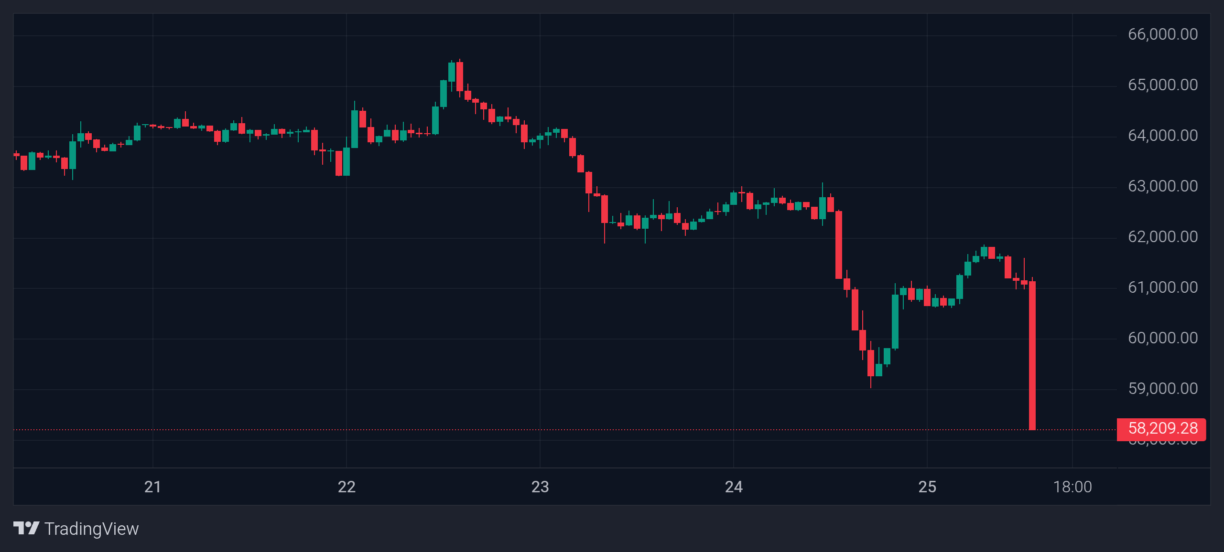
At press time, the Bitcoin price slumped 4.98% to $58,183.51 on Thursday, June 25. This crash triggered $212.35 million long liquidations within the 1-hour timeframe, per CoinGlass.
Whilst, Core PCE, which excludes Food and energy prices rose by 0.3% for the month. Moreover, it marked an increase of 3.4% year-over-year to May last year.


Detailed Look At Latest U.S. Economic Data
The report also cited ongoing robust demand from consumers. Spending rose $43.8 billion, or 0.3%, in May in real PCE, after being adjusted for inflation. Consumer spending grew from $156.1 billion, due to a $94.3 billion gain in services spending and a $61.8 billion gain in purchases of goods.
Personal income rose by $181.6 billion, or 0.7%, in May in the BEA report. Per capita disposable income also increased by 0.7%, but personal outlays grew by $159.9 billion. Personal savings amounted to $704.2 billion and the personal saving rate was 3.0%.
Moreover, signs of economic strength joined the U.S. data release that showed some recovery. First-quarter GDP growth was revised up to 2.1%, reflecting the fact that it was stronger-than-expected. Now, market participants are eyeing the Federal Reserve’s next move.
Amid this backdrop, the crypto market erased millions in value with $1.34 billion in total liquidations. Inflation indicators typically have a negative impact on risk-sensitive assets if the levels are high. At elevated inflation levels, the Fed could hike interest rates, which may lead to liquidity contraction in the Bitcoin and crypto market.
Instant Currency Exchange at BestChange with Ease
- Compare Rates Across 1000+ Exchanges
- Access 250+ Cryptocurrencies & Pairs
- Save Time with Real-Time Price Tracking
- Trusted & Verified Exchange Listings

Why Trust CoinGape
CoinGape has covered the cryptocurrency industry since 2017, aiming to provide informative insights Read more… to our readers. Our journal analysts bring years of experience in market analysis and blockchain technology to ensure factual accuracy and balanced reporting. By following our Editorial Policy, our writers verify every source, fact-check each story, rely on reputable sources, and attribute quotes and media correctly. We also follow a rigorous Review Methodology when evaluating exchanges and tools. From emerging blockchain projects and coin launches to industry events and technical developments, we cover all facets of the digital asset space with unwavering commitment to timely, relevant information.



Delivered every day.
- Insights that move markets
- 100,000 active subscribers