


GameStop Stock Outlook After $1.4B Debt Exchange Triggers 10% Sell-Off


Highlights
- GameStop exchanges $1.4 billion debt for newly issued common shares.
- Dilution concerns pushed GME toward its lowest level since 2024.
- GameStop Stock next faces support near $18.70 and resistance around $20.30.
GameStop Stock fell sharply on Monday after the retailer announced a $1.4 billion debt exchange involving newly issued common shares. The plan reduces the long-term commitments without cash. Nonetheless, the issue of dilution drove GME to its lowest intraday since August 2024. The sell-off was an expression of investor fear of dilution in the trading.
The crypto market is up 0.52% to $2.18T in 24h, primarily driven by progress on U.S. regulatory clarity act.


GameStop Cuts $1.4 Billion in Debt Through Share Exchange
GameStop entered private agreements with holders of its zero-percent convertible senior notes due in 2030 and 2032. The investors will buy over 2030 notes totalling around $400 million and 2032 notes totalling around 1 billion in common stock.
The company will receive no cash from the transaction. Rather, it will cancel the traded securities at the end of the day, cutting down long-term debt by about 1.4 billion.
$GME GameStop Announces Private Exchange of $1.4 Billion of Convertible Senior Notes for Equity #GME #GameStop
GameStop announced that it has agreed to exchange approximately $1.4 billion aggregate principal amount of its outstanding convertible senior notes for shares of its… pic.twitter.com/JPBwpYLAKo
— Wolf of My Street🏡 (@Ryan__Rigg) August 3, 2026
GameStop expects the deal to close around September 23, subject to customary conditions. After completion, about $1.1 billion of 2030 notes will remain outstanding. Another $1.7 billion of 2032 notes will also remain.
The transaction enhances the balance sheet without using cash. But when more shares are issued, it increases the number of outstanding shares and dilutes the ownership percentages of existing investors.

GameStop Stock Slides as Dilution Fears and eBay Bid Weigh on Sentiment
GameStop Stock fell approximately 13% on Monday, and hit an intraday low of around $19.05. That marked its lowest trading level since August 2024.
The stock was still down approximately 3% in the year and approximately a quarter since the beginning of May. The pressure to sell grew following a proposed acquisition of eBay by GameStop.
eBay turned down the alleged 56 billion offer, terming it as credible and unattractive. Investors also questioned how GameStop could finance such a large transaction.
The most recent regulatory filing by GameStop indicated a 9.8 stake of eBay, which is equivalent to approximately 43.4 million shares. Chief Executive Ryan Cohen has continued focusing attention on the proposed takeover.
The debt exchange may provide greater financial flexibility by removing interest-free convertible obligations. Nevertheless, the newly issued shares may stress GameStop Stock until investors are assured more definitive takeover financing information. Reaction in the market was still very negative.
GameStop Stock Price Outlook: What’s Next For GME
GameStop shares fell below $20 with sellers taking over the day. The action of the price then took the shape of low highs and lows, which validated the intraday pressure of selling.
GME was trading under $19.00 in the afternoon, and the volume was softened following the initial sell-off. The immediate support is around $18.70, which coincides with the price area tested towards the end of the session.
Any confirmed lower break would reveal $18.50 before traders move to the psychological level of $18.00. However, holding $18.70 could support a rebound toward $19.00, the first nearby resistance.
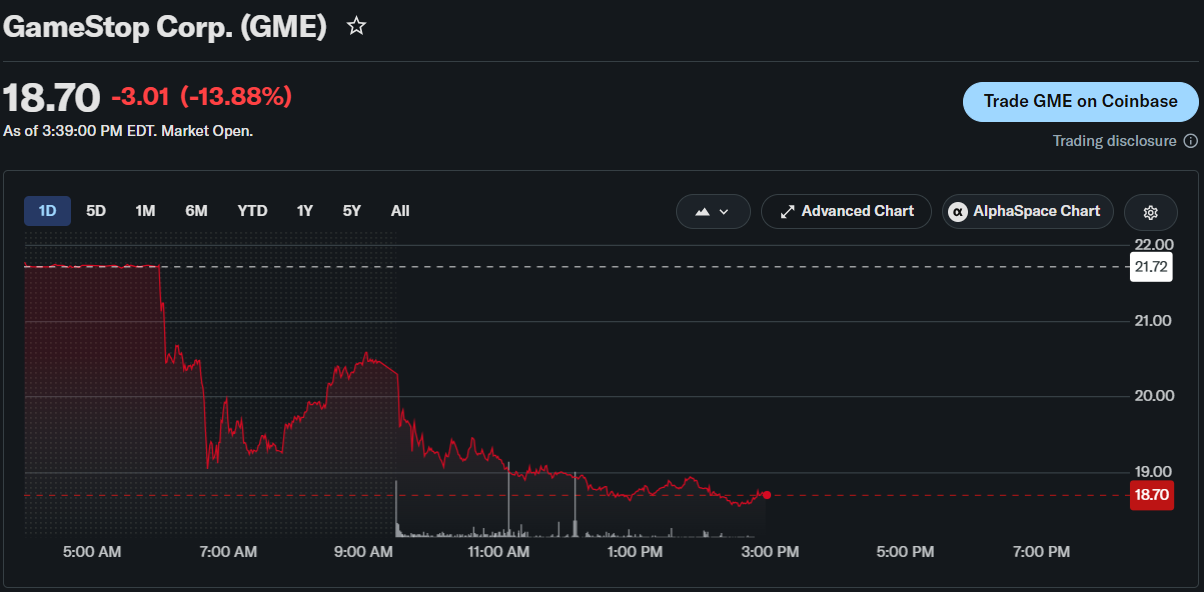
Further gains would require a move above $20.00 and the marked $20.30 resistance zone. Breaking out to above $20.30 would open the way to $21.72 and the larger area of $22.00.
Instant Currency Exchange at BestChange with Ease
- Compare Rates Across 1000+ Exchanges
- Access 250+ Cryptocurrencies & Pairs
- Save Time with Real-Time Price Tracking
- Trusted & Verified Exchange Listings

Frequently Asked Questions (FAQs)
1. Why did GameStop stock fall sharply?
2. How does GameStop’s debt exchange work?
Why Trust CoinGape
CoinGape has covered the cryptocurrency industry since 2017, aiming to provide informative insights Read more…to our readers. Our journal analysts bring years of experience in market analysis and blockchain technology to ensure factual accuracy and balanced reporting. By following our Editorial Policy, our writers verify every source, fact-check each story, rely on reputable sources, and attribute quotes and media correctly. We also follow a rigorous Review Methodology when evaluating exchanges and tools. From emerging blockchain projects and coin launches to industry events and technical developments, we cover all facets of the digital asset space with unwavering commitment to timely, relevant information.



Delivered every day.
- Insights that move markets
- 100,000 active subscribers

Global ONCHAIN AWARDS 2026