

Quantum Threats Could Kill Crypto—Bitcoin.h Could Stand Against Them




When quantum computers first made their entry in 1998 as a 2-qubit NMR (Nuclear Magnetic Resonance) system, none would have thought of the security threat they could pose to modern cryptography.
And now that Bitcoin is perceived as the “savior” of the world’s economy, not a day goes by when a “quantum leap” made towards quantum computing isn’t being highlighted as something that could destroy the core of decentralized finance before it has a chance to thrive.
The issue is that none of these features are unwarranted; traditional cryptos were not designed with quantum resistance in mind, and with each passing day, the threat is growing.
However, realizing this issue, Bitcoin.ℏ has emerged as a solid, quantum-resistant, and sustainable solution to this problem. How could this new innovation, however, stand against a threat that’s still taking shape?
How Quantum Computers Could Impact Bitcoin and How Bitcoin.ℏ Can Tackle The Threat?
To dive into the solution that Bitcoin.ℏ provides, it is first important to learn the problem that traditional cryptos face due to quantum computing.
Bitcoin essentially uses two main types of cryptography — SHA-256, which is used to secure mining and block creation, and the second is the Elliptic Curve Digital Signature Algorithm, or ECDSA. Its job is to secure private keys and wallet addresses, which is essentially a fancy way to say moving the coins from one address to the next.
Threat to Private Keys
The biggest threat that a quantum computer poses is to private keys. Right now, they aren’t visible, appearing only to those who spend their Bitcoin.
The issue arrives once it becomes visible, allowing a quantum computer to use Shor’s algorithm to reverse-engineer the private key from the public key.
Shor’s algorithm is a quantum algorithm designed to quickly factor large numbers.
This is one way a Bitcoin could be stolen. People who have spent their coins are the most vulnerable, since their public keys are already exposed.
Threat to Mining
Quantum computers pose a threat to mining since they could use Grover’s algorithm, which could be used to solve SHA-256 puzzles, allowing quantum miners to guess a number below the hash target.
Grover’s algorithm is a quantum search algorithm that could be used to accelerate brute-force attacks.
This could eventually give quantum miners a lead when producing blocks. And if there is enough quantum power, these miners could conduct a 51% attack.
The Solution Lies with Post-Quantum Cryptography – The Bitcoin.h Paradigm
Bitcoin.ℏ has emerged as a quantum-solution replacement for traditional crypto. Built on Hedera Hashgraph, this new cryptocurrency project leverages SHA-384 cryptographic hashes, which ensure that it remains quantum resistant.
Unlike the standard Bitcoin, which leverages SHA-256 that has a security strength of 128-bit, with Bitcoin.ℏ, SHA-384 is implemented, which offers a security strength of 192-bit.
It means that standard computational power won’t be enough to crack it. Furthermore, quantum computers can’t simply brute-force their way to cracking this encryption using Grover’s algorithm.
Furthermore, since Bitcoin.ℏ achieves asynchronous Byzantine fault tolerance (aBFT), it offers the highest degree of security to any decentralized network.
Beyond Adding Post-Quantum Security, Bitcoin.h also Focuses on Sustainability
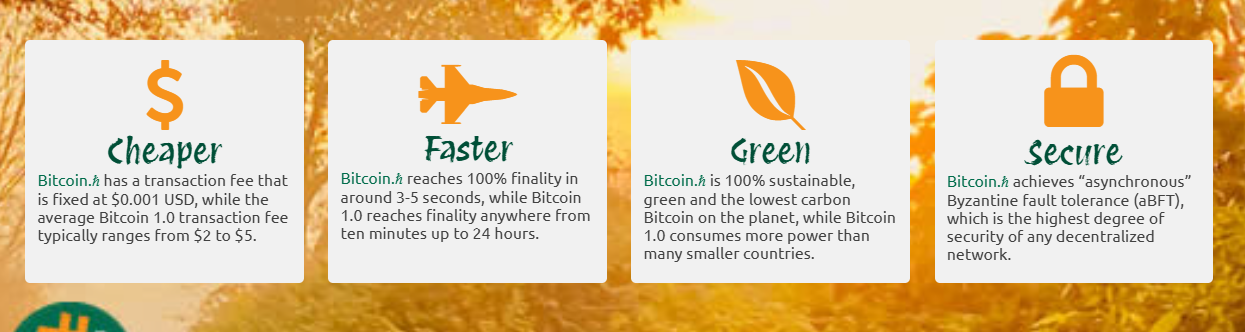
While Bitcoin.ℏ has focused on a security protocol to make itself resilient against quantum threats, it has also offered a greener alternative to Bitcoin—one more sustainable and better in terms of growth.
Eco-Friendly Transactions
Unlike Bitcoin, which takes 703 KWH for a single transaction, Bitcoin.ℏ consumes only 0.000003 KWH—a massive upgrade.
Scalability
Thanks to its foundations being built on Hedera Hashgraph, it has achieved a high level of scalability. With upwards of 10K transactions per second possible, Bitcoin.ℏ does not suffer from any congestion issues like Bitcoin does.
Focusing on Decentralized Governance
Governing the ecosystem are many leading organizations, which ensure that Bitcoin.ℏ stays decentralized and community-friendly.
Faster and Cheaper
Bitcoin.ℏ defeats the world’s largest crypto in terms of speed, reaching 100% finality in just 3 to 5 seconds compared to Bitcoin’s 10 min – 24 hour window.
Creating a Sustainable and quantum Resistant Future
Bitcoin.ℏ is gearing towards more strategic partnerships to promote its motive to create an eco-friendly alternative that’s already ready to counter the quantum threats that emerge.
Its approach to implementing the new SHA-384 hash makes it far superior to traditional crypto, ensuring that quantum computers cannot just brute-force their way to compromise investors’ private keys.
To learn more about the platform and this altered and secure Bitcoin paradigm, visit the official website today.
Website – https://bitcoin.org.ht/
Reddit – https://www.reddit.com/r/BitcoinHT/
TikTok – https://www.tiktok.com/@bitcoinht
Telegram – https://t.me/BitcoinHT
Instagram – https://www.instagram.com/bitcoinhedera/


- EX DeFi Aims to Offer Stable Passive Income as Bitcoin Passes the $66K Mark
- What If Staked ETH Could Do More? Definica Starts Building Beyond Staking
- NodeMeta Strengthens Its Global DePIN Vision Through Security, Utility and NTE-Powered Innovation
- Binaxity Introduces Gold Investment Line of Credit Backed by Tether Gold (XAUt)
- Blockchain Life 2026 Coming Back to Dubai This December
For PR & Sponsored Content Reach us :
 @Coingapeofficials