
Beginner’s Guide to Crypto Exchange: How It Works and Where to Start


Triple A released a report recently that revealed that 560 to 993 million people hold crypto worldwide. But while the popularity of this digital asset class continues to grow, things get confusing when people need to go from holding crypto to moving, swapping or cashing it out.
They often feel stuck selecting the platform, and their pain is not just about usage. Rates matter too. And beginners who are trying to exchange crypto for the first time also need assurance that there are safeguards if they pick the wrong service.
This article explores how crypto exchanges actually work, which mistakes to avoid, and how to start safely.
What Does It Mean to Exchange Crypto?
What does “exchange crypto” mean? In simplest terms, it means swapping crypto for another asset. The type of asset crypto is exchanged for then determines the type of exchange you need.
A crypto exchange is akin to a currency exchange platform where, instead of swapping national currencies or shares, you exchange cryptocurrencies.
If you are swapping crypto for another crypto, you need a crypto-to-crypto exchange. For swapping crypto for traditional currencies, which is the act of cashing out through a traditional payment system, you need a crypto-to-fiat exchange. A fiat-to-crypto exchange is the service that lets you buy crypto using traditional currencies.
Most centralized crypto exchanges play the role of all three. Some don’t, however. Most decentralized exchanges, for instance, only offer crypto-to-crypto swapping to maintain their infrastructure and privacy.
Types of Crypto Exchanges: CEX, DEX, and Aggregators
Here are the three main types of crypto exchanges active on the market. Most beginners don’t know about the third one:
Centralized Exchanges (CEX)
Centralized exchanges are service providers under the governance of a single company. The company manages accounts, takes custody of assets, and maintains matching systems. Here, you put funds into wallets that the platform controls, allowing you to trade crypto inside the system. Binance is the best example, as it is the largest CEX by trading volume.
The positives of a CEX are many. They are often licensed and offer a good UI, making them particularly beginner-friendly. The issue, however, is that they take custody of your assets.
Decentralized Exchanges (DEX)
Decentralized exchanges are ecosystems with the same bones as a centralized exchange. They also deliver a crypto swapping service. The difference lies in how funds are maintained. While centralized exchanges have traditional order books, DEXs have liquidity pools.
On the positive side, you don’t often need to create an account, and your funds remain in your control. The trade-off comes in the form of technical complexity. Beginners often encounter issues because DEXs expect users to have some prior familiarity with the platform. Also, decentralized exchanges don’t have the best history when it comes to security.
Uniswap, PancakeSwap, Jupiter, and Raydium are some of the best DEXs available in the market.
Exchanger Aggregators
There is a third type of crypto exchange information service that most people don’t know exists. Known as exchange aggregators, they are best for beginners who want to change crypto without needing to create accounts on multiple platforms.
Aggregators provide a list that categorizes exchangers based on their exchange rates. Interacting with aggregators is easy. You simply come to the aggregator’s website, pick an exchanger, and swap crypto.
It does not require any technical expertise; instead, it gives you the option to act like a smart-shopper, picking exchangers based on your requirements but without researching each one individually.
How a Crypto Exchange Actually Works: Step by Step
Here are the steps that demonstrate how a crypto exchange actually works:
Select what you have (e.g., USDT TRC20) and what you want (e.g., BTC)
The first step is to select the crypto you want to exchange and the asset you want to exchange it for. For instance, you may want to exchange USDT for BTC, or ETH for BTC. Make your pick beforehand and make sure that you have enough crypto in your wallet to meet any fee-related requirements. If you’re using assets available on multiple networks (e.g., USDT), double-check the correct protocol (such as TRC20 or ERC20), as selecting the wrong network can lead to irreversible loss of funds.
Compare rates, fees, and reserves across available services
Assess all available crypto exchange services and compare rates, fees, and reserves.
Fees often range from 0.5% to 1.5%. When it comes to the rate, it is important to be mindful of floating and fixed rates.
Most exchangers select a floating rate by default, which changes the amount you receive once the transaction is complete. If you want to receive the exact amount of crypto as advertised, pick the fixed rate. The trade-off is higher fees. A floating rate typically offers lower fees.
Reserve size is the third factor to compare. A thin reserve may lead to a failed transaction.
Enter your destination wallet address or payment details
Enter the destination wallet address and the payment details: crypto to swap, amount of crypto to swap, what to swap it for, and the blockchain network used. There should be no typo at any step, since that could cause permanent loss of funds with no recourse.
Send your funds to the exchanger’s address
Enter the exchanger’s address and recheck the details entered. After confirming the details are correct, proceed with the transaction.
Wait for confirmation (varies by network)
Confirmation time varies depending on the network chosen. Bitcoin can take 10 minutes to one hour. Ethereum can take 1 to 30 minutes. Tron is fast, taking only three seconds. That said, network congestion can lengthen the transaction time.
During the waiting period, you may receive a transaction ID. We recommend that you copy it, in case any issues arise during the process.
Receive the exchanged amount
Once the transaction is complete, you will receive the exchanged amount in your wallet.
What to Look For in a Trustworthy Exchanger
As a beginner, you need to measure the worth of an exchanger based on multiple parameters:
Verified Reviews
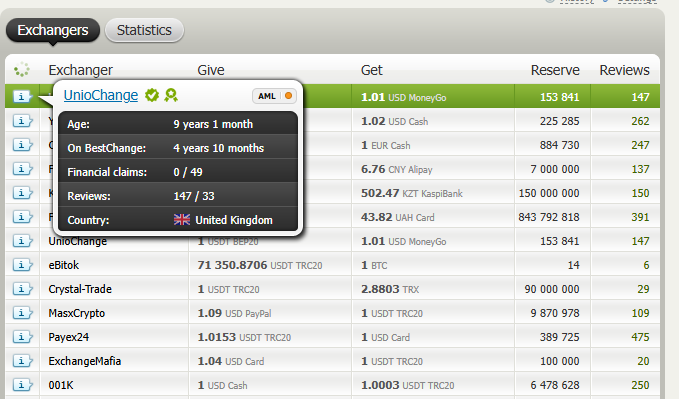
The first signal is a selection of verified reviews. BestChange is one exchanger aggregator that shows the number of reviews an exchanger has received.
Clicking on it will take you to individual reviews, giving you insight into the exchanger’s performance.
Reserve size
Does the exchanger actually hold enough of the currency you want? It is the most important question to consider, since a thin reserve could lead to a partial or failed transaction.
KYC Requirements
While exchange aggregators don’t often ask for ID verification, some exchangers do.
Among those that do, some may require KYC documents right away, while others enforce this requirement based on the amount of crypto you are exchanging.
It is often impractical to manually vet each exchanger individually. Exchanger aggregators such as BestChange offer a simple solution to find the exchanger that provides the best rate.
How to Use BestChange to Find the Best Rate Fast
BestChange is an exchange aggregator that monitors over 470 vetted exchangers. In addition to supporting crypto and stablecoins, it also supports fiat-specific payment systems such as e-money, bank cards, cash, and bank transfers.
It is precise about rates, updating them every 5 to 8 seconds. Using it is easy. You can simply choose the pair you want, get access to a ranked list of exchangers, and pick among them.
The aggregator clearly displays the rate, reserve, and review of individual exchangers. It also offers an information tab that showcases the history of an exchanger, their verification status, history of any financial claims, the country they belong to, and whether they require AML checks.
The fact that you don’t need to create an account on the platform is a big plus.
Common Mistakes Beginners Make When Exchanging Crypto
When exchanging crypto, avoid the following mistakes:
Not comparing rates
Do not get swept by the 0% fee claim. It is a pitch that often hides spreads of 1-3% in the fine print. For instance, Coinbase’s interface shows a 0.5% fee, but a transaction could carry an additional hidden spread of 0.5% to 1%. Therefore, instead of focusing on the pitched fee claim, dig deep and check the spread. On BestChange all fees are already included in the displayed exchange rate, providing a transparent “what you see is what you get” pricing model.
Using unverified exchangers
If you go to an exchange aggregator platform and see an exchanger with no reviews or limited feedback, do not rely on the absence of reviews alone. On BestChange, all listed exchangers are pre-verified, and review activity serves as an additional layer of confidence rather than the sole indicator of reliability. Even if an exchanger has fewer reviews, it has still passed the platform’s verification process.
Sending to the wrong network or address
Once an exchange takes place, there is no button that can undo it. Even a single typo in the address could lead to permanent loss of funds. Checking and rechecking the entered info, therefore, is of critical importance. It is also recommended to keep all transaction details and confirmations saved for record-keeping purposes, just in case any issues arise later.
Final Thoughts
Crypto exchange does not need to be complicated. Before every exchange, know exactly what you are sending and what you want to receive. Open an aggregator like BestChange to compare live rates across vetted exchangers before committing to any one service. Check the reviews and reserve size of the exchanger you pick. Confirm the network matches on both ends. And if it is your first time using a particular exchanger, send a small test amount first.
That is the entire framework. Simple habits, applied consistently, are what separates smooth transactions from costly mistakes.
BestChange is the right place to start for anyone looking to fast exchange crypto without overpaying or guessing at who to trust.


- Exchange ETH to XMR Without KYC in 2026: GhostSwap and the Best Alternatives
- Bitcoin to Zcash and Back: The 2026 ZEC – BTC Swap Guide with GhostSwap and More
- How to Swap BTC to XMR In 2026: Full Step-by-Step Guide
- CoinMarketCap API vs CoinStats API: An Expert Deep Dive
- DeFi Startups Are Exciting, But TradFi-Driven Finance Is Gaining Better Traction In The Real World